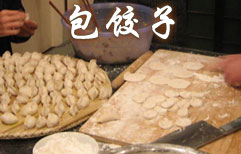



mafanniFebruary 13, 2014
I was asked this : 你吃过天津狗不理包子吗?
I found out it doesn't mean eating dog(so I've been told). so what is it? 美味吗?

katewebbSeptember 2, 2011
There should be a lesson on ordering Shanghai Dumplings. For example, how would I say beef, pork, or chicken dumplings?

jennyzhuSeptember 2, 2011
Try Elementary - Ordering Xiaolongbao and •Elementary - Hungry Traveler: Shanghai.

darkstar94July 29, 2011
Am I right in guessing that whether or not it's pi + 儿 or pian + 儿 they are both said the same? Cause I just listen to 皮儿 and 片儿 back to back and they sound identical to me
MingmaoJuly 22, 2011
I have a question about a supplementary sentence for this lesson:
你看,我捏死了一只虫子。
In the sentence does the speaker have to have squished the bug between thumb and forefinger? Could it have been squashed in some other way? Such as smashed agains another surface with the whole hand, or caught in the air between one's palms?
Thanks.


xiaophilJanuary 27, 2011
Fun fact: at restaurants, the measure word for a batch of about 6 jiaozi is 两. Don't think it means two jiaozi ;-)

pretzellogicJanuary 27, 2011
Costco would always have a giant bag of Jiaozi with about 30 dumplings in them. Is that 五两饺子? Fortunately, Costco can't speak Chinese :-)
pretzellogicJanuary 27, 2011
Yikes. I didn't occur to me to actually learn the characters for Jiǎozi until now. And I even looked at this lesson previously.
pretzellogicDecember 21, 2010
I am curious if any of the Chinese women reading this thread have brothers/husbands/sons/male cousins/fathers that make jaozi. I am hearing from a number of Chinese women that while there is the occasional "enlightened" male, that making jaozi is most likely the mom/sister's/female cousin's job.

aprilwhiteAugust 7, 2009
Interesting discussion. Incidentally, my understanding was that the people who Marco Polo and his father had originally been trading with were Turkish. There are, of course (if you've been following the news lately), Turkish people living in China to this day. At one time the capital of China was in Xi An which is smack dab in the middle of modern China so I would imagine that interaction between the Han Chinese and Western minorities would have had a significant impact on the development of culture in both the East and West. Oh and of course much of South East Asia is Muslim as a result of Arab traders spreading their religion: I understand that Marco Polo, after leaving China, did also visit South East Asia and Arabia upon the recommendation of the Kahn Emperor.

pearltowerpeteFebruary 16, 2009
Hi nickorange
You asked about the rules for adding "r." There are rules, but they're complicated and not very methodical. Here are a few :
Sometimes, adding "r" shows affection, and implies a close connection -- 小孩儿,脸蛋儿,etc.
Sometimes it shows that something is small, light or scarce-- 门缝儿, 米粒儿
Sometimes it changes the grammatical role of a word-- 顶 is a verb but 顶儿 is a noun.
But even native speakers, especially those not from Northern areas where the "r" is added quite naturally, don't always know. If they study for the 普通话考试 the Mandarin exam that you need to be a broadcaster, etc, they must study with a list like this.
chiefmadappleFebruary 15, 2009
@shanyisheng
I think its wrong for historians to determine whether someone (in this case Marco Polo) has or has not been to a place based on what they did NOT say. For example, I went to Venice and never mentioned noodles, the canals or glass blowing to my friends. I did, however, talk extensively about the handmade notebooks and the art work in the galleries I visited. Does that mean I must have never been to Venice?
Also- foot binding did not happen nationwide. I don't have a single relative that had bound feet.
nickorangeFebruary 14, 2009
Is there a rule for what words to add the 'r' sound to in Beijing-hua? Thanks!
tanxlnFebruary 8, 2009
@jonsg "as someone whose only concession to meat-eating is seafood, how can I tell easily whether dumplings are non-meaty?"
I don't think you can tell what filling was used just by looking at them (althoguh some variants have some of the filling coming out at the top), but you can always ask (你这)包子是什么(馅儿)的?是肉馅的吗? 要是肉的我不吃。
The smell may give the filling away, though. (As a vegetarian, you might have become more sensitive to this kind of smell, at least that's what has happened to me.)

raymondcFebruary 3, 2009
Thanks pearltowerpete,
for you answer. I just changed my username as my first name is raymond.


JohnFebruary 2, 2009
helandou,
A "skit" is like a short play, usually humorous. A contemporary American example would be the short performances on Saturday Night Live. We call each one a "skit."
SueFebruary 2, 2009
helandou, see here, skit = a short sketch http://www.nciku.com/search/zh/detail/%E5%B0%8F%E5%93%81/1316755 (in case this link doesn't work: www.nciku.com, xiao pin)
helandouFebruary 2, 2009
A 'skit' is that something like a serial on TV? Is it drama or comedy? On google.com/translate I can't translate the word 'skit'.
小品 is translated as: 'an essay' or 'a sketch' but those words are about writing or theatre play.
pearltowerpeteFebruary 1, 2009
Hi raychenon
Your question reminds me of an old American folk song, "Hold the Woodpile Down." Doc Watson sang it memorably:
"Book-keeper swallowed a nickel a day,
Run him 'most crazy, so they say.
Now listen real good and I'll tell you what it's all about
It's a nickel in and a nickel out--hold the woodpile down." ;-)
The 嘛 shows that something is obvious or goes without saying. It makes a statement a bit more friendly.
raymondcFebruary 1, 2009
Does it happen someone swallow a coin in 年糕 ?
A question in the sentence 你满有天赋的嘛 , what is the meaning of 嘛just an exclamation like 阿 ?
chrkaJanuary 29, 2009
jojje,
in pinyin it is always the original tone that is given irrespective of tone sandhi (not only for 不 but for all characters, the same goes for 一 which is always written as yī even though it changes tone, and for, say, two consecutive third tones) See for instance §11 of Hanyu Pinyin Rules (or if you have got the ABC dictionary, there is an appendix with the rules).
(Välkommen tillbaka! Skoj med fler svenskar här. Själv har jag tänkt åka till Kunming om en månad — Peking verkar lite väl kallt just nu, har blivit lite vek sen jag flyttade till Skåne ;)
jojjeJanuary 29, 2009
i have a question for you all at chinesepod, which doesn't only concern this channel or this lesson, but all the pinyin material on the website.
in beijing, my teacher told me that every time "bu" (normally tone 4) is followed by another word with tone 4, the tone of "bu" automatically turn into tone number 2. that's totally correct when speaking, if one is thinking about all the basic and common used phrases like 不是 不用 不要 不会 etc. the "bu" is all rising as in second tone.
so, everytime i download the .pdf to check out the pinyin, it distracts me when seeing the "bu" is made a 4 tone when it's actually is a 2 tone. that's a fixed rule at least in speaking chinese. so there is no idea of changing the pinyin away from the way that chinese language is actually used/spoken.
otherwise thank you for a great job and please keep it up, chinesepod is the best way of studying chinese while being back home in sweden again!
pearltowerpeteJanuary 29, 2009
Hi kimiik
These are just two different ways of writing the same idea. I guess you could liken 蛮 to the (annoying) modern Americanism of "crazy + adjective" e.g.
ChinesePod is crazy useful
(eggchh, I cringe to type that.) Whereas, 满 just means "full of," which is a pretty clear. But in any case, both just emphasize the meaning, "very."

kimiikJanuary 29, 2009
Is it possible to write 你蛮有天赋的 instead of 你满有天赋的 ?
For me, this two sentences sound exactly the same but do they have exactly the same meaning ? I guess there's a subtle difference.
... Oops sorry the answer is already up there.
jennyzhuJanuary 28, 2009
sushan,
面粉/mian4 fen3 is flour (generally made from wheat). We don't distuiguish 粉 (which means powder) by which type of food it makes, e.g. 饺子粉、包子粉。Different types of flour is indicated by the kind of raw material it is made from. For example, 大麦面粉/da4 mai4 mian4 fen3/barley flour, 荞麦面粉/qiao2 mai4 mian4 fen3/buckwheat flour。
magnus1977January 28, 2009
another great lesson. I've been that person who says, "HEY GUYS... what do you think?" they all laugh. It's pretty normal that all the dumplings that are ugly or falling apart or bursting... are mine.
But in my opinion...Dumplings are the perfect food. A mix of flour, water, meat and veggies. Hmmm! delicious.
eight8isenufJanuary 28, 2009
Sorry, I do dumplings the easy way. I just simply go down to my local Chinese store and buy the frozen ones. It was a revelation to me when I started shopping in Chinese groceries here in Florida,of all the fun variety the Chinese have in their stores.

davidtzauJanuary 27, 2009
light487, I hope to catch up to you some day. I had a hard time keeping up with the dialogue today, let alone trying to understand mianto go to town on the comments section here.
Must keep trying.
aryehJanuary 27, 2009
Xin Nian Kuai Le!
Great lesson and very helpful as I come off a week of zuo bao shuai jiao parties here in Washington, DC...
that said, please note that the traditional transcript is missing some of the characters such as lia3 and pi2.


cassiJanuary 27, 2009
Here is what Wikipedia says:
Chinese noodles pre-date Italian pasta, and Arab traders probably became introduced to them due to their trade routes with China. Historically, people in Italy ate pasta in the form of gnocchi-like dumplings – pasta fresca eaten as soon as it was prepared. It has now been asserted that the Muslims who populated Southern Italy (around the 12th Century) were the first to develop the innovation of working pasta from grain into thin long forms,[2][3][4] capable of being dried out and stored for months or years prior to consumption (see Peter Robb's Midnight in Sicily pp 94-96 for details). Or Muslim traders with links to Arab trade routes to china, may have been introduced to pasta or noodles that way. Legend has it that Cicero, the famous Roman orator was fond of "laganum," an ancient tagliatelle.[5] The Saracens, originally from North Africa, invaded southern Italy in the 9th century and occupied Sicily for 200 years. Pasta is now associated with Italians as a whole. The popularity of pasta spread to the whole of Italy after the establishment of pasta factories in the 19th century, enabling the mass production of pasta for the Italian market.[6]

zhong_bideJanuary 27, 2009
Really liked this lesson for the sequencing it includes and other connections. I'd love another recipe lesson too sometime - lots of possibilities, and all those possible verbs to do with cooking and preparing food - great stuff.

jonsgJanuary 27, 2009
Loved the story about Marco Polo and his flat 包子 "pizza", but I'm afraid it's a funny fiction. The Romans already had something like pizza - flat bread with toppings and melted cheese - and as johns says, the tomato arrived in Italy about 4-500 years after Marco Polo's travels.
Now here's a question for the Poddies here assembled: as someone whose only concession to meat-eating is seafood, how can I tell easily whether dumplings are non-meaty?

matt_cJanuary 27, 2009
@tvan Hehe, I think qingdaossadventuresdotcom has spent a long time here in China, I also find myself, from time to time, using Chinese verbs and then adding an English tenses (eg. fang + 'ed') to them in English conversation.
I just ate yummy spicy dumplings for dinner , and drank the dumling water, with a generous helping of vinegar. Yum!
What's everyone eating tonight?
I'd better get back to our family Mahjongg game. 886
miantiaoJanuary 27, 2009
长夜,
缺麦的面还算是面,不过,缺心的爱呢?简体汉字比繁体容易些,但是我觉得简体没繁体表意义的清楚。我想知道是谁改的,因为个缺心的爱的单词太没意思了。前进一步改革汉字过程中的阶段可能就是拼音。那么,缺爱的单词将要成为缺心缺友的爱,当那时候到来谈恋爱就没有现在的复杂。
不用每天对你宝贝儿说 “宝贝儿,我真的爱你”,无论你说的是真的假的,都没意思,因为爱缺心。后来应该说 “宝贝儿,我太喜欢你” 就好了。
“你答应天长地久爱他吗”?
“是啊,因为爱缺心了,所以我没问题”,“你以为我能这么轻易的跟那样长得那么丑的大姐结婚吗”?“过了两三年当了他的爱具后,我要申请离婚”, “我只是追求她爸爸的钱”。
爱国、爱好、爱情、爱人、恋爱、做爱等,既然爱缺心,这些单词什么意思呢?当然大家晓得意义,书不尽言,言不尽意。
解放后 好像爱的意思相对解放了
怎么样,啊夜?

changyeJanuary 27, 2009
"面" is a good example of a simplified character that has lost its important semantic part. Its traditional form is "麵" (麦 + 面), and this makes good sense. Incidentally, wheated food is generally called "面食" (mian4 shi2) in China. 面条 is also part of 面食.

shanyishengJanuary 27, 2009
是否有任何证据表明,马可波罗是在本社?我读的地方,他他的知识来自道听途说。他没有提到有界英尺,也没有长城。奇怪的是不是? (about the same message, I hope !!)
shanyishengJanuary 27, 2009
Is there any evidence that Marco Polo was in zhongguo? I read somewhere that he had his knowledge from hearsay. He did not mention the bounded feet nor the changcheng. Strange is not it ?
miantiaoJanuary 27, 2009
我试一下
不同可能是配料,这个粉的意思很有可能是mix的意思,比如;蛋糕粉,英语称为cake mix。我曾在面包店打工过,无论是什么样的麦粉,都算上麦粉,就是配料不一样,比如;麦粉,饼干麦粉,全麦粉,面粉等。以前从事产面包或面由个人准备好所需要的配料再弄好个恰当的mix or dough
sushan像你说的,自发麦粉,一般麦粉,在做面包或者面等这类的食物,各种需要具体的麦粉和其他的配料才能做的标准。一般配料包含 baking soda,yeast,sugar,salt etc, even fruit。
pearltowerpeteJanuary 27, 2009
Hi sushan,
面 can mean "flour" or "noodles." 意大利面 is spaghetti. Some of the other types of noodles have Chinese names-- linguine is 扁意面, (flat Italian noodles) but I'm not sure how many Chinese would know what that means.
"Dough" is 面团, literally, a ball of flour. And I really don't know the differences between the types of 粉 you mentioned. Could any cooking-minded poddies come to the rescue?
sushanJanuary 27, 2009
So '面' means both dough, and the result? (like 'pasta' in Italian?) Did I hear Jenny say 面粉, at 4:19, also to mean dough?
When buying flour in China, note that a lot of it is 自发 - self rising. So if you use it in a recipe calling for additional 发现粉 (I really hope that is the right 现) like baking powder or baking soda, the recipe won't work.
Does anyone know the difference between the wheat flours sold as 包子粉、 饺子粉、 and 面粉?
light487January 27, 2009
Another superb lesson.. or maybe I am just starting to understand enough to get stuff form Intermediate level lessons now. I didn't quite understand the dialog fully by I certainly could follow along with what was happening knowing what the context was beforehand. This lesson has renewed my confidence in my ability to learn beyond the basics of the language.
Still have a long way to go though :)
changyeJanuary 27, 2009
Hi ihatemidterms,
The 蛮 (man2, very) is originally a dialect usage mainly seen in 吴方言 (i.e. Shanghainese).
JohnJanuary 27, 2009
ihatemidterms,
You're right that 满 is third tone, and 蛮 is second tone. In practice, though, the Chinese are not very careful about which character they use. Perhaps part of the reason is that one of the most common expressions using "man" is 蛮好/满好, and tone change rules render it impossible to "hear" whch character it is (it is 2-3, whichever character you pick).
johnsJanuary 27, 2009
The answers appear in ilovepasta.org
"Contrary to popular belief, Marco Polo did not discover pasta. The ancient Italians made pasta much like we do today. Although Marco Polo wrote about eating Chinese pasta at the court of Kubla Khan, he probably didn't introduce pasta to Italy. In fact, there's evidence suggesting the Etruscans made pasta as early as 400 B.C. The evidence lies in a bas-relief carving in a cave about 30 miles north of Rome. The carving depicts instruments for making pasta - a rolling-out table, pastry wheel and flour bin. And further proof that Marco Polo didn't "discover" pasta is found in the will of Ponzio Baestone, a Genoan soldier who requested "bariscella peina de macarone" - a small basket of macaroni. His will is dated 1279, 16 years before Marco Polo returned from China."
Tomatos came from South America in the 1500's and did not make it into the pizzas until the 1700's.
matt_cJanuary 26, 2009
@qingdaossadventuresdotcom I also heard that Marco Polo may have learnt about the pizza base in China, but I also heard from a Sicilin friend of mine that a pizza was usually used to throw all the left over food from the week on to. It may have been a Chinese inspired 饼 that was the base for this wonderful creation.
It's now lunch time so I'd better go back home for a feast.

VDragonUQJanuary 26, 2009
I believe Marco Polo actually bought dumplings and/or won-ton back to Italy and thus inspired ravioli. Any historians out there who can clarify this? I love eating them all, but it would be interesting to know which culture inspired the other. Or did China and Italy cross-fertilize -- rice, pasta, and dumpling cuisine?
qingdaossadventuresdotcomJanuary 26, 2009
Off subject a bit, but the ravioli comment above brought it to mind. Anyone heard the story about how Marco Polo brought back pizza, along with noodles, to Italy?
Supposedly he wanted to make some baozi/包子 upon returning and he couldnt figure out how to fang/放 all the xianr/馅儿 inside, so he just fanged/放 it on top and thus we now have pizza.
ihatemidtermsJanuary 25, 2009
Isn't the 'man' in 满有天赋 supposed to be the famous 南方 "蛮"? It sounds like second tone when John and Jenny pronounce it in isolation. Is there a difference in meaning between the adverbs 满 and 蛮? My slang dictionary lists them both as "pretty".
What did you notice in this lesson?
You are posting as a guest. Your reply is reviewed before it appears. Log in to post without review.