ramanaOctober 4, 2009
the reordering exercise doesn't work so well with this dialogue since many of the lines are identical but the grader distinguishes between them

pinkjeansApril 22, 2009
Lots of stories of the satnav (GPS) causing big vehicles to get stuck in narrow country roads in UK! Personal experience also sees them leading the driver to a no-entry road!

miantiaoApril 20, 2009
@pete
cheers mate, so i guess a 人贩子is a person that indulges in 拐卖, a new word for me. yes, sad but true. there are thousands of families still looking for their children who have been abducted and sold, not only toddlers, but also teenage girls sold as wives. seen the movie 盲山?(set in sichuan)
the current rate for a bouncing male toddler is around 1万快钱, and somewhat less for a female. a wife on the other hand will set you back far less, about half the price of a male toddler.
these figures haven't been plucked from my a#$%, but have been garnered from those in the know.
贵州、云南and四川 are particularly good hunting grounds for those mongrels peddling wives and children to the east. however i read a recent article describing how in 广东and广西and even 越南 are becoming more popular for human traffickers in china.

pearltowerpeteApril 20, 2009
Hi miantiao
Thanks for the info! One use of 拐 that is (sadly) understood around China is 拐卖 -- human trafficking.
I suppose the origin of the phrase might be that you grab someone, turn around, and sell them to someone else.
miantiaoApril 20, 2009
just a note on directional vocab.
in sichuan provence and in taiwan it is more common to use 往wang3 instead of 向xiang4,(must be a shanghai thing or i just don't get around china that much)
eg,前面的路口(往)右转,(往)左转。
(电梯)往下,(电梯)往上。往下往上?
also in sichuan (四川话) 拐guai3 is very 地道。
(往)右拐,(往)左拐。
i've put the directional vocab in brackets because it is often omitted.
@pete, my taiwanese mate living in shanghai had a good giggle when explaining to me the usage of 大转、小转 in a cab in shanghai last week。i was giving directions to the cabbie who was looking at me very confused because i've become accustomed to using 拐。
pearltowerpeteApril 19, 2009
Hi daoming123
If you have already made it clear what direction the person should be going in (ex: 右,左, etc.) you can just say 一直走500米. The 一直 simply implies that you don't need to turn, and does not say anything about the direction of movement.
Hi evasiege
If you are saying something like 一直往前走, then, yes, you can leave out the 面. But if you are saying something like "前面就是银行“ then you cannot leave out the 面.
As China began Reform and Opening in the late 1970s, a popular slogan/play on words was 一切往前看 -- look to the future in all things (i.e. don't think too much about the past). But some wags turned this into the identical sounding 一切往钱看.


daoming123April 18, 2009
你可以说:"一直走500米"?
(Instead of 一直往前走500米)
一直走 = "walk straight"?
Wouldn't automatically imply to continue straight ahead?

baha17April 18, 2009
thank you for the answer.i did not notice i has typed same letter.so that it displays in different way i assume. by the way i check it out the website,thanks for the advice.
have good day

gesangApril 18, 2009
Hi baha,
as we can not see any difference between the two 直
you typed, I think you maybe use different Chinese fonts in your computer.
Also for the three strokes in the short version of the water radical e.g. in 河 you sometimes see the bottom stroke more looking like a long hook ...Seems that for some radicals there are different ways to be "printed" or shown on screen... in different fonts.
Hope this was helpful... If you have more questions about simplified and traditional I recommend this homepage where you get good information about both for every character!
http://de.mdbg.net/chindict/chindict.php
baha17April 18, 2009
hi,
it's me again:)
is it "直" is a tradtional ad the simplify mehod is “直“ can anyon tell?
thanks for the help
Baha
gesangApril 17, 2009
Ken says 路口 literally translated "street mouth" makes sense...
It makes even more sense translated in German... We can say for example:
Die Strasse mündet in einen Kreisverkehr.=
The street ends/leads in a traffic circle.
"münden" stems from the word der Mund = the mouth=口 :) ! (don't mix it up with "munden"= tastes good (food/drink) ;-))
Maybe not super useful information for Chinese learners...anyway...

mikeinewshotApril 16, 2009
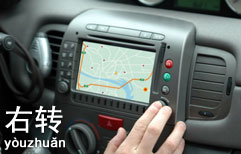
I was bought a TomTom GPS for Christmas. You are able to download voices from so I found the only Mandarin one and downloaded it.
This turns out to be a (male) voice that appears to mangle some of the words. My Chinese friend from Beijing says that the pronunciation is not very biaozhun (standard). She suggested it may be Taiwan...
Does anyone know where I could find another Mandarin voice?
Incidentally he says - youzhuanwan - for turning right (I think!).
pearltowerpeteApril 16, 2009
Hi weibwo
The words 大转 dàzhuǎn and 小转 xiǎozhuǎn literally mean "big turn" and "small turn," and refer to left and right turns respectively.
If you make a left turn, you drive across a bigger arc, hence the name.
Based on my own experience, this is pretty much just a Shanghai thing.
maizelsApril 16, 2009
I feel like a total klutz Bob i can't even work out how to do numeric pin yin !!!
weibwoApril 16, 2009
When I was in Shanghai last summer my nephew told me that they tell the cab drivers to say instead of you zhuan and zou zhuan they say xiao zhuan and da zhuan.

lujiaojieApril 15, 2009
carlosgg:
turn left: xiàng zuǒ zhuǎnYes, zuǒ should become 2nd tone here.continuously raining should be 一直下雨(yīzhí xiàyǔ)make a U-turn is 掉头 (diàotóu)
"Also zài kàn is an -ing word I think" I'm sorry, what does that mean?
kaixin_in_tampaApril 15, 2009
Ní hǎo, can someone please verify turn right and left?
turn right: xiàng yòu zhuǎn
turn left: xiàng zuǒ zhuǎn
(does zuǒ become 2nd tone here?)
Also, alwingate's questions. I think it should be
yīzhǐ yǔ (continuously raining)
Also zài kàn is an -ing word I think. Is that right?
Xiè xie
Carlos


alwingateApril 14, 2009
One more question?
zai4 kan4
In that construction, does zai4 make kan4 (look) into an ing word?
looking or is looking?
darylkApril 14, 2009
This lesson reminds me about that poor couple whose seatbelt warning system malfunctioned in their rental car. They had to listen to "fasten your seat belt" for 6 hours as they drove up an Hawaiian mountain and then came back down.
alwingateApril 14, 2009
I am wondering if this is an okay translation?
yu3 yi1zhi3 xia4
Rain continuously to fall.
It has been raining continuously.


go_manlyApril 14, 2009
I keep sending requests for assistance to 'Contact Us', but I have yet to receive a reply. Is anyone monitoring these requests? If not, how do I ask for technical assistance?
Bob

matt_cApril 14, 2009
It's true that these devices can cause accidents. When the systems/maps aren't regularly updated things like new traffic islands across small hilly intersections may not show up, causing some drivers who rely on the GPS to 发生事故 fāshēngshìgù (to have a traffic accident).


jennyzhuApril 13, 2009
bababardwan,
It is 向/xiang4/towards or in the direction of. 向右转/xiang4 you2 zhuan4/turn right,向左转xiang4 zuo3 zhuang3/turn left.
bodaweiApril 13, 2009
A useful term when directing the taxi driver (maybe when the GPS fails):
U-turn... circumrotate (ok, circumrotate is not a real word)...回转! hui2zhuan3 (v) U-turn
My Chinese dictionaries seem undecided on the noun:
掉头 diao4tou2
向后转 xiang4hou4zhuan3
Which is the best one to use? Can either be used also as a verb?
bababardwanApril 13, 2009
Thought that 走 must be referring to the walking cars:
or this new climate change friendly rebirth of the old Flintstone's car:
..but I get your point now.It could be referring to other things like ships that walk:
..and then in the last line when he does turn right he is surprised to be confronted with zou gou,right?
bababardwanApril 13, 2009
I'd love to hear the GPS navigating some of these:
“下右转,不。。,左,别,别。。哎哟”
。。。and if 十字 describes the cross shape of a four way 路口,怎么说这个:
What did you notice in this lesson?
You are posting as a guest. Your reply is reviewed before it appears. Log in to post without review.