
go_manlyApril 12, 2010
In the Expansion sentence:
他女朋友长什么样? (Tā nǚpéngyou zhăng shénmeyàng?) What does his girlfriend look like?
shouldn't that be 长得 (zhǎngde)?

connieApril 13, 2010
If you want to use 长得 (zhǎng de), the sentence should be, 他女朋友长得怎么样?Tā nǚpéngyou zhǎng de zěnmeyàng?
go_manlyApril 13, 2010
I've been trying to sort out your answer in my mind. Does the following make any sense:
他长什么样? His look is what type?
他长得怎么样? He looks how?
Does the 长 sort of act like a noun in the first example?
suansuanruApril 13, 2010
here are my oppions.
长 is a verb in the first example.
It means "grow",it like "长"in“成长”cheng2zhang3、“长大”zhang3da4。
when asked 他长什么样 ,the answer will focus on "what does he look like",while answering"他长得怎么样",the answer may focus on "is he handsome,tall,healthy?"

derricksOctober 29, 2009
Hi i recently picked up the word 搭讪 da1shan4, but having difficultly finding it in the chinese pod dictionary? is there something i should be searching for to add it to my flash cards? :) thanks!

baha17August 30, 2009
Thank you for the answers.
In that case,房间里还有谁,something like is there anyone still in the room(asuming the room should have been empty kind of thing).
thanks


jennyzhuAugust 29, 2009
@baha17,
房间 means 'room', so 房间里还有谁 means 'who else is in the room?' 家 means 'home', therefore 家里还有谁 means 'what other family members do you have?'If you want to ask who is at your home (as in right now instead of how many family members), then you can say '谁在你家?'
baha17August 28, 2009
hi everyone,
I'm a bit confused with the term of 房间里还有谁?
For instance if I want to ask who is at your home?
你家里还有谁? Do I need to ask like that?
Thanks for the help
Have a good day
Baha

kaixin_in_tampaAugust 27, 2009
Thank you Connie and Shenyajin. Here are examples of 咯, used in this lesson:
https://chinesepod.com/resources/glossary/entry/咯
connieAugust 27, 2009
Hi inland
"ta1 shi4 yi1 dian4 pang4." It's not correct.
The structure is, Subject + 有一点儿+ adjective.
So you can say,
这个有一点儿贵。Zhège yǒu yīdiǎnr guì.
今天有一点儿冷。Jīntiān yǒu yīdiǎnr lěng.
For more information, you can check this Qingwen show.

helenshen_counselorAugust 27, 2009
@dunderklumpen, we do have lessons of Qinwen on these particles, FYI
咯and啦,啊and呀,嘛,吧,呢
user26513August 26, 2009
What is the meaning sense of the word 酷? I am thinking it could be like 隨便. At the same time i<m not sure if it could mean laid back or fashionable etc.
dunderklumpenAugust 26, 2009
Shenyajin
可不可以麻烦你帮一下^_^ I'm still confused about those particles used in the end of some sentences. Please have a look at my post from yesterday. 谢谢。

bodaweiAugust 26, 2009
Thanks Shenyajin for patiently explaining those points. You point to interesting cultural distinctions - as a native English speaker I would not have guessed at the difference between the role of the human species in propogating grass, trees and flowers. I will have to go and practice some of that - there are so many flowers, plants, trees, grass etc. here in KM!
Reminds me that in my first day in Hangzhou a couple of years ago I learnt to say .. 他把树砍倒了。 (He chopped a tree down). We were looking at a 樟树 zhang1shu4 (Camphor Laurel) which is Hangzhou's tree but classified as a pest in Australia.
helenshen_counselorAugust 26, 2009
@bodawei, "种" is a verb, and only human can "种" something( "we" are the Subject ), so you can not say "树上种着花?植物上种着花?" the flowers are not planted by the tree, they are the product of nature. You can say these:
土地上种草?(there is grass on the ground)
菜园里种着菜?(there are veteables in the garden) Because we can plant grass and vegetables in the garden.
In these sentences, "长" is the word. You can say " 树开花了”,“这个植物开花了”. There is nothing grammatically wrong with the sentences, just ways of expression.
bodaweiAugust 26, 2009
@shenyajin
啊,明白了。 我记得那个句子‘山上种着树‘。 多谢。
可以说:
树上种着花?植物上种着花?(there are flowers on the trees/ growing on the plant)
土地上种草?(there is grass on the ground)
菜园里种着菜?(there are veteables in the garden)
helenshen_counselorAugust 26, 2009
@bodawei, in this situation, 'there are trees growing on the hills', we'll say "山上种着树”, shān shang zhòng zhe shù. “The crops are growing quickly”,庄稼长得快. You can not say 庄稼种得快, which means The peasants sowed quickly. And "种" can be used alone, and in reference to other stuff eg, "种花” flowers ,“种草" grass, "种菜" vegetables, "种树" trees.
dunderklumpenAugust 26, 2009
Hi inland,
nciku has some information on yidian:
有一点 [yǒuyìdiǎn]
1. a touch of;a little
The typing tool in www.mdbg.com also recognizes 有一点儿: "a bit/ a little".
If I got things right, 有一点儿 and 有一点 is exactly the same thing. It's just that people from the northern part of China like to add an extra 儿.
Chinese doesn't need a 是 shi4 in front of the adjective. The simplest sentence structure may be subject+adjective: 他胖 Ta1 pang4 He is fat. In swedish and english we must use "is" to make the sentence correct, but that is not needed in chinese. However, subject+是+noun is correct, e.g. 他是中国人 ta1 shi4 zhong1guo2ren2 He is Chinese.

inlandAugust 25, 2009
Is you yi dian a collocation?
有一点儿酷的
and
她有一点儿胖
while I would have guesed, ta1 shi4 yi1 dian4 peng4
Is it always Subject 有一点儿 adjective?
bodaweiAugust 25, 2009
@shenyajin
种" means to "sow", 播种,bōzhòng
Thanks for that; I can see how it can't be used in reference to 'rate of growth'. But are you saying that 种 can only be used collocated with 播? I can remember using it on its own,in reference to trees, and not being corrected before. Do you mean that it can only be used in reference to seeds? I'll be more specific: are you saying that it cannot be used in a translation of 'there are trees growing on the hills'?

matt_cAugust 25, 2009
长 zhǎng can also mean the chief/head as in 校长 xiàozhǎng,院长 yuànzhǎng,省长 shěngzhǎng,市长 shìzhǎng,队长 duìzhǎng,班长 bānzhǎng and so on.
dancanAugust 25, 2009
@Suxiaoya
Very interesting article and I wasnt aware of 2 Valentines either, thanks for the link
dunderklumpenAugust 25, 2009
I'm still a bit confused about those sentence-ending particles...
好困啊! Hao3 kun4 a! I'm so sleepy!
小鱼爱吃什么呀? Xiao3yu2 ai4 chi1 shen2me ya? What does the little fish like to eat?
当然是帅哥咯!Dang1ran2 shi4 shuai4ge1 lo! Handsome guys of course!
Do those particles have different meanings or are they chosen because they fit smoothly into the flow of the sentence?(E.g. I don't think shen2me a have the same flow as shen2me ya. Likewise, shuai4ge1 lo flows better than shuai4ge1 ya, e and lo sounding more similar to each other than e and ya.)
suxiaoyaAugust 25, 2009
Thanks for the corrections (as ever), Changye.
I didn't realise the festival was called "七夕", but I'm pleased to discover that there is tradition behind it. Celebrating two "Valentine's" days in one year would seem a little excessive otherwise!

changyeAugust 25, 2009
Hi suxiaoya
明天正好是中国情人节“七夕”。明天农历七月七号就是中国情人节“七夕”。
Thanks for reminding me! I had forgotten about that.
suxiaoyaAugust 25, 2009
正好, 明天是中国的情人节!zheng4 hao3, ming2tian1 shi4 zhong1guo2 de qing1ren2jie1Perfect timing; tomorrow is Chinese Valentine's Day!
Can I say that or is there a better way?
Sticking with the subject, this timely article in China Daily includes a quote from my flatmate on the dating scene for foreigners in Shanghai. Amusing!
helenshen_counselorAugust 25, 2009
@bodawei, "The crops are growing quickly", "庄稼长得快", you can not say "庄稼种得快", “种" means to "sow", 播种,bōzhòng
bodaweiAugust 25, 2009
Thanks Pete. That reminds me of the other verb to grow, 种 zhong4 - can 种 be substituted for 长 in the above sentence?
庄稼种得快和庄稼长得快,都可以说吗?
The two sentences meaning 'The crops are growing quickly' - are both sentences correct?

pearltowerpeteAugust 25, 2009
Hi bodawei,
You are indeed correct. Thank you for taking the time to help a fellow poddie.
Please note that 长 zhang3 refers not only to one's appearance but also to rate of growth, or the act of growing. In Chinese you can say 庄稼长得快 the crops are growing quickly as well as 他长得很帅 he's really handsome. English would use very different verbs to illustrate these ideas.
bodaweiAugust 25, 2009
@luolina27
I think the meaning here is more along the lines of 'grow', in the sense of 'grown' to be like... It is a commonly used verb when describing how people appear. Note that this is zhang, not chang - it is one of those characters with tow pronunciations.
There are many more competent people to answer your question than me but I don't like seeing a question going ananswered; perhaps someone will come to our aid if I have it wrong?
pearltowerpeteAugust 25, 2009
Hi luolina27
Great question.
长 is a 多音字,a character with multiple readings. It can mean "long," as 长城 the Great Wall, as you suggested.
But here, it is pronounced zhang3, and refers to appearance, growing.
There are quite a few such characters with multiple readings in Chinese. A few examples are 干 gan1 "dry", vs. 干 gan4 "to do." The word 解 jie3 as in 解放 "to liberate” can also be a surname, in which case it is pronounced xie4.
jennyzhuAugust 25, 2009
@desluo949,
While '他女朋友长什么样' means 'what does his girlfriend look like', in Chinese it means 'exactly how does his girlfriend look like, i.e. what do her features look like'. So strictly speaking, the answer should describe her physical attributes. While 长得 is followed by a complement, e.g. 长得很漂亮,长得很帅。And the most accurate way of asking the question is 她长得怎么样?/'How' does she look like if you will. But in daily conversation, the line gets a bit blurry. The sample sentence 他女朋友长什么样 is the most common and colloquail way of saying 'what does his girlfriend look like?' Stick with that and you will be fine.
maeann_ramirezAugust 25, 2009
Thanks Pete.
Perhaps you should answer luolina27's question on the same sentence. I would jump in, but I can't remember the term for these types of characters.
pearltowerpeteAugust 25, 2009
Hi desluo949
Good question. The verb + 得 construction requires an adverb afterward. 他长得怎么样 is literally asking "how does he look" as opposed to 长什么样 which could more literally be "what does he look like?"
In practice, the two are very similar.
maeann_ramirezAugust 25, 2009
In the expansion sentence
他女朋友长什么样? (Tā nǚpéngyou zhăng shénmeyàng?) What does his girlfriend look like?
I thought it would have been 他女朋友长得什么样.
Could someone explain?

bababardwanAugust 25, 2009
So can 穿穿 chuan1 chuan1 mean a cross dresser then,or was this just a Freudian slip from someone like the translator at CPod[我开玩笑。。j/k]? If so,better watch those verb reduplications.
jennyzhuAugust 25, 2009
@machenghan,
Try this one 'haircuts'. Also a tip on search, after you type in a keyword, select 'glossary' rather than 'lesson'. You will see a list of relevant sentences and related lessons. The search results are better.

baolinna27August 25, 2009
大家好!
I have a question for this lesson, why 长 is used in the sentence 他女朋友长什么样?
I know 长 as "long" like in 长城 but not as "look alike" or something like that. I am a little confused. 0.o
Thanks!
Note. Last year when I was in Beijing every day I was so astonished for the male look...sometimes was very hard to find out the gender. In Japan they call them "vegetarian men" because they don´t have the aggressive look anymore.
bodaweiAugust 25, 2009
Is it really the case that 帅 cannot be used in relation to women in China? .. 帅女?? (Okay, I am making that up.) I thought that with the discussion of trends to adrogeny above this might be acceptable now.
The term 'handsome woman' has long been acceptable in the West; I remember when I was a boy the term was common. I am not sure if this term 'handsome woman' came in with the adrogenous look, or if it is much older. In the West the adrogenous look was around in the 1930s for example, and possibly earlier periods of history.
machenghanAugust 25, 2009
Thank you Jenny, but the link to the elementary lesson doesn't work, and I have searched "hair" and found the "getting your hair done" lesson, but it didn't find the "hair cuts"....
jennyzhuAugust 24, 2009
@machenghan,
No comment is stupid especially given that we did make a mistake with the annotation of 穿/chuan1. You are right. It should be 'to wear' in the context of the sentence. We have corrected it. Thank you for pointing it out.
咯/lo is a modal particle which helps define a tone of voice rather than grammartical function. It makes one sound vivacious and light hearted. It can't be fully equited to 了 which does perform a few important grammartical purposes. Although in some aspects 咯 is similar to 了, i.e. when they are both used in the end of a sentence, it can't substitute 了 entirely.
We have 2 lessons on hair cut, one elementary 'hair cuts' and an intermediate 'getting your hair done' .
machenghanAugust 24, 2009
by the way, has there ever been a lesson on getting a haircut? Stuff like telling them to not cut it too short, or to cut it shorter, or whatever.....? I get scared about going for a haircut, for more reasons than one....
machenghanAugust 24, 2009
I'm sure this is a stupid comment, but in the expansion 穿 is translated when you click on the "save word" option as "to cross" -- which I know is one meaning of 穿 but surely it's not the meaning here....? it's "to wear"
I had also never come across 咯 before. My dictionary says it functions like 了.... is that right?
pearltowerpeteAugust 24, 2009
Hi tommy2tone,
This is just anecdotal, but I'd say we're seeing more androgynous women around as well. The most famous example is the Supergirl, 李宇春. She got made fun of but I've seen plenty who look like her.
Hi tal,
Yeah my taste generally runs more toward Kenny Rogers and Pink Floyd, but we needed to shake it up a bit.
jennyzhuAugust 24, 2009
@tommy2tone,
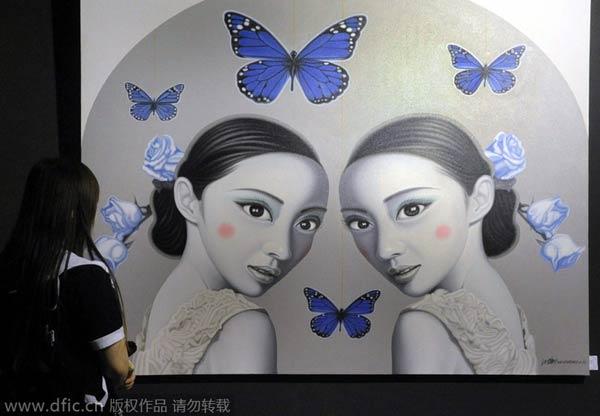
While the Zhang Ziyi type will have lasting appeal, standards for female beauty have also changed to accept a much more androgynous look. (Yes, this is a woman...)
jennyzhuAugust 24, 2009
In the past 2 or 3 years in China, what's considered as 帅/shuai4/handsome has moved from a man's man to a much more androgynous look (yes, that's a man...)


kimiikAugust 24, 2009
Pitter-pat ?
I thought it came from Peter Pan but no that was just pitter-patter. ;o)
What did you notice in this lesson?
You are posting as a guest. Your reply is reviewed before it appears. Log in to post without review.