

chrisSeptember 26, 2010
Quite often I find that if I'm in a cafe with wifi and I can't connect to their network, a simple switch off and then switch on again of the cafe's router resolves the problem (think it's something to do with clearing caches or something.....).
Anyway, my question is simply how can I ask the service staff to do this? I usually try something like 麻烦你们把无线上网机,先关再开 "máfan nǐmen bǎ wuxianshàngwǎngjī xiān guān zài kāi".
I know this is probably really bad chinese and grammar, but they always know what I mean. Could I actually use this lesson's "chóngqǐ" here? Any help appreciated, Chris.

tiaopidepiAugust 16, 2010
Ironic that my teacher assigned this lesson this week. I had to laugh when I heard John blindly bashing Windows. https://chinesepod.com/community/conversations/post/10057

pretzellogicJuly 24, 2010
On a scale from 1 - 5, where 1 is easy, and 5 is difficult, I'd rate this intermediate lesson is a 4 - challenging intermediate. Mostly 1 sentence paragraphs. No major new sentence patterns, but this lesson works in an example of the luànqībāzāo "chengyu" that is only explained in the show. Introduced about 5-15 new words for someone at the early stage of intermediate. Fast speech in the dialogue at times.
My take is that if you could listen to this dialogue and get 90% of it on the first listen, go to upper intermediate and stay there.
lamps5jam3April 8, 2010
I'm a little concerned that this dialogue came from real-life happenings in the Chinese-Pod office!

pretzellogicJanuary 18, 2010
Hopefully, the links work this time:
Newbie - Downloading Music
Newbie - Surfing the Internet
Newbie - Wireless Internet
Newbie - Internet Cafe Rates
Elementary - ID Check at the Internet Cafe
Elementary - Office Policy: Internet
Intermediate - Internet Slang
Newbie - Sending Emails
Newbie - Chatting Online
Newbie - Downloading Music
Elementary - Surfing Online
Elementary - MSN and QQ
Upper Intermediate - Battling Internet Addiction
Upper Intermediate - Getting Internet at your Apartment
Elementary - Connecting with Email
Upper Intermediate - Adventures of an Andy Lau Fan on Taobao
Upper Intermediate - Buying on Taobao
Upper Intermediate - Social Networking
Upper Intermediate - Online Shopping
Intermediate - Internet is Down
Elementary - My computer froze!
Intermediate - Buying a Computer
Upper Intermediate - Buying a Custom-Built Computer

mandarinkoalaJanuary 18, 2010
Thanks CPod. The best lesson I've seen for a while, as it has language Ican use more often, including grammer.
When i have taught Chinese and Korean students IT, I had to say "lao shu". Though I've leaned the correct form, it is useful to use the wrong one for humour purposes.
Are there any related lessons to this topic?

ousijiaJanuary 18, 2010
Mandarinkoala, great to hear you enjoyed the lesson. I agree, it has very useful grammar and vocab. Was going to suggest other lessons, but pretzellogic has beaten me to it! Thanks pretzellogic :)

svikJanuary 17, 2010
I have a question about this sentence from the expansion:
我真服了你了,800米居然跑了10分钟。
Is this sarcastic, since one could walk 800 meters in 10 minutes?


WillBuckinghamJanuary 17, 2010
Here' s a handy help-sheet for all those people who find themselves offering unofficial tech support...
XKCD Helpdesk Flowchart

matthiaskJanuary 17, 2010
Oh, there are indeed XKCD's that I have forgotten about. :) Thanks for sharing/reminding.
tiaopidepiJanuary 14, 2011
And here's one for those who think this lesson is still relevant today: http://xkcd.com/694/
pretzellogicJanuary 14, 2011
I didn't know anyone cleaned viruses using the registry editor. Maybe all those "DANGER: HIGH VOLTAGE" signs Microsoft puts around the editor.
pretzellogicJanuary 14, 2011
huh. I didn't realize Windows 7 still lets you get into the registry editor.

bababardwanJanuary 17, 2010
this word 鼠标 for computer mouse is interesting.I'm presuming that 标 was chosen for it's meaning of mark indication...meaning the mouse was indicating or pointing to something on the screen.
I think 杀杀毒 sounds much more effective than antivirus [which may just be anti the virus but unable to get rid of it]
不会。。almost sounds like no way,just as 服了 in 服了你了 almost sounds like fool.

TalJanuary 16, 2010
My enquiry relates to this expansion sentence:
那个酒吧乱七八糟的,我可不想去。(That bar is dodgy. I really don't want to go.)
I really don't get how 乱七八糟 means 'dodgy' here. If someone said that to me I'd assume they meant the place was a mess, not well-run maybe. But dodgy?
bababardwanJanuary 16, 2010
yeah,good question tal.If it was a restaurant then I'd take it that dodgy was kinda meating up with disorder/mess to imply that you couldn't trust the hygiene [I'm not sure if you can also eat at these 酒吧 or not] but the added definition in the rollover of "shady" leaves one in little doubt as to which nuance of dodgy is implied here,so I too would be very interested in authoritative answer.It's similarity to English's at 6's and 7's also tends to suggest disorder ,not something potentially criminal or underhanded.

JasonSchJanuary 17, 2010
Glad you brought this one up. It's a good sentence for the expansions in that it gives another, different use of 乱七八糟. I don't have a definitive answer as to why it's used this way, but in reference to a bar, it means that the place is questionable. Specifically, the environment, the things that go on there, or the kinds of people that patronize it.
JasonSchJanuary 17, 2010
Baba, I was wondering the same thing about a restaurant. Can it be 乱七八糟? I asked a native speaker though and got a, '我们一般不用这个词去形容吃饭的地方'.
bababardwanJanuary 17, 2010
thanks heaps Jason for clarifying that for us,and in being specific in your elaboration....ok,so yeah,exactly how we'd use dodgy in reference to a bar. :)

zhenlijiangJanuary 16, 2010
gesang,
I'm sorry this took so long. I didn't want to give BC (bogus Chinese) example sentences so went and culled these from my dictionaries, for different kinds of 可 as emphasizer. Apologies in advance for any English awkwardness (translated from the Japanese):
1) Close to 真的*, modifies the adjective immediately following. Often seen in the 可+真 pattern. Not stressed in pronunciation.
那姑娘长得可真漂亮!That girl is really very beautiful.
他汉语说得可真好!His Chinese is really very good.
外面雨可不小,等会儿再走吧。 (maybe this one is a #2 ...?)But it's absolutely pouring outside. Let's wait a bit, then go.
2) Expressing how strongly the speaker feels about the extent (extremity) of something. Stressed in pronounciation, at times over-exaggerated even.
可了不得啦,又下雨啦!No! Not rain again!
妈妈,快拿吃的,可饿坏了!Mom, give me something to eat,I'm starving!
3) Mainly used to stress, in emphasis or a declaration (but often also expresses the speaker's reaction to a somewhat unexpected situation at hand).
这一问可把我给问住了。That question did have me really stumped.
你可真爱管闲事儿。My but you do stick your nose where it isn't wanted.
时间不早了,我可得走了。It's late already, I do have to go.
好!干就干,这可是你说的。Fine, well let's do it then. But this is your idea.
他可不爱吃鱼。He really does not like to eat fish.
我没有,你去跟他借吧。 ——我可不。I don't have any. You can go ask to borrow his.——I don't want to do that.
4) Emphasizing a strong, heartfelt wish.
我的事儿您可给放在心上点儿!Please do keep in mind that matter (that I've asked your help on, and you promised) for me!
这次是出远门儿,你可要注意身体呀。You'll be traveling such a distance. Do take care of yourself now, hear?
5) Emphasizing the tone in a rhetorical question.
这件事我可怎么知道呢?Just how was I supposed to know about this?
都这样说,可谁见过呢?Everybody says so--and? Who has seen?
I may have mis-classified a few of these. But anyway, 可 is an emphasizer in many different ways.
* 真的--maybe I gave the impression earlier that it isn't used as often, but it is actually very common of course, and perhaps the first (default, until our vocab increases) emphasizer of adjectives that we learn.
zhenlijiangJanuary 16, 2010
... perhaps the first (default, until our vocab increases) emphasizer that we learn. NOT accurate to call it an emphasizer of adjectives I guess--sorry about that.

gesangJanuary 16, 2010
Wow! Thanks so much zhenlijiangさん! For all the effort and great help! *(^o^)*
zhenlijiangJanuary 16, 2010
Glad if it helped gesang さん! But I'm sure it could be explained better by someone else.And hope if anything I've written is misleading or just plain wrong I will be corrected.
mandarinkoalaJanuary 18, 2010
Zhenlijiang, Thanks! Great stuff, and good on you for putting some useful stuff there.

bababardwanJanuary 16, 2010
呵呵,I got a dictation exercise wrong for writing 八百 instead of 800 and 十 instead of 10.
bababardwanJanuary 16, 2010
“我真服了你了,800米居然跑了10分钟”
。。米饭权力奶奶
xiaoxiaotomJanuary 16, 2010
哈哈哈。我想跑的是一位 "电脑怪物" ("computer freak", admittedly I have no idea whether this is correct in Chinese, maybe someone can help?) :)
gesangJanuary 16, 2010
There was just an answer to my question and when I wanted to answer it was gone :-(... Anyway..thanks to...I don't remember the users name...
What about this new feature...the reply button, should or may I use it?
Add-on to my question: could someone post other example sentences for this 可? ...the glossary only has 可以 and 可能 samples...
zhenlijiangJanuary 16, 2010
Sorry gesang that's because I deleted it once (it's back up there now).
Yes do use the Reply button!
gesangJanuary 16, 2010
Thanks zhenlijiang, it was a useful answer, no 废话 at all ;)
I especially liked the才example... As it is often very complicated to explain the use of a word I feel I learn a lot from examples...and I always use them when explaining something to my Chinese language partner!
Any 可 sentences coming to your mind:)?
xiaoxiaotomJanuary 16, 2010
three nice - and easy - ones are:
可爱: lovely, cute
可怕: frightening
可靠: trustworthy, reliable
gesangJanuary 16, 2010
interesting... I never saw this constructions that way... But used in sentences, does the可 really function as an emphasis particle here? 他很可爱,这个电影太可怕的,。。。有什么可怕的? Maybe it is more a 3rd use of 可 ? I don't know, maybe I am totally wrong...just write what I think..or maybe I overanalyse ;-)
zhenlijiangJanuary 16, 2010
可 has many uses, and even several different uses as emphasizer alone. 让我想一想!回头再说

oranginaJanuary 16, 2010
I think in 可爱,可怕 and 可靠 the 可 means -able. Which still doesn't answer how it serves to emphasize. I am also curious about this.
zhenlijiangJanuary 16, 2010
Yes, those 可 stand for ~able.
My patience is too limited to work in this little text input box so I'm going to put the example sentences up outside the thread.
gesangJanuary 16, 2010
大家好, 好久不见:-)
The expansion sentence: 那个酒吧乱七八糟的,我可不想去!Is the first time I saw 可 as particle used for emphasis...
Is it very common? Are there special occasions where it is preferred to the use of 很,好, 真,...
Would 那个酒吧乱七八糟的,我真不想去. be absolutely the same or does it express e.g. more/less emphasis ...
Thanks, 格桑
zhenlijiangJanuary 16, 2010
Hi 格桑, until someone who knows well comes along to help here are my thoughts:
This 可 for emphasis is common. I quite like using it myself (can't really outline though, the guideline for when to choose it over others).
For this particular sentence I think you also have the option of 才: 那个酒吧乱七八糟的,我才不想去呢。 To me this sounds very strong (stronger in fact, than the one with 可)--"who would ever want to go there!"--that sort of tone.
真 I don't think you could use here (wish I could tell you with authority why ...). You might say 真的 I guess. But 可 seems like the most obvious choice for emphasizer in this instance.
(And I tend to see the "really" of 真的 as a different kind of "really" from a "I really don't want to go" kind. 真的 to me is a bit more like trying to convince someone that you really mean what you say, that something you say is from your heart and true.)
OK I'll stop right here before my 废话 confuses you any more!
jeddaJanuary 15, 2010
We've had ongoing problems with the computers at work. The tech guy eventually found the problem. He tried to explain to the manager several times that the cpu was occassionally malfunctioning due to a cheap and nasty motherboard, but the manager refused to listen and would get angry. this was perhaps due to the fact that our company had a partnership with the manufacturers of the motherboard.the tech guy just scratched his head and wondered off.
i'm not literate as yet in chinese tech terms. how would one say 'the problem with the computers is in fact the result of a cheap and nasty motherboard'
thanks in advance.

bodaweiJanuary 15, 2010
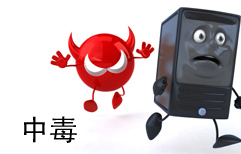
那你可能中毒了 (You've probably got a virus.) It occurs to me that this expression is more 'descriptive' than the English, because it implies that the computer is affected, or even poisoned, by something. Virus is a mysterious term to apply to those problems we have with our computers, although it does convey the sense of being passed from one computer to another, something lacking from the above Chinese expression.
I wonder if 中毒 is an abbreviation of 中病毒 because 病毒 bìngdú means virus. If so, the expression loses the description alluded to above.
Other expressions using the word 中毒 zhòngdú (v. be affected or poisoned - note that 中 here means 'suffer' and 毒 means 'poison'):
酒精中毒病人 (alcoholic - someone who is 'affected' or poisoned by alcohol - actually not a common expression, see 酒鬼 below.)
and 食物中毒 shiwuzhongdu (food poisoning)
By the way, 酒鬼 jiǔguǐ; and 嗜酒者 shìjiǔzhe (both meaning alcoholic) - these three Chinese expressions for alcoholic seem problematic from a Western point of view; maybe because they sound non-scientific. But they are colourful and idiomatic.
changyeJanuary 15, 2010
Hi bodawei
There is another interesting word that means "heavy drinker", i.e. "海量" (hai3 liang4), which literally means "ocean/sea amount (of alcohol)". I don't know which will win if 海量 and 酒鬼 compete with each other.
Have you ever seen the character "酗" (xu1)? This character consists of "酉" (you3, alcohol) and "凶" (xiong1, vicious), and means "drink heavily". Chinese is a language that is fully prepared in terms of "drinking".
P/S. 电脑中毒了 = 电脑感染了
bodaweiJanuary 16, 2010
我觉得酒鬼比海量赢,因为,因为。。。。。。因为我很喜欢这个汉字鬼.
I like both 电脑中毒了 and 电脑感染了 better than 'computer virus'. Actually I posted before I'd listened to the lesson; John does say that 中毒 is an abbreviation of 中病毒 which spoils my theory that Chinese has avoided the vagueness of the English 'virus'. Semantically it is exactly the same as the English.
bababardwanJanuary 16, 2010
bodawei,
thanks for those mate.I like 酒鬼 best for all the descriptive qualities that 鬼 brings to the word [ghost,sly,crafty].嗜酒者 sounds more precise and I'm guessing formal.However 酒精中毒 as you've also alluded to,seems particularly problematic as the translation for me would suggest alcohol poisoning rather than alcoholism.
bababardwanJanuary 16, 2010
changye,
mdbg gives 海量 as meaning huge volume ,so I'm guessing the application of this to mean heavy drinker is slang,对不对? It does remind one of the English expression "he/she drinks like a fish"
ps my reply button to bodawei didn't work ,and I guessed it was maybe because this subthread was over a day old,whereas it's working to changye [though that comment was less than a day old...hmm,is there a 24 hour cutoff before the reply link no longer works?]
changyeJanuary 16, 2010
On second thought, "海量" has a different connotation from "酒鬼", the former is "great alcohol capacity", and the latter "drunkard". In any case, both are "guzzler".
The English phrase "drink like a fish" is just interesting, and makes sense. For the record, a heavy drinker is called "うわばみ/uwabami" (a big snake) in Japanese, and "술고래" (alcohol whale = drink like a whale).
Which do you think is the heaviest drinker? Semantically, "海量" (sea amount) seems to surpass a whale and a big snake, but in fact even Chinese and Japanese drinkers can't beat Korean drinkers.
Does anyone know its equivalent in Russian?
P/S. I can't believe there is a dictionary that doesn't show the definition "great alcohol capacity" for "海量". Nciku shows the definition.
bodaweiJanuary 16, 2010
海量 (huge capacity for alcoholic drinks) - Oxford Concise. 海量脂很大的酒量,对吧? 而且,海量有别的意思,是宽宏的度量的意思。 很有意思。 英语说‘magnanimity'.
bababardwanJanuary 16, 2010
thanks changye.Yeah nciku is always more thorough than mdbg..i was just too lazy to go and check over there as well.But having just checked it seems to me that 海量 is suggesting tolerance and then the context is needed if one is to extend that meaning to alcohol tolerance [but as you rightly imply,generally one has a higher alcohol tolerance through regular drinking...enzyme induction,so in the end the distinction is not overly important].Hehe,yeah,sea amount seems to take the cake.
bababardwanJanuary 16, 2010
these reply and edit functions continue to surprise me.I posted a reply to changye which came up straight under his comment and then decided to add something and when my edit came up ,lo and behold bodawei snuck a comment in there.bodawei,你这个人,你应该排队啊 !! 呵呵,当然我开玩笑
changyeJanuary 17, 2010
In reality, just saying "你是海量" (without context) automatically means "You can drink much/You have great alcohol capacity".
bodaweiJanuary 17, 2010
Ah, this raises an interesting cultural question that we were just discussing over on Xiaophil's 'List of Emotions'. In my experience you would never say in English 'you are a magnanimous person' unless you had your tongue firmly in cheek. You however may say 'he is a magnanimous person'. So if you say 你是海量 we can safely assume that the meaning relates to alcohol consumption. I take it from Changye's comment that this is so regardless of my culture point. Which raises the further question - does the magnanimous meaning actually get a run in real life, or does it just reside in dictionaries??
changyeJanuary 17, 2010
Hi bodawei
"海量" (in the sense of "magnanimous") is a very formal word, so it's usually not used in everyday conversation.
bodaweiJanuary 17, 2010
Hi Changye
Gotcha! Thanks for that. I did suspect that you were talking 口语. By the way, it is kind of formal in English as well, unless said as a joke. Many educated people would use it in conversation, but most of us aren't that educated. :-) In my case I am over educated, which is just as bad as under-educated.

pettoraFebruary 26, 2010
Hi Changye,
can't speak for Russians but we Czechs say "to drink like a rainbow" or "to drink like a Dane". I just wonder, who the heaviest drinkers are, Koreans or Danes? 笑
changyeFebruary 26, 2010
Hi pettorra
Looks like Czechs are a very romantic people! I wonder what story/etymology there is behind the "drink like a rainbow". Incidentally, I hear Korean guys drink as if there was no tomorrow, hehe. I don't know about Danes.
pettoraFebruary 26, 2010
Thank you for the compliment. If it only were true in our beer centered culture...汗
Unfortunately, I coudn't find anything about the "rainbow" etymology, it may have been a very old expression already. But I find it to be a nice metaphor. Rainbow surely needs plenty of water before it comes into existence.
changyeFebruary 26, 2010
Hi pettora
> Rainbow surely needs a plenty of water
That really makes sense. Furthermore, it seems to me that the colors of the rainbow suggests that your face becomes red first, and later becomes pale if you drink too much.

martinkuMarch 24, 2010
Ahoj pettoro!
jako duha? I never learned that, or if I did I've forgotten long long ago. My favorite Czech drinking idiom is having "monkeys in the head" for a hangover - very descriptive, and nice pun on opice/opit se ;)
(and I know my screen name is ungrammatical in Czech...)
eupnea63355January 15, 2010
For the first time the "Paste from Word" button showed up on my computer, so I'm going to try to post this way. I hope you all don't end up with a lot of coding. My internet truly is so slow and spotty, the graphics most often don't load.
我 的 网 速 这 么 慢!我 经 常 不 能 用 Skype.
wǒde wǎngsù zhème màn! Wǒ jīngcháng bù néng yòng Skype.
My internet is so slow! I often can't use Skype.
What I'd like to say, and it's true...
My internet is not reliable.
Usually it is very slow, even slower than dialup.
Any corrections or suggestions appreciated. This is a great lesson for picking up useful vocabulary.

shushengJanuary 15, 2010
Great useful lesson for me. I wonder if anyone could kindly tell me how to say something in Chinese?
"Recover Lost data"
我是技术部的人, 死机了的时候, 有人总是需要recover what they were working on. 很多中国人学生。
实践中文的机会
shushengJanuary 15, 2010
Ah thanks. So 'data' is 数据 (shùjù)?
huī fù shù jù
需要恢复数据马?(xūyào huīfù shùjù ma?)
other useful ones:
打印坏了吗? (dǎ yìn huài le ma?) - is the printer broken?
上不了网吗? (shàng bù liǎo wǎng ma?) - Internet down?
not sure if 上不了网 means "internet connection is down" or "can't get online personally" or both.
arg how do you get rid of this crazy spacing between lines?

dunderklumpenJanuary 15, 2010
Janmusi
[enter] makes crazy spacing.
[enter]+[shift] makes normal spacing.
Hm, seems it doesn't work with the new threaded posts though.

frognotinawellJanuary 16, 2010
We now need to learn html code.For a new line without spacing, type < b r >
newline one.newline two.
carl89January 15, 2010
In the vocab section, unable to open (打不开)has no tone mark for 不。 Shouldn't the 不 in this phrase be 4th tone?

carl89January 15, 2010
Hi simonpeterson,
I asked my two Chinese native speakers and they both individually told me it's 4th tone and not neutral. I have a feeling that Beijing people are the only ones who use neutral tone for that

BrokenJokerJanuary 15, 2010
how would you translate
cyberattack
web censorship
freedom of information
i am having difficulty accessing google

matthiaskJanuary 15, 2010
minor mistake: the 对了 from the line 对了,有时候还会出来一些乱七八糟的网页。is not in the lesson, but in the pdf and the dialogue tab.
For the rest: awesome lesson!!!
tiaopidepiJanuary 14, 2010
anti-spyware: 反间谍软件
anti-spam: 反垃圾邮件
anti-virus: 防病毒
backup copy: 备份副本
Source: http://www.microsoft.com/language/en/us/search.mspx
This page gives the translations used by Microsoft in their products so they're pretty well guaranteed to be current.
pretzellogicJanuary 15, 2010
a1pi2, thanks for the link. I was casually doing a search for the Chinese term for "virtualization", and was hoping for both pinyin and characters, but I see it only does characters. Next time, I should try "cloud computing".
tiaopidepiJanuary 15, 2010
Yeah, this page is intended for people who already know Chinese : ) I learned about it when I had a coworker translate some slides for a talk I gave in Beijing from English to Chinese.
It's amazing how difficult it is to keep track of technology terms. Most Chinese at work just use English terms in Chinese conversations.
I suggest you use one of the many Pinyinizer programs to transcribe this from Hanzi to Pinyin.

rodsJanuary 15, 2010
That page is going to be handy. Thanks for the link. It even has Blue Screen of Death 蓝屏死机
pretzellogicJanuary 16, 2010
Hey, I just observed that your Microsoft link doesn't give names of products like Tivoli Provisioning Manager, or Apple Remote Desktop. Do you know of a website that's more "vendor agnostic"? :)
tiaopidepiJanuary 16, 2010
The source is unfortunately vendor specific. MS built that database by looking at documentation for every product and comparing translations. Since we don't sell Tivoli or Apple products we don't have documentation.
carl89January 14, 2010
do people Chinese people use a different word for "mouse" in Taiwan?

jennyzhuJanuary 14, 2010
Some people in Taiwan call it 滑鼠/hua2 shu3, which literally means a sliding mouse.
pretzellogicJanuary 14, 2010
It's cool that cpod is adding technology lessons. I recall that much of the tech dialog in this lesson (internet, websites, mouse, "computer froze") has been taught in other lessons. I don't recall that virus and operating environment have been, so that's helpful.
It would be helpful for those of us that have technology backgrounds if there could be additional dialog around some of the steps that IT would take in troubleshooting. Certainly, reinstalling the OS is one answer to virus infection, but another intermediate step might have been to install and run anti-virus, anti-spyware, or anti-spam programs.
Plus, reinstalling the operating environment means potentially losing data. It would be helpful to have dialog around "backup", "saved files" and "reimaging" so that the panicked user with slow websites wouldn't be scared that he lost the Word document he spent the last 2 weeks working on for an important client.
So, how do you say in Chinese in context:
Anti-spyware
Anti-spam
Anti-virus
Reimage
backup (as in, "did you backup your files so that you have a copy somewhere else besides your computer?")
jennyzhuJanuary 14, 2010
anti-spyware:反间谍软件/an3 jian4 die2 ruan3 jian4
anti-spam: 反垃圾邮件/an3 la1 ji1 you2 jian4 or 垃圾过滤/la1 ji1 guo4 lv4 (过滤 means 'filtering')
anti-virus:防毒软件/fang2 du2 ruan3 jian4
backup: 备份/bei4 fen4
I don't know what 'reimage' is though.
tiaopidepiJanuary 15, 2010
I always forget about threaded comments!
Reimage: 重新安装, install once again. There's no set term for this.
tiaopidepiJanuary 15, 2010
Or 重装系统 from the lesson. Most "normal" people don't keep actual images, do they?
pretzellogicJanuary 15, 2010
my take is that most "normal" people don't keep a 2 GB image of their operating environment and applications and data on their computer either. Then their machine dies, and takes critical data with it, and then people get religion.
tiaopidepiJanuary 15, 2010
Ah, sorry. What I meant is that I've only ever heard the term "OS image" from people working in the industry. I know of people who back up their data, but don't know anyone outside of work who "reimages".
pretzellogicJanuary 15, 2010
fair point. maybe I should have said, "ghosted" :) At least I used to hear that in the ancient past.
tiaopidepiJanuary 15, 2010
"Norton Ghost"...wow, they still sell that! Long time, no see. Some time I'll tell you the long and winding tale of how Windows OS installation staging works in an OEM manufacturing line...but not tonight, and not in English :)
pretzellogicJanuary 16, 2010
oooooohhhhhhh...... sounds interesting. Don't the OEMs just use System Center Config Manager? :) Well, maybe not HP. Dell and Lenovo perhaps? Or is Lenovo just using Tivoli Provisioning Manager for IT?
bababardwanJanuary 16, 2010
pretzell,
"keep a 2 GB image of their operating environment and applications and data on their computer either"
..有意思和我觉得明显是很好的主意。麻烦你,你有没有一个链接为了显示那怎么办?
"then people get religion"
。。呵呵,好笑的说法。。我喜欢。我猜意思是他们“看到一个灯”。。换句话说他们以后学习他们的错误和备份,对不对?
pretzellogicJanuary 18, 2010
baba, In answer to your first question (I think), here are some handydandy links that are probably more than you really wanted to know about imaging. By the way, I probably should have better called it cloning. Do not consider the links below an endorsement of any product or methodology.
http://www.pcstats.com/articleview.cfm?articleID=418
http://www.bay-wolf.com/ghostclone.htm
http://msdn.microsoft.com/en-us/library/system.operatingsystem.clone.aspx
http://www.acronis.com/homecomputing/products/trueimage/
http://www.symantec.com/norton/ghost
Another by the way: I'm not quite sure if you're a Star Trek fan, but if you are, cloning is a Genesis device for PCs. (Recall the Wrath of Khan) It can replicate the Eden that was your pristine computer before those nasty viruses and spyware attacked your machine and made it foul. But in the wrong hands, it will erase completely and permanently everything that went before, including those rare pictures of your teenager when she was 2.
Cloning has advantages, but mere backup gets much of the data protection job done.
What did you notice in this lesson?
You are posting as a guest. Your reply is reviewed before it appears. Log in to post without review.