

pushpushMarch 27, 2011
Really enjoyed the way you broke down the sentence structures in this lesson. Good Stuff!
tgarranJanuary 13, 2011
你好ChinesePod队,
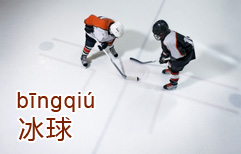
感谢你们弄这种课, 不过我的水平比这节课有一点儿高。我住在北京三年了。在北京冰球越来越通俗。小儿队是二十多,大人队几乎十个。我们外国人有六个队。我们常去国外打比赛, 在盲谷,曼谷,等等。每一个星期一我们最好的外国人和一个最好的中国人队打一个比赛。所以我希望你们可以做一节课用冰球的特词汇, 比如offsides, pass, icing, slapshot, elbowing, 什么的。
谢谢,
林青阳
Thomas

Michael KrzykowskiJanuary 8, 2011
CP Team,
The answers of questions 3 and 4 in the Dictation section of the Exercises, are using different forms of "求“ and 哪 from that used in the expansion sentences and in the multiple choice questions。Are these incorrect or just another way to use the terms?

abelleJanuary 5, 2011
Thanks for this lesson. My son played hockey from the time he was 5 years old until about 12 years old. Then he realized he was never going to be a very tall or big guy and stopped playing. His winter sport is now snowboarding, 雪板, a sport where someone's size doesn't matter.

jennyzhuJanuary 6, 2011
I made a very poor attempt at snowboarding last winter in Whistler. 雪板很难!/xuěbǎn hěn nán!/ Snowboarding is tough!
abelleJanuary 6, 2011
Jenny, I tried to learn to ski when I was in my mid-20s and failed miserably. So I am one of those people who stays in the ski lodge by the fire, drinking hot chocolate and watching everyone else ski or showboard. Which is not a bad way to spend a few hours! My son is studying at the University of Utah in Salt Lake City and goes to the nearby Park City resorts, where the 2002 Winter Olympics were held.


xiaophilJanuary 3, 2011
I got a sports question. I did a search for what verb collocates with 橄榄球 gǎnlǎnqiú (American football/rugby). It looks like 打dǎ is the most frequent choice. But I noticed that a lot of people also say 玩橄榄球 wángǎnlǎnqiú. Is it normal to use 玩 with other sports? For example, can we say 玩篮球 wánlánqiú (play basketball) instead of 打篮球?It certainly makes for a smoother translation between English and Chinese.


byronmeinerthJanuary 3, 2011
I'd say it's a dangerous habit to think about collocations like 冰球, as "ice ball". If you ask a Chinese about what 球 can refer to (in collocations), he'd mention anything including balls used for sports, the Earth, charcoal briquettes, and yes, pucks. I think breaking these collocations down are excellent for remembering them, but not very useful for trying to use them the same way Chinese people would.
For example, if someone asked me how to translate 帽子, I could very easily say "hat", and say that Chinese have no other word for "hood". But I could also say that 帽子 means "hood" and the Chinese have no word for "hat", like we do in English. But both methods would ignore the fact that the Chinese don't differentiate the two like we do in English.
I really appreciated this lesson, as I play hockey in Changchun. Thanks as always!

aylishJanuary 3, 2011
Here are the tone change lessons Jenny refers to in the podcast.
Yi '一'
Bu '不'
Two third tones

lordstanleyJanuary 3, 2011
A source of hockey-related Chinese vocabulary (especially if you have the Pera-kun plugin) are Vancouver's Chinese newspapers which cover hockey quite extensively. Here's a story on Crosby, Ovechkin and the Winter Classic from Sing Tao.
http://news.singtao.ca/vancouver/2011-01-02/sports1293957936d2931707.html
user271828January 2, 2011
From the expansion:
你小时候最喜欢的动画片是什么?
I've been told that 片 is only read 1st tone when it includes 儿化音, but remains 4th tone without. Here, the audio file clearly does not have an "er" at the end, but the woman pronounces 片 first tone. Is this standard pronunciation in Shanghai?
connieJanuary 4, 2011
People in the South usually say "dònghuàpiān", and don't use the "r" at the end. In the North, people say "dònghuàpiānr".
Since the Pinyin text has "r" at the end, we'll change the audio to "dònghuàpiānr".
lordstanleyJanuary 2, 2011
Best, most useful, most long-awaited (from the days of Colleen and Amber) lesson in the history of ChinesePod!
By the way, at one point Canada's national broadcaster, the CBC, was broadcasting its weekly Hockey Night in Canada game in Mandarin and Chinese. Not sure if that's still the case, although they still telecast in Punjabi. The Chinese broadcasts were available online at cbc.ca, but maybe available to Canadian IP addresses only.
And I just have one more thing to say .... GO WINGS!!!

pretzellogicJanuary 2, 2011
Wings? As in Detroit Red Wings? Aren't they an American team (notwithstanding mostly Europeans and Canadians playing on the team)? Your profile implies you're Canadian. :-)
lordstanleyJanuary 3, 2011
Yes, I'm Canadian, pretzellogic. But grew up within an hour's drive of Joe Louis Arena, and many people from my hometown have played or coached for the Wings. Have been a fan since the Dead Wings era of the '70s. I'm a fan of all the Detroit sports teams, even the Lions. Besides, the Wings have a very international flavor - Americans, Canadians, Swedes, Russians, a Finn, a Czech, a Slovak, a Slovenian, and a Belarussian.
jbowesJanuary 3, 2011
Red wings are huge in Canada...Canadians are not totally patriotic in their team of choice!! That said, go leafs go!
I think the more sports we get involced in (in terms of language) the better. Each year I explain to my new students that in Canada I paly hockey and I take some time to try to explain to them what the game is. Its a cultural exchange for them, to learn about us. So, in that regard, a hockey lesson is totally worthwhile.
lordstanleyJanuary 3, 2011
I agree, Jbowes, I have often spoken to Chinese people about hockey. And more often than not, they brought up the topic not me. Snow, Da Shan, hockey, and "my cousin is studying in Burnaby, do you know that place?" seem to be the four most common discussion points once they find out that I'm from Canada.
xiaophilJanuary 4, 2011
Wow, you know someone is persistent if they can support the Lions. I support them, but it's so hard.


waiguorenJanuary 2, 2011
Seriously, how can you have an ice-hockey lesson over a cricket lesson?
iaingJanuary 2, 2011
heh. I agree. The most watched sporting event in 2011 will be held in Asia - with over 1 billion viewers and using nothing but leather and willow :)
I also heard Pakistan may push to have their test matches in GZ, China?

bodaweiJanuary 3, 2011
Well, this is a lesson for the American customers, even though they are unlikely to ever discuss ice-skating with a Chinese person. More relevant sports include skate boarding, billiards, squash, rugby, handball, golf, rollerblades, ballroom dancing. Even baseball. [Welcome to add to this list.]
And, I suppose, cricket (cricket was a sport at the recent Asian Games in Guangzhou), but I doubt that anyone much in China wants to talk about it. Even I've lost interest because I am not allowed to watch (or even listen). I can't get to either cricket or rugby league on the Internet and it is nothing to do with China. The great Aussie firewall.
xiaophilJanuary 3, 2011
This comment strikes me as wrong in several ways. One, this is more likely to be for the Canadian customers as it is a far more popular sport there. But then again, I concede where I'm from in the cold north, the Red Wings are huge, which brings me to point two. Why would it be unlikely for a hockey fan to say at the bare minimum to a Chinese person, interested or not, "I am a fanatic about watching/playing hockey"? After all, this isn't an advanced lesson--they don't go into details. And besides, we would think it is silly for a Chinese person not to learn the word for "Buddha" because most English speakers aren't Buddhists. Three, perhaps it is just because Shanghai is different than where you are based, but why would rugby and handball be more relevant? I have never seen a Chinese person play these sports, watch these sports or talk about them with any interest. I haven't even walked past a TV and seen a game on that everyone was ignoring. They don't even bother to give rugby and American football separate words. I have never heard mention of handball.
But just to end on a point of agreement, I too think skateboarding, billiards, squash, golf, rollerblading, ballroom dancing and baseball would be topics some Chinese would be interested in talking about. I have come across all these sports in China. (There have been kids playing baseball behind my home recently, and I used to see some kids play at the university I last worked at, although they might be Japanese or Korean or whatnot.) I know there already are lessons on billiards/pool and ballroom dancing.
waiguorenJanuary 3, 2011
I want the lesson on cricket from a personal point of view, as is it of interest to me. My reasoning is, if they can do a lesson on Aussie Rules, surely they can justify a lesson on cricket - a more 'international' sport by comparison.
Besides, they only have to mention the word 'cricket' in the podcast, I'm sure the language they use (including the word 'boring') could be applied to any number of sports.

wenjongJanuary 4, 2011
Hey, as a Canadian (admittedly one who has no love of the game) stuck here in Montreal in winter, I am quite happy to learn a wee bit of vocab about ice hockey. And HEY! There are MANDARIN SPEAKERS in Canada! In fact my son has a native mandarin speaker in his preschool class, I've run across whole families of them in Parc Lafontaine, on the street, and even in the public library in Saskatoon Saskatchewan (where winter lasts a long time, and anyone with a pair of skates takes to the indoor or outdoor rinks to play hockey)...
Anyways, I have yet to see people from age 4 to 70 playing cricket, handball, squash, golf, billiards or ballroom dancing out in public ... they may be professional sports, or ones enjoyed by a certain group of privileged adults, but they are hardly as egalitarian and widely played as hockey (which can be played by any two kids with sticks and a cheap puck on the street... and even without skates!)
So thanks for the lesson!

cinnamonfernJanuary 4, 2011
Can the cricket matches (?) really last >24hrs? Some of my Indian friends get really excited about cricket, sometimes skipping work to watch the big match. My first exposure to it was at undergrad with all the Indian students playing in the yard in front of my dorm - it wasn't a big space, and full of large trees, and so they took over the yard, the parking lot, and all the sidewalks too - and I was always afraid I'd be hit by the ball at some point.
I think hockey has an advantage over cricket in that, even more than football/soccer, the rules are very simple to understand. The team in red tries to get the puck in the left net, the team in blue tries to get the puck in the right net, and you try to stop the other team by knocking them into the walls or onto the ice, all while on skates. How can you not love hockey?
And why not have a lesson on cricket? Maybe not right after the one on ice hockey though. :D
xiaophilJanuary 4, 2011
Yeah, sure. I would think it would be fun to learn about cricket from CPod. I know nothing about the sport.
bodaweiJanuary 4, 2011
Hi xiaophil
It was wrong in one way in particular: I said ice-skating and meant ice-hockey. Sorry about that - it's history and no way to edit it.
Aren't Canadians Americans? Don't tell me I have got that wrong as well?!
Actually you took me a tiny bit seriously; I had my tongue-in-cheek but that is hard to convey on these boards. I realise that some of the ones I mentioned are not big in China (I purposely avoided the obvious ones like tennis and field hockey), but they were all played at the Asian games so I'm guessing China had a team.
I also agree that a discussion on ice-hockey is possible - I said it was unlikely, a question of probabilities. And when that rare chance arises, damn, can't remember the vocab. :)
And really the sport doesn't matter - you can substitute whatever your interest is - eg. knitting - I was was just lamely trying to be funny.
cinnamonfernJanuary 4, 2011
Yes! Forget cricket and ice hockey, we need a lesson on embroidery, cross-stitch, knitting, and crocheting! Now, that's something I can relate to! ;)
I thought there must be a lesson on embroidery - but I just checked and there totally isn't! What is up with that?!? My friend spent a good hour the other day telling me about the famous embroidery that comes from different parts of China. I guess I get to make a lesson suggestion...
And I have successfully destroyed the universe by talking about embroidery on a page about ice hockey. :D Mwahaha!
pretzellogicJanuary 4, 2011
such as it is, here's the knitting lesson.
https://chinesepod.com/lessons/knitting-a-scarf/dialogue
cinnamonfernJanuary 4, 2011
Thanks pretzellogic! Interesting though...apparently there is just the one lesson on knitting and none on any other handcrafts from what I can find...and how many on sports? I sense a discrepancy here. :D hehe
bodaweiJanuary 4, 2011
You are on a good point here cinnamonfern, don't stop. Knitting is indeed a national pastime, if not sport. So many women at the market and in shops spend their time knitting, and serving part-time. That is not to suggest that they can't do both at once. They knit the most complicated designs without even looking. And, as discussed once before her in the past, traditionally men in China knitted.
cinnamonfernJanuary 4, 2011
I know! I was in China for less than three weeks and I saw many women knitting, but I didn't see anyone playing hockey. ;) Of course, it was October and I didn't visit any ice rinks...but still. :D Haha.
But seriously, even here in Hong Kong I've seen kids playing ice hockey - and I almost died of shock. Of course, you can't tell if they're international or not under all that gear, but I'm guessing they weren't because there were at least four different teams.
pretzellogicJanuary 4, 2011
even better, there are multiple basketball and soccer lessons....... but I must say that i've seen plenty of guys playing basketball and soccer around town....On the other hand, there are plenty of women on the cpod staff, why have they not demanded such lessons.... hmmmmm :-)

cinnamonfernJanuary 4, 2011
Ha ha - pretzellogic - you are stereotyping. :P I like Xiao_liang's comment.
A true story: My friend from Ha'erbin told me that she had to learn how to do needlepoint in elementary school, and she teased the boys because they also had to do "such a woman's task". But then they teased her back because they were better at it than she was. :D
cinnamonfernJanuary 4, 2011
Nope. There are the Girl Guides in Hong Kong and Girl Scouts in Taiwan, but neither in the Mainland - though there was before 1949. The Chinese government banned the organization in favor of more patriotic activities for young people.
waiguorenJanuary 4, 2011
I'm surprised you have this information (seemingly) off the top of your head. Well, you learn something new everyday!
cinnamonfernJanuary 4, 2011
Haha - I'm just really efficient at tracking down information. :) Here is the worldwide Girl Scouts/Girl Guides website.
http://asia.wagggsworld.org/en/organisations
And you have to trust Wikipedia about the banning issue, but I'm inclined to agree because...well, it's China. And I think I've mentioned Girl Scouts to my friends from China once and they had no clue what I was talking about.
pretzellogicJanuary 4, 2011
stereotype, moi?
But yes, point well taken regarding the relatively plentiful amount of sports lessons. There was even one about Formula 1 that I would love to wax more eloquently about.
lordstanleyJanuary 4, 2011
Rumor has it that there was an internal debate within the ChinesePod office whether to have a lesson on ice hockey or one on cricket. The ChinesePod person who favored ice hockey dropped his gloves and punched the ChinesePod cricket supporter in the face. The cricket supporter then took off for a tea break. Upon his return, the hockey fan clubbed him over the head with a hockey stick. Decision made. So the point is, if you want there to be a lesson about a sport you like, you have to really want it and be prepared to do what it takes.
xiao_liangJanuary 4, 2011
Surely the cricket supporter would have just bribed the writers to make a lesson?
waiguorenJanuary 4, 2011
Respect.
And what are the chances of that happening? Maybe the future cricket lesson could be about match-odds (or match fixing) so as not to bore the 'cricket haters' out there.
Aren't there any English-Chinese Podders out there? Where's the Barmy Army when you need them?
xiaophilJanuary 4, 2011
Got it. Hopefully you didn't take me too seriously either. I'm just having fun writing.
I met a Canadian once who thinks that Canadians are Americans, as in indicating a people who are from a nation that is in the Americas, and that it is unfair that people from the US get called Americans and no others do, as if they were the only nation in the Americas. I can understand this. Really. But it would be just too strange to say, "I'm a United States American." I my humble opinion, it is better to refer to people from North America as North Americans, and not just Americans.
cinnamonfernJanuary 4, 2011
Oh - it isn't just Canadians. I have a friend from Guatemala who also considers himself to be an American, and several friends from South America as well. When my friend first came to the U.S. he was very offended that we call ourselves Americans as if we're the only ones. But it's just too difficult! What should we call ourselves instead? Anything else would be really strange or cumbersome (although I seem to use "people from the U.S." rather frequently). I guess we could adopt the word they use for us in Guatemala - "gringos". :)

light487January 4, 2011
Yer.. it's a little like my friend who is from Taiwan.. She always emphasises the fact that she is from Taiwan, China. Always! Which is fine by me.. but I just find it so curious that she is so forceful and insistent about that point.. :)
cinnamonfernJanuary 5, 2011
I once made the mistake a few years ago of saying that someone who was from Taiwan was from China - and yes, I received a very forceful response. :) But I can understand a little because I got an almost identical response when I said one of my friends was from Detroit (they were actually from one of the suburbs). They are from the Detroit Metro area, NOT from Detroit! Detroit has certain negative perceptions that people who aren't from Michigan might not understand. I think there is a similar feeling toward Mainland among people from Taiwan and Hong Kong that might be difficult to understand looking in from outside the history and culture.
bodaweiJanuary 5, 2011
I'm pleased that they don't have Guides/Scouts here - the poor kids are already overloaded with extra-curricular activities. And my dim recollections of Scouts involved a lot of indoctrination - again, the kids here have quite enough of that.

zhenlijiangJanuary 5, 2011
I asked a guide who was showing us around Suzhou where Wang Leehom is from (this is how little I knew about anything Chinese in those days), because we were seeing his face all over the place, on magazine covers and in ads and Wahaha mineral water labels etc etc. Her eyes flashed and she said, forcefully (yes, forcefully indeed.) through her teeth, "China". We were like (ignorant), well yeah of course we know he's Chinese, so where in China? She fairly growled at us, "Taiwan". So then we understood (and only later did we get it that he was actually raised in the US, which is really more to the point). This was an otherwise pallid, unenthusiastic kind of girl, this guide, not a people person and not too fond of talking. I do hope she's since found a different career.
xiaophilJanuary 5, 2011
I hope this is not an unwise thing to say, but I always wonder what it is exactly that mainland Chinese are taught about Taiwan. It seems to me a very complicated, gray area topic. But I so rarely find any Chinese mainlanders who have anything but a black and white view of the matter. I wonder why so many Chinese are skeptical of what their government says in general, but this one they pretty much unanimously agree? I have heard some other foreigners give their opinions on this matter, but I have never heard a person explain what Chinese are exactly taught. I always want to ask a mainlander, but it is so often so very sensitive that I just avoid it.
zhenlijiangJanuary 8, 2011
You wouldn't ask your wife even?
This one, and there's at least one other that I can think of. I think it's got something to do with fierce determination on the government's part. But I also think the Chinese who react so forcefully re Taiwan may be primed to do so particularly when speaking with Americans, and Japanese, because they come into contact with so many of us who are (irritatingly, to them) unaware that this sensitive issue even exists, cheerfully referring to Taiwan as a country in their presence.
bodaweiJanuary 8, 2011
Hi xiaophil
If it is a 'black and white' story that you hear is it possible to post it here? I honestly have never heard it expressed in black and white terms, either officially (eg. trade and travel regulations, constantly being reviewed and changed) or unofficially.
xiaophilJanuary 8, 2011
I wouldn't ask my wife. I don't think she feels strongly about this and any other political issue except what directly affects her income and personal security (which she cares a lot). But still, I sense that this would be best to be let alone.
xiaophilJanuary 8, 2011
What I mean is, most Chinese that I have heard talk about Taiwan seem to think, no matter what angle looked upon, that Taiwan is and should be a part of China--it's a law of nature, as if you could pick up a handful of dirt and read on it, "This belongs to China." I have also heard before Chinese people say that other countries and their peoples want Taiwan to be independent so China will be weaker. I just always wonder why is the feelings of the people who actually live in Taiwan are never considered?
By the way, I really don't have feelings one way or the other on this issue. My interest is mostly curiosity and just wanting to understand.

安潔莉~ An1Jie2Li4January 8, 2011
I don't know what the Chinese people think, but I know for a fact Taiwanese don't consider themselves a part of China. Having grown up there, I agree with their mentality--Taiwan is its own country, and in no way a part of China. They're way more sophisticated (again, this is Taiwan's POV). And plus, even their writing is different; instead of simplified, they use traditional. There are other things, but in many ways, the Taiwanese consider themselves independent.
bodaweiJanuary 8, 2011
Hi Angelica
If you grew up in Taiwan you would know that the people there do not all think the same way. It is democratic after all? Amongst the older generation you find some who feel a strong affiliation with the mainland and quite a few retire to the mainland under arrangements that allow them to rediscover their roots. I am constantly surprised by the number of people from Taiwan I come across on the mainland - doing business, teaching in universities, re-settling in their old family towns.
'They're way more sophisticated' - ??? You don't think this is kind of a sweeping statement? :) It's okay .. I can see you feel strongly about this matter, but whole countries cannot properly be described as 'sophisticated'. :)
安潔莉~ An1Jie2Li4January 9, 2011
Oh, I see your point.
I'm actually very heavily influenced by my friend deemed uncle, who is very passionate about the differences between Taiwan and China. The sophistication comment comes from there as well. However, I do agree with it to some extent. I just feel, unfortunately, that Taiwan is of a higher class. This is probably due to the language differences (spoken language sounds a lot better and written language is harder).
安潔莉~ An1Jie2Li4January 9, 2011
By the way, I do not mean to offend anyone. Like I said, my uncle has enforced a lot of ideas on me. It is very likely that I am completely biased.
ouyangjun116January 9, 2011
I just asked my girlfriend (who is mainland Chinese) what she thinks of Taiwan. Like all Chinese people I've ever met, she is insistent that Taiwan is absolutely a part of China. She said that from the time Chinese children were very young, in school they are taught this.
When I asked her about the two different political systems, she said it's like having a child. That child's mother is of catholic religous belief and the father buddhist. And the child ended up moving away with the father and studied buddhism with him. When the child comes back home, the child is not Catholic, but it is still the mothers child. She said that Taiwan is the same as in the child of China.
She also went on to say that due to America supporting Tawian; this is the only reason Taiwan ever wants to say they want to be alone and not a part of China. If not for the American's supporting them, then Taiwan would want to come back under a communist regime and would not talk about separation... PS - I'm American, but this does not stop her (or many other Chinese people I've met) to voice the "bad" things they believe America does to upset China. :)
xiaophilJanuary 9, 2011
Thanks for asking. An interesting analogy, but I must say it only helps her explain her view--it doesn't really make a case. Countries are only mothers, fathers and children in the metaphorical sense, and even if the analogy was somehow valid, children grow up and then have the freedom to leave the house if they want to. I'm sure that's not what she wants!

calkinsJanuary 10, 2011
In the 2 plus years I've lived in Taiwan, I have never come across a Taiwanese (young, middle-aged, or old) who wants Taiwan to give up its independence to become a part of China (PRC). I'm not saying this is an accurate poll or anything, it is just my experience as a foreigner (who admittedly knows too little and has too little experience on this subject) living in Taiwan.
The way I look at it, if China had a more "open" government, allowed more individual freedoms, and had even a decent human rights record, I think many more Taiwanese would be happy being a part of China. But to do so now, with the way the government is in China, would be taking a step backwards, not forwards. Why would anyone in Taiwan want to do that? Why would any country want to do that, to take a step back? The ultimate goal of a country is to improve the lives of its people.
Please don't take this as a bashing of China or its people, it is not at all. China has many many great things to be proud of. There are just a few areas that would need to be greatly improved before it could expect Taiwan to happily (without force) become a part of the PRC.

brendaninausJanuary 12, 2011
I have come across many Taiwanese who seem themselves as Chinese amd Taiwan as part of China, but they think the Beijing government as imposters, and the Taiwanese government as the legitimate Chinese government (as did the western world until the 1970s)
ouyangjun116January 12, 2011
brendaninaus, Yes, you're right. Sometime in the 70's Taiwan did not compete in the Olympic games because the other countries decided to only recognize one China and Taiwan refused to compete under a new name given to them that recognized them as a part of China. Shortly after that boycott they gave in and have ever since (*i think) participated in the Olympics being officially recognized as a part of China.
Also around that timeframe I believe that Taiwan officially lost it's seat as being recognized by the United Nations as the United Nations began to only recognize the mainland's governmet.
In Peter Hessler's book "Oracle Bones" he talks some about the history of this world shift to China instead of Taiwan and mentions that his opinion is that the Taiwan government was the one government in history who got screwed over more than anyone for not doing anything wrong. I'm not a history buff, so I don't have much of an opionion on this, just recalling a Peter Hessler book.

bweedinJanuary 12, 2011
I have two classmates from Taiwan in the same class. One, if you even want to talk to him about the weather in China, he'll say, "I'm not Chinese, I'm Taiwanese."
The other, if you say she's Taiwanese, she'll say, "It's silly to say I'm 'Taiwanese' I'm just Chinese from Taiwan."
One man I met from the Mainland didn't flat out tell me that they were their own country, but when I mentioned going to Taiwan to study Chinese, he looked very surprised and said that their culture is different from his, but he could have just meant maybe as different as Dongbei is from Guangdong.
bweedinJanuary 12, 2011
yep and they insist Taipei is just a temporary capital, until the Republic of China (中華民國)gets the Mainland back and reestablish Nanjing as the capital.
It seems like both sides of the strait have issues with losing face.
abelleJanuary 12, 2011
bweedin: So far I have had 3 Chinese language teachers: 2 from Taiwan and one originally from Harbin and educated in Beijing. The Taiwan teachers will absolutely not visit the Mainland, mainly because their relatives who didn't move to Taiwan were killed during some of Mao's "movements". The Mainland teacher has been lived in the US for 20 years and visited several countries in Europe, but she has no interest in visiting Taiwan. I found their attitudes interesting that they have no desire to visit each others' countries. Also depending where they come from, they tell me privately: "The teachers from Taiwan are the better Chinese teachers" or "the teachers from Mainland China are the better teachers, etc." However, all the teachers are very cordial to one another whenever they meet in the lunchroom, hallways, or department meetings.
calkinsJanuary 12, 2011
Absolutely, Taiwanese consider themselves Chinese (at least those who can trace their ancestors to mainland China). Taiwanese don't dispute that, and Taiwanese certainly have deep roots in Chinese culture and ways of life.
However, you wouldn't call a 華人 (a person of Chinese descent) born and reared in the United States a Chinese, you would call them an American. Same applies to me....I can trace my ancestors to Germany, but I was born and reared in the U.S. - I'm not German, I'm American. Same applies to those of Chinese descent who were born and reared in Taiwan - they are Taiwanese...台灣人,not 中國人!
xiaophilJanuary 12, 2011
I have asked adult students before if they think Chinese Americans are Chinese or American. They seemed to agree that they are both. I doubt if any German would say I am both German and American, although we might chat for a while about how my great grandparents came from Bavaria if given the chance. It does seem to me that there is this idea by many in China that a person with Chinese roots cannot totally jump out of the China club, even if his or her cultural identity has been mostly severed from 华ness.
cinnamonfernJanuary 12, 2011
I've noticed this mindset too. My fiance is Asian-Canadian and his heritage is Chinese-Malaysian - I think it was his great-grandparents who emigrated from China. Though he is rather western (with Asian tendencies) and speaks and understands only a little Chinese - I think most of our Chinese friends still consider him Chinese. I think the view is kind of like being part of a (very large) family. No matter whether you speak the language or not, or whether you were born in the same place or not...you're still part of the family. That doesn't change. It is a very interesting.
calkinsJanuary 13, 2011
I agree with you completely. My point is that you wouldn't call a "Chinese" American a 中國人,you would call them a 美國人. And definitely, as you and cinnamonfern point out, most 華人 maintain strong ties with their Chinese heritage and customs (at least as much as they can in a foreign country). Taiwanese are no different.
Taiwanese (at least the ones I have encountered) definitely consider themselves Chinese, but from my experience you'd be very very hard-pressed to find one who says "我是中國人。"
What did you notice in this lesson?
You are posting as a guest. Your reply is reviewed before it appears. Log in to post without review.