bohan2007March 30, 2013
Question:
Why is Shanghai's abbreviation 沪 ? I can understand 湖北 and 湖南 having different characters because these two provinces share the character 湖, and they can't be called 北or 南 because there are many other provinces with those characters, such as 河北,河南 and some others. With Shanghai, though, I can't think of a reason why it can't be 上 . It makes sense that it's not 海 because there is 海南 and 青海, but I don't know why it can't be 上 . Can someone explain this? Chinesepod is based in Shanghai, so we've got to understand this one

lujiaojieApril 1, 2013
每个省的简称方法不同,原因比较复杂,也许下面这个可以对你有帮助,不过都是中文的:
http://iask.sina.com.cn/b/18142185.html
bohan2007February 20, 2013
Question related to this lesson:
How do I say, "Anhui's provincial capital is Hefei" ?
Is it 安徽的省会是合肥 or 安徽的省会在合肥 ? Or is there a more proper way to say it?

richwarm2March 10, 2012
I don't think anyone has commented on this yet. John made an error giving the tones of 简称 ("third tone, fourth tone") during the podcast, and Dilu then says 没错. It should be "third tone, first tone" and both Dilu and John pronounce it with the correct tones.

bodaweiMarch 6, 2011
专 zhuan (So you think you are so special?)
New bus services have started in my city - the bus shows route number X followed by a 专, X专.
This means that you pay 2 RMB rather than 1 RMB. All other aspects of the service are exactly the same as the regular version.
Same origin, same destination, same stops.
Bus travels at the same speed.
The buses are the same.
I find this an extraordinarily clever bit of pricing. The economist's dream, hee hee.
I also think that this kind of thing would not happen in Australia. We would insist on some explicitly higher level of service for the doubling of the ticket price.
Anyone care to comment? Anyone know why I am so happy*? Don't worry about the 'ignorance is bliss' solution. :)
* Okay, 'happy' is perhaps too strong a word. I will explain more later.

bababardwanMarch 6, 2011
you're paying extra for the dream, while the journey lasts, that you too are that little bit extra 转 and thus, this bus is just right for you
bodaweiMarch 7, 2011
Hey Baba, so close (if not a little too personal). :)
The full answer is that it gets rid of the riff-raff. (Hence my ambivalence about the word 'happy' - I consider myself properly one of the riff-raff.)
The truth is that by charging 2 RMB some (brighter?) people prefer to wait five minutes for the next 1 RMB bus. So the 2 RMB bus remains blissfully un-crowded. Similarly, the 1 RMB bus is less crowded because some people with more money than sense are prepared to pay 2 RMB.
I love it - it doesn't solve traffic congestion problems but it demonstrates that the authorities understand the people.
After trialling the 2 RMB bus I will most likely return to the 1 RMB bus where I feel more at home.
bababardwanMarch 7, 2011
"if not a little too personal".
...haha, sorry 'bout that chief. Disclaimer: any resemblance my comment has to being applied to persons...yada yada.....
"I consider myself properly one of the riff-raff"
哈哈, how very Aussie of you. Being from the convict colony this is natural, but I can't help but think it must sit ok with Chinese values of 谦虚 also, 你这个中国通。I'm not sure how other cultures will understand it, hehe. ;)

cinnamonfernMarch 6, 2011
Hey everyone - a group of us poddies has compiled a transcript of this lesson (with a downloadable PDF). Feel free to check it out here:
https://chinesepod.com/community/conversations/post/11416

veronique21March 4, 2011
Hi !
I've got 2 questions:
1. Except plates with province's names, what else can we see ? I once saw "军" wich is "army", I think. Is there a special character for government, by example ?
2. What is the difference between "想不起来" and "记不住" ? Is it possible to exchange in this dialogue ?
Sorry for my English. I hope you can understand what I mean...

toianwMarch 7, 2011
Hi veronique21,
军 is indeed army. You may also see:
空 - air force
海 - navy
警 - police
使 - diplomatic/embassy
想不起来 means unable to think of or remember/recall something. So, you have it in your brain somewhere but you can't (at the moment) retrieve it.
"记不住" means unable to get it into your brain in the first place.
There was an old episode of Qing Wen that gives a good explanation of 记住 and 记不住:
Qing Wen - Do You Remember....
bodaweiMarch 7, 2011
hi veronique
There is a free iPod/iphone app that John referred us to (called China Plates) which has a list of plates and their abbreviations including the non-private ones. (Whether it is comprehensive I am not sure - it appears to lack the government ones, diplomatic. Maybe it will be updated in time.)
dominic_auMarch 4, 2011
"越"和"粵"有没有关系?
越南 - Vietnam
粵 - Guangdong
Until now, in my head, I actually thought they were the same character because they were pronounced the same.
对了,以前听说中文播客要开始粤语的课文,还没有新信息吗?我对粤语的课很有兴趣。


arneneithelMarch 2, 2011
This female voice actor is really good. She managed to make the conversation seem really lively and funny, despite the fact that I have an aversion to paying any attention to number plates. For a while I was friends with someone who was tiresomely obsessed with them. After so many tedious number plate conversations, I never thought I would find this lesson any fun, but that woman has a very compelling voice. Thank you!!

xiao_ma1119March 2, 2011
Has anyone else heard of a funny way to say "BMW?" I've heard people making a little joke of saying 别摸我 Bié Mō Wǒ - Don't touch me!

lidiluMarch 2, 2011
Haha, you're right, xiaoma. We were going to say it in the podcast but we thought that would be pointed out in the comments. That name makes it sound like "别摸我,我很贵".

DonglinMarch 3, 2011
Hi Xiao_ma I have heard this Bie Mo Wo atleast 2-3 years ago from my Beijing friend.
I my self drive a 沃尔沃 WòEr3Wò (Volvo)
bababardwanMarch 2, 2011
Sorry to be a bit slow here and still need clarification, but I can't help but be curious about the whole 韩国人 thing here. Was John just saying that character A in the dialogue is Korean, or was he actually saying that the male actor who plays the part of character A is Korean in real life? This actor sounds very familiar and seems to me to have been around a long time and this is the first I've heard of him being Korean. I thought it was all native speakers. John also mentioned other nationalities in the dialogues so I guess he was just saying these native Chinese actors are playing the part of other nationalities, but I just wanted to double check. [ps was the actor who played the Canadian Businessman Peter a native Chinese?]...I took it as just playing the part of a Korean up until the point Dilu asked about assuming he was Korean and John emphatically stating that he is Korean...then I was butai qingchu
bodaweiMarch 2, 2011
Baba, I think John is saying he IS Korean in the 对话,but he is played by an actor. The actor is a ChinesePod employee, native Chinese. John comments that some Koreans speak Chinese pretty well. Dilu asks ..'so you just ASSUMED he is Korean?' meaning when you heard the dialogue did you assume that he is a Korean character for some reason. John reiterates, no he IS Korean, meaning that the script writers wrote a Korean part.
Actually there is not much justifying the Korean character in this dialogue, except that it is someone who speaks good Chinese but lacks knowledge about contemporary Chinese culture. Could be any number of nationalities. How they would get to speaking at this level of Chinese without knowing about this pretty simple cultural artifact is questionable. :)
Anyway, John mentions a range of other foreign characters who have appeared in the dialogues; this one is no less authentic than those others. Those speaking excellent Chinese but asking dumb questions do lack a little authenticity. :) But they HAVE to speak excellent Chinese for educational purposes.
bababardwanMarch 2, 2011
Yeah, thanks bodawei, that's pretty much my take on it too mate, but I just wanted to double check. I just found the word "assumed" a little confusing I guess. I couldn't see what there was that would make one assume something as specific as being Korean.
JohnMarch 2, 2011
No, the actor is definitely 100% Chinese. We just occasionally have our Chinese actors play the part of a fluent foreigner, and this time I thought it would be fun to create a little backstory on the guy (e.g. he's Korean). Dilu, obviously, is mystified by my little game. (I think she still is.)
bababardwanMarch 2, 2011
I like it. Thanks John, I should have stuck with my first impression. Play on :)

bodaweiMarch 2, 2011
在云南那个字是‘云’,很容易, 可是发音很难。
bodaweiMarch 2, 2011
‘你可以说:云发音被神秘云了’
I’m almost certain I know what you mean but I can’t quite turn it into a被bei sentence. (Thanks for making me try!)
You mean: Pronunciation of ‘yun’ is a cloud of mystery? It is ‘wrapped’ in mystery?
You need to know or identify what made the pronunciation of ‘yun’ a mystery in order to turn this into a 把字句or a 被字句, don’t you? The pronunciation of ‘yun’is (made) mysterious by virtue of it’s cloudiness? I went back to ‘wrapped in mystery’.
云的发音笼罩在神秘的气氛之中。
(The pronunciation of ‘yun’ is wrapped in mystery.)
云的发音笼罩long3zhao4(wrapped)在神秘shen2mi4(n. mystery)的气氛qi4fen1(atmosphere)之中zhi1zhong1(in the midst of). Courtesy of the dictionary so I am actually not at all confident this is right.
More simply 云的发音是个谜。 (The pronunciation of 云 is a mystery.)
Or …云的发音之能是这一个问题变得复杂起来。
(Pronunciation of ‘yun’ only clouds the issue.) ..Okay, not at all sure about that one; I also bastardized this one out of the dictionary. :)
bababardwanMarch 2, 2011
hehe, yeah you nailed it mate. You know me mate, I thought you probably couldn't use 云 that way to mean clouded [though I did find a 云豹。。clouded leopard, so who knows] and I'm none too confident on my grammar, but I couldn't help myself to have a bit of fun with the language. Yeah, specifically I was trying to say:
"you could say the pronunciation of 云 is clouded in mystery"
..in the sense of veiled or wrapped as you have said above. Well done...to deal with my poor Chinese. You know me well enough to not heed the correctness, but I do enjoy my Engnese, hehe. :)

chris.kMarch 2, 2011
Not sure that the rest of the sentence quite works, but the subject (thing that did the mystery-ising) is optional in 被字句, although not in 把字句.
Although here, maybe we could try it with 云 as the subject, and say 云的发音被云神秘了 (the pronunciation of 云 is made mysterious by the clouds)...?
bodaweiMarch 3, 2011
Hey chris.k, thanks for that - need to 复习 。。
I did think of that structure, but does 神秘了 work as a verb? I just didn't know.
chris.kMarch 3, 2011
Yeah, neither did I- Chinese adjectives sort of function like verbs, and I think they can be used that way in 被 sentences, but I'm not too sure.
JohnMarch 3, 2011
"To be shrouded in mist and clouds" is 被雾云笼罩. And yes, 被 works with verbs, but not adjectives.
bodaweiMarch 3, 2011
Thanks for that. So.. going back to what we were trying to say originally (this has become a little confused and I contributed to that) ..
云的发音被神秘笼罩。 A被Bverb。 云的发音(pronunciation of 'yun')被神秘shen2mi4(n. mystery)笼罩long3zhao4(wrapped/shrouded in)?
(The pronunciation of 'yun' is shrouded in mystery.)
Of course you may not agree John?? I loaded that car number plate app and the pronunciation of yun is actually pretty good in my extremely humble opinion. :)
bababardwanMarch 2, 2011
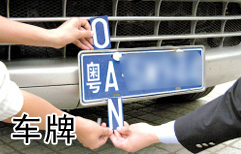
So what's OAN?...Owner Applied Number? Old Abbreviated Name?

bababardwanMarch 2, 2011
hehe, you've got me mate. I've no idea about that....either how it means now in Latin [is it an acronym?...I've never heard of it], or how that is likely to be the answer to why it's on the lesson avatar, or whether there's some joke I'm missing here? Are you just pulling my leg? Please explain. :)
bababardwanMarch 2, 2011
oh, I see you've edited....hoc anno....ok so you're not joking. yeah ,hoc anno is this year, but how do you get OAN thus?: hOc ANno? ...and is that really an explanation of the avatar?
kimiikMarch 2, 2011
This is not the most common latin abbreviation but I saw it before.
O for hoc and AN for anno

rodsMarch 2, 2011
Well, it would seem our Korean friend and his partner just pulled a bank job, and now they're planning to alter their license plate in order to facilitate their getaway. The trouble is they can't decide whether to remain in "A" (Guangzhou) and try and blend in, head to "N" (Shanwei), or to go with the gutsier option "O" and try and pass themselves off as members of the Guangdong Provincial Public Security Dept.
Personally, I'd advise against "O". Seems risky. They might consider ditching the car and heading to "Z" using public transit(?).
https://secure.wikimedia.org/wikipedia/en/wiki/Vehicle_registration_plates_of_the_People%27s_Republic_of_China#Guangdong

meihuar2006March 3, 2011
"OAN" also can mean "a race of aliens, native to the planet Oa, who self-appointed themselves guardians of the galaxy, and host the central power battery employed by the Green Lantern Corps." In other words, maybe it is a product placement for the upcoming Hollywood "Green Lantern" movie.
Hey, discrete, non-intrusive product placement, it's the future of advertising.

bababardwanMarch 1, 2011
The 7th column in this:
https://en.wikipedia.org/wiki/Province_(China)
wikipedia article has the abbreviations.
What did you notice in this lesson?
You are posting as a guest. Your reply is reviewed before it appears. Log in to post without review.