BangWoMarch 10, 2013
Quick Question: Shouldn't the following sentence use 'hui' instead of 'yao'?
明天可能要下雨.
明天可能要下
明天可能要下雨
明天可能要下雨。

daenafNovember 18, 2012
1st expansion sentence"你衣服的拉琏没拉" translated "your pants zipper isn't zipped". I thought from other lessons (e.g. 'Mailing a package at the post office') that 衣服 only applied to upper body clothes?

TomMangioneNovember 20, 2012
没错!It looks like there's a mistake in the translation here. We've changed the translation from "pants" to "jacket" to reflect the fact that 衣服 applies to upper body clothes.

karlovacNovember 30, 2011
The expansion (and exercises section) contains this example:
míngtiān tiānqì yě bù hǎo.
I've listened to the audio version to it several times, and I cannot hear the "ye" at all.

bababardwanNovember 30, 2011
karlovac,
just had a listen to the expansion for you. It's definitely and quite clearly there. Don't forget that yě is third tone so be on the "lookout" for a much lower sound after tianqi. Keep listening, this happens to all of us but eventually you hear all the sounds.
karlovacDecember 12, 2011
Thanks for the follow-up bababardwan. I guess my ears aren't fully tuned to Chinese tones ;)
mrzhouNovember 15, 2011
In the last sentence of the dialogue (那个是不是门铃?), the 那/nà sounds more like "nei" to my ears. Is this a normal way to pronounce this character, or is this some kind of local accent?
lujiaojieNovember 15, 2011
In colloquial Chinese, “这" and ”那“ are often read as "zhèi" and "nèi" when followed by either a measure word or a number plus a measure word.
For example: 这个zhèi ge 那个nèi ge 这些 zhèixiē 那些 nèixiē
khunchokNovember 11, 2014
lujiaijie,
your teach is well,please you will teach us more..i like you teach...

anonymous519113April 30, 2011
Hey, 行 as in 拉不行 and 行 as in 银行 are the same character, but with different pronunciations. Is there any interesting reason for this, or is it just an anomaly?

tingyunApril 30, 2011
Most characters have multiple pronunciations - its usually just a question of whether they've lost them in modern use. Older Chinese (Tang and such) really liked to distinguish verbs and nouns, ie 治 would alternate between zhi4 and chi2 depending on whether verb or noun (this is gone in modern language). 行 might have been similar - 行hang2 is basically the noun road, and 行xing2 is basically the verb walk. 数 is similar - shu4 is the noun, shu3 is the verb. 处, chu4 is the noun, chu3 is the verb. Both of these are doing fine in modern Chinese (though I've known some beijingers to get 处 mixed up in some words - generally, Beijing accent is pretty bad on multiple pronunciation characters, ie 供 seems hopelessly mixed up).
If you want to ask why 行 might have preserved its multiple pronunciations, then I'm happy to wildly speculate. Alot of characters lost their second pronunciation in modern use because one use is uncommon. In giving examples here I really have to go with ones that still have a second one in use when reading classical writings, else I wouldn't be aware - so these ones only lost their pronunciation in the sense that modern chinese dictionaries don't include them (but people still use them in reading older writings). 王 wang2 has the alternate wang4, a verb to institute rule by kingly principles. Not gonna hit that one often enough to really preserve. 数 has a pronounciation cu4 meaning dense, in the context of nets, and showing up once in Mencius. Then there is the interesting example of 骑 - qi2 for the verb to ride, ji4 for the noun - a horse, or a horseman. Except in the modern dictionaries approved in the new china they eliminated the ji4 pronounciation, probably because they figured we don't talk much about cavalry anymore (pretty much the only context it was used). Yet most people still remember the pronounciation, are unaware of the change, and it definitely gets used both ways in older dramas. I'm curious as to whether it will disappear in the next 100 years.
BTW, to really appreciate how many characters have multiple pronunciations, you just have to go to place names. Take 共gong4 for example, its gong1 in meaning a certain ancient nation's name. 宛wan3 is yuan1, also in certain ancient names. 并bing4 is bing1 in 并州, an old province name. BTW, tv shows get these wrong something like 70-80 percent of the time, so I'm guessing these are being slowly forgotten too, as people become increasingly unaware of them. And none show up in modern dictionaries to my knowledge...
But 行 seems safe - both are common enough to be preserved. BTW, just for fun, note that 行 has the third pronunciation of heng2 in 道行, meaning the achievement/level of a daoist priest...;)
handaigradMay 1, 2011
I know this is for people who are learning Chinese, however, I feel it would be interesting to note that the Japanese language that adopted the Chinese characters usually have two or more readings per character. Additionally, the meanings differ greatly based on which reading and context. Just as a side note.


BrokenswordApril 21, 2011
Slightly off topic but anyone can point me where I can find the grammar lesson 的 vs 得?
多谢。

chrisApril 22, 2011
Hi Brokensword, there is a Qing Wen episode (QW106) covering 得 from a couple of years ago, but I don't recall if it also covered 的。I've tried to insert the link below:-
https://chinesepod.com/lessons/howre-you-doing-%E5%BE%97
BrokenswordApril 23, 2011
Thanks for this chris. 得 lesson on that qingwen is about its post-verb use. I hope I can find something like a comprehensive lesson 不 vs 没/没有 like this:
https://chinesepod.com/lessons/negating-verbs-when-to-use-%E6%B2%A1%E6%9C%89-meiy%C7%92u-when-to-use-%E4%B8%8D-bu
But that qingwen lesson is full of really nice examples and new vocabulary for me.
谢谢!

ejrungeApril 21, 2011
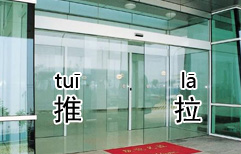
Good Lesson. Very simple, but I learned some new characters. I always wondered what 拉 and 推 meant, maybe will save some embarassment in the future. Also, 怎么回事 has a good ring to it.
bertson135April 21, 2011
'Expansion' de jùzi shí sì yīngwén fānyì shì "Do you also want to go abroad?"
watyamacallitApril 21, 2011
For 5 days, all you have done is 'correct' the English translations in the Expansion sentences. You seem quite convinced that your translations are correct and that Chinese Pod's are wrong. In your profile you say that you are an Elementary learner, and this is quite evident. The alternative translations you have provided range from trivial rearrangements, to ones which are plain wrong. In this case, the translation provided is perfectly correct. You have clearly not yet learned how to use 要-yào to express future intent. I think you should also learn how to use 第.
keyclickApril 21, 2011
Too funny! You are right, he spent 5 days straight correcting translations in some cases 5 years old! Thes translations are meant to be idiomatic, not always word-for-word. Wait, I have an idea... in a recent News and Features, I heard the translator job will be up for grabs when Jason moves to Taiwan! Perhaps Bertson could apply for the job!
user9476April 21, 2011
Great lesson! Concerning the locked door, instead of
可能锁了
could one say
可能是锁的 ?

jbagsApril 21, 2011
The character for pull 拉 I found especially easily to remember because it is used very often on mainland Chinese World of Warcraft servers, when it's used to mean 'to summon'.
可以拉我吧? - Can you summon me?
拉人,我们马上开始。- Summon people, we're about to start.
Perhaps a bit of a nerdy anecdote, but it certainly made it easy to distinguish between 拉 and 推 !

kong_yiApril 20, 2011
Its always a funny experience when intelligent human beings are outwitted by a door. Great lesson ChinesePod.

cinnamonfernApril 20, 2011
There's a door at my university that has pull-type handles, but it is a push-to-open door. (The door also says both "push" and "推".) Yet I always try to pull it open and every time I think of this...
The Far Side by Gary Larson


bluesky3064April 27, 2011
Reminds me of the "less than positive" way to describe someone:
'Going through life pushing doors marked "Pull"....'

cosa_nostraApril 20, 2011
I wonder, is there a contextual link between the first two expansion sentences?



What did you notice in this lesson?
You are posting as a guest. Your reply is reviewed before it appears. Log in to post without review.