aisiniSeptember 11, 2011
what's the difference between 之前 and 以前?
Are they interchangeable?
ps really like and appreciate the "grammar' tab


stevemischSeptember 6, 2011
Hi Team,
How long between new lessons these days? Seems this one has been here a long time.....
Thanks,
Steve
jennyzhuSeptember 6, 2011
We publish a new lesson everyday. But the schedule between levels alternates, i.e. you might get an elementary on Monday and the next elementary the following Wednesday.

otter1206August 26, 2011
I always enjoy listening Jenny and John's lesson
I am newbie but I tried this lesson
Many questions were rising on mind
1. I think the first line is past-tense, so I thought at first that 了should be put at the end of the sentence -你以前住在哪里了 like this, but it didn't. So it is confusing.
2. Another question is that like the lesson(Newbie-how long in China) 你在北京呆了多久了
Can I say "How long have you lived in Beijing" =" 你在北京住了多久了?" or "你住在北京了多久了?"
3. last question, 我也是 is me, too. then 你也是is you, too. so can I use that in the situation like "Good night" "You, too" " 晚安" "你也是"
Thank you
jennyzhuAugust 27, 2011
1. 了 can't be universally applied to all verbs to indicate past tense, e.g. verbs which indicate a prolonged action such as 住 shouldn't be coupled with 了 。On the contrary, they don't require 了. The tense is implied by the context and time words such as 以前.
2. Verb+了+多久了 indicates a present continuous tense, somethings which started earlier and continues to the present. Remember 多久了 as a set phrase . 你在北京住了多久了?" is correct 你住在北京了多久了 is not. 了 should come after the verb in this type of structures.
3. You can use 你也是 in this kind of situations.
otter1206August 28, 2011
I am really thank you for your nice replay , Jenny .
and another question hits me about 了
then, verb like 去, I wanna say "did you go to the bookstore, yesterday?"
I'd say 你昨天去书店了吗?(ni zuotian qu shudian le ma?) or can I say 你昨天去书店吗?(cause like you said, the time word here is obvious here so they don't need 了?)
no need 了 is just applied to verbs which indicate a proloned action ?
sorry for question bombing :)
thesedays I am confused with the past tense
thank you
jennyzhuAugust 29, 2011
你昨天去书店了吗?is correct. The sentence structure is verb+noun+le. 你昨天去书店吗? is not correct. Please see the excellent explanation on Oxford University's Chinese department's web page regarding the use of 了. http://www.ctcfl.ox.ac.uk/Grammar%20exercises/Summary%20on%20LE.htm


kaixin_in_tampaAugust 26, 2011
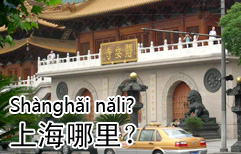
Maybe it's common knowledge but I didn't know that Chinese used to be written in columns, from top to bottom, and then from right to left. The sign in front of the 静安寺 (Jing'An temple) sticks with tradition.
"Historically, vertical writing was the standard system, and horizontal writing was only used where a sign had to fit in a constrained space, such as over the gate of a temple or the signboard of a shop."

Jess_AndersenAugust 26, 2011
The only thing I know about Shanghai is that I don't like the train station. Buying a ticket was a nightmare.
eion_padraigAugust 25, 2011
I love that John mentions Windows 2. I must say I practiced my Chinese there a lot back in the day.
Also there used to be a good clothing market behind Jing'an Si many years ago which I assume is gone by now.

JohnAugust 26, 2011
No one is proud of having gone to Windows 2, but it still has a special place in the history of Shanghai's nightlife. :)

karenshaneAugust 25, 2011
I think you guys do very good job. I listen to a lesson all night long. The more Chinese the better. Like if you mention how Chinese say the word Burger King and what makes the Burger King different in China than in the West these would be great for my nightly Chinese absorption.
jennyzhuAugust 25, 2011
Burger King is 汉堡王/hànbǎowáng. We actually have an upcoming Qing Wen show on translation of foreign brands in Chinese. You will find the Chinese for a few major fast food chains amongst other brands.
karenshaneAugust 28, 2011
Thank you so much Jenny. I appreciate you taking time to answer questions, I will keep an eye out for your new lesson :)
karenshaneAugust 25, 2011
Great job guys, I learned a lot.
I was wondering is it possible to add more Chinese to your descriptive discussion. For example Jon said he walked down a certain road and past a park and said the Chinese word for the road and park. So it would be nice if Jenny would do something similar like say the Chinese word for glitzy shop, or cbd.
thanks
jennyzhuAugust 25, 2011
The amount of Chinese we use in our banter depends on which academic level the lesson belongs to. At newbie and ele, we limit the amount of Chinese used outside the lesson to keep the content comprehensible and digestable. But we also include level appropriate words such as the ones John said whereas glitzy shops and CBD are not elementary words (shops are, 商店/shāngdiàn). In intermediate you will notice I use almost all Chinese to explain things with John providing the translation.

ejrungeAugust 25, 2011
You touched on many of the interesting aspects of Jing An district. One of the subway exits is home to maybe the world's shortest escalators, I think only 11-12 steps. I have to admit that I have never gone inside the temple.
JohnAugust 25, 2011
Ha ha, it's so funny that you bring up that escalator. I personally always found it ridiculous and like to point it out to visitors, but I wasn't aware of anyone else taking note of it.

RJAugust 27, 2011
see the worlds shortest, and yes, also get a peek at the longest one in the world:
http://english.lacaterinca.com/2009/02/worlds-shortest-escalator-and-the-worlds-smallest-escalator/
Here is the escalator of which you speak:
http://www.debritz.net/node/955
masine145August 25, 2011
Very nice lesson and podcast, but perhaps a mention might have been made why the next-to-last line in the dialogue is translated in the past tense? I know why but an Ele might need a reminder.

matthewrudyAugust 25, 2011
Maybe you can explain masine.
I assume it's just the context is obviously in the past?
kaixin_in_tampaAugust 25, 2011
Map of Shanghai districts
静安寺是一座佛教寺庙。 - Jìng'ān sì shì yī zuò Fójiào sìmiào. - Jing'An temple is a Buddhist temple.
位于南京西路 - wéiyú Nánjīng Xī Lù - located in West Nangjing Road
matthewrudyAugust 25, 2011
I must say I found the temple to be a bit too pristine.
A bit disneyland, i dare say.
jennyzhuAugust 25, 2011
Jing'an Temple was a very modest-looking temple in my childhood. All the golden touches were added quite recently. Oh, beware of the fake fortune tellers outside the temple.

xiao_liangAugust 26, 2011
I really liked Jing'an temple. Particularly it was fun watching people trying to throw all the coins into the centre tower.
I loved how you could look up and see these ultra modern buildings framed by this ancient structure.
kaixin_in_tampaAugust 26, 2011
Yes, a lot of people say it's not very authentic. The one day I went the monks led the faithful in a ceremony, there was chanting, etc. For someone who has never been to a Buddhist temple -like me- it's a very nice experience, and very convenient since it's so close to the subway station.
kaixin_in_tampaAugust 26, 2011
I liked it too and agree that in that busy intersection one doesn't expect to find a peaceful Buddhist temple. :)

filbeeAugust 27, 2011
I remember being at this temple a few months ago...around that shrine thingy was a fence with a sign saying "Please do not throw coins" ...There was at least 5 people around it trying to get their coins as high as possible on the shrine hahaha.... No mortal fence was going to stop the acquisition of divine good fortune!
akalovidApril 4, 2012
Thank you for revealing to us the most glamourous parts of Shanghai. That was very funny ;-)
turksoldier11August 25, 2011
would it be acceptable to say 我也住了 instead of 我也是?

lujiaojieAugust 25, 2011
"我也住了"sounds weird.
You can say:
我(以前)也住在静安区。
Wǒ (yǐqián) yě zhù zài Jìng'ānqū.
jennyzhuAugust 24, 2011
Jing'an (the Westgate Mall to Shanghai Center end) is full of Sex and City-esque Shanghai women and expats looking like Don Draper in Mad Men. A great place to people watch.

tomwilberAugust 27, 2011
Yes. I remember walking along 华山路 toward 昌平路 and 静安公园 and seeing...Jenny Zhu!

What did you notice in this lesson?
You are posting as a guest. Your reply is reviewed before it appears. Log in to post without review.