gracechen7874May 15, 2019
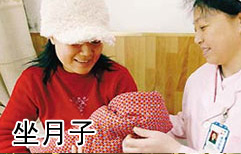
that is a good topic, I just heard just Chinese woman has lying-in after confinement in childbirth , is that true?
bohan2007March 8, 2013
Does 产妇 mean a woman who has already given birth, or can it also mean a pregnant woman, or a pregnant woman in labor ?

angepangeFebruary 10, 2012
I never did the yuezi thing, people always asked me if I wasn't doing it, but they kinda understood that I don't since "we foreigners don't have that custom". But I think next time, I am gonna order yuezi food delivery to my own house, I loooove the food, if someone can eat chicken soup for a month - it's me!
But one thing confuses me, if you just had your baby, for many your first and only baby. Why don't you, especially as a mother, want to spend time with your baby? getting to know him or her? Creating a BOND? My thoughts is get that ass out of bed, dress in something else than a pyjama, go outisde for a walk with your baby so both of you get some fresh air! (imagine just staying inside for a month? and some friends of ours didn't leave the house for 4 months!). No wonder you're tired! A helper could be good yes, but not to take care of the child, that is your child to love and protect, let the helper do the cooking, cleaning and washing instead. :)
oh, and I loved the 生化湯 as well. Good stuff. I also use it during the menstrual periods and it really works, that is something that should be introduced in western countries. That and the food.

henningNovember 18, 2011
按照中国传统来说一下的算一个适合生产妇方法吗?
http://www.wenxuecity.com/news/2011/10/10/1494533.html
:P

bababardwanNovember 14, 2011
Interesting discussion. But I'm most interested in Jenny's comments. As Zhenlijiang has suggested, we don't know just how serious Jenny was when she said:
"Yuèzi was the darkest days of my life."
...and I think this comes to the crux of it. Why were they the darkest days, and what depth of feeling is really behind those words?
The idea of having a month of rest after birth sounds quite appealing especially having others to slave over you. But I'm guessing the restrictive nature of it could be a bit oppressing. Also, some people aren't comfortable with having others look after them [or perhaps they're not on an outward level, but if it's culturally the norm then that may make it ok to be comfortable with]. There are of course non cultural reasons for them being dark days for some...such as the baby blues...post natal depression.
But it was interesting to read Jenny's take on yuezi and see it in it's historical context and also that she was following to keep her mum happy. I suspect this may well be why a lot of traditions such as this continue. So what would be most interesting to know is whether her mums views on yuezi were the same [I suspect her mum may have had more belief in the significance] but more to the point, and here's the question, would Jenny expect a daughter of hers to adhere to all of yuezi's customs regardless of her daughters comfort with it? Of course I don't want this to get too personal and I respect Jenny's privacy and thank her for being so generous with sharing in this lesson. But at least in general terms I'd be interested to know how many modern mums will expect this tradition to continue in the next generation.
bababardwanNovember 21, 2011
btw, the above was an accidental triple post when the connection dropped out and had trouble reconnecting for some reason, so feel free to delete the 2 redundant copies

RJNovember 13, 2011
I don't believe in much I cant measure, or at least see the direct consequences of, but cultural traditions are way complex, and involve much more than just medicine or the stated reasons for practicing them. Some sensitivity and respect are required here. If you would have asked me when I was 25, I would have been sure it was all crap (I was a lot smarter then). Today, I know love is good medicine.
In this article (link posted below) for example, nurses are urged to acquire some cross cultural training so they can be more "culturally competent" during the hospital stay of mothers of differing backgrounds. Its hard not to be sympathetic.
The article touches on some interesting factors and mitigating complexities, such as those mentioned in the following comment:
"In the traditional non-Western view, birth is part of a holistic and personal system, involving moral values, social relations, and relation to the environment, as well as the physical aspects. Birth ceremonies often are used to recognize the importance of the event in the culture. Special foods are prepared to express the reward of motherhood, as well as to symbolize a new baby's entry into the family and community".
http://www.nursingcenter.com/prodev/ce_article.asp?tid=408218
Some aspects of yuezi should probably be taken as what they are, things more relevant to circumstances long ago, but this is a personal choice, based on more than just science. I am now comfortable leaving it at just that.

guolanNovember 13, 2011
RJ, I like what you said. Well put. I also find that, the older I get, the less black and white I can see. Maybe a part of wisdom is becoming less certain about the things we know for sure!

zhenlijiangNovember 14, 2011
Agreed with guolan. Love is good medicine--well said!
Thanks for the article. The author shares her own experience which is especially interesting. She says:
Although as a nurse I had been educated in Western postpartum practices, I found I still believed in the traditional Korean postpartum practices, whether or not they had grounding in Western medical theory. She doesn't explain that further or try to argue the scientific validity of her position. I wonder what she would have to say if pressed to explain what made her still believe in the traditional Korean ways.
ahjuhssiNovember 12, 2011
Wow, interesting topic. Pregnancy, yuezi, religion, science...
I have three kids and the first two months (of each kid) were the "darkest days" of my life (as a husband)--not because my wife didn't shower or wash her hair for two months, butdue tolack of sleep... Of course, mothers have it worse because their bodies go through so many changes during pregnancy, not to mention all the nutrients they are robbed off by the little ones.
Just for clarification, my wife did shower and washed her hair after few days of giving birth (thank God!), but we made sure it was a nice and hot one. Koreans practice something similar to "yuezi" tohelp the body recuperate faster. Though not scientifically proven, keeping the body warm helps the stretched bones to reposition to its original position faster. We also eat seaweed soup after giving birth to help restore nutrients. Some go the extra step of taking the nasty tasting Chinese medicine (hanyao). Keeping the body warmapparently helps to prevent arthritis later in life.
On religion, I believe that true faith can actually set you free.
On Science, Einstein once said, "Science without religion is lame, religion without science is blind."
Just wanted to give my two yuan (which is about 31 cents)

dahouxiaohouNovember 11, 2011
interesting conversation.
call me low-brow, but "Tiger Penis"! ROFL!
你们一定要写一节课关于中医这方面!
john能用经验写吗?是不是你的darkesthour?嘻嘻哈哈
livinghereNovember 10, 2011
Can I clarify, are all three speakers woman? It sounds like the "Ayi" is a man. Maybe completely insignificant, but just looking for a clarification.l

jennyzhuNovember 10, 2011
She is mostly positively a woman. It's voiced by one of our female co-workers. I won't tell her you said she sounded like a man...

GrambersNovember 10, 2011
To get away from the politics and controversy for a moment, can I just say thanks for an excellent explanation of 才 in the grammar section. It's one of those words that I've struggled with for years and never really mastered. This may just get me there!

toianwNovember 10, 2011
I wondered how this series passed me by. Turns out it's almost three years since this girl got pregnant. No wonder she's so keen to get up and about:)
bababardwanNovember 10, 2011
"No wonder she's so keen to get up and about:)"
hahadaxiao. Bushi yige yuezi, shi ge sannianqizi
jennyzhuNovember 9, 2011
My take on yuezi is that the custom must have made sense hundreds of years ago when people didn't have running water and electricty. They probably had to go to the river to take a bath, which would be hard for someone who's just given birth. I also guess Chinese women typically had to work very hard all their lives taking care of children, parents, husbands and do farming as well. Yuezi was the only time of rest and peace for them. Of course to completely follow the old way of doing things is impractical and unnecessary. (There are indeed a lot of Chinese women who do shower and wash their hair during yuezi.) But people still honor the tradition, which is one of the few things that survived the tumultuous modern PRC history.
GrambersNovember 10, 2011
This sounds like a very rational explanation, Jenny, and I totally understand the urge to honour traditions. But, to my mind, most people who 坐月子 are not doing so to honour tradition. They are doing so because they are cowed by the threat of future health problems etc.etc. They are scared by superstition, and this is the point where I can't really accept Yuezi as a cuddly 'cultural' artefact anymore.
Don't get me wrong, having witnessed childbirth twice and helped my wife recuperate (though probably not very well), I do appreciate how tough the process is, and how resting is important. But imposing what seem to be arbitrary and unscientific conditions on the process (in terms of diet, hair-washing, number of days etc.etc.) seems 'unnecessary', to put it mildly!
malaccaNovember 10, 2011
talking about superstitions, you will find there are quite a lot of similar superstitions (maybe not on yuezi) in East and West . And whatt about religions?. They have also there superstitions that are nowhere scientifically explained. Christianity is no exception.
GrambersNovember 11, 2011
I couldn't agree more. This whole discussion has echoes of the never-ending Religion vs Science debate, and - as you can guess - I definitely come down (mainly) on the science side of things. That said, I do think it's worth making a couple of important distinctions on the religious side of things. While all religions ask followers to believe in a central myth that, almost by definition, cannot be scientifically proven, different religions use the faith that is generated in different ways. Some religions (the Catholic strand of Christianity springs to mind) use this faith to enforce rules and regulations which are restrictive, and fundamentally negative in the way they play constantly on 'fear'. Other religions use the same 'unscientific' basis to promote compassion, understanding, joy etc.etc. and which can be described as fundamentally 'positive' in their outlook. I guess I could go further and say some PEOPLE use religions in these two different ways (ie. there are some very good Catholics and some quite dastardly Buddhists, I'm sure). I wouldn't sign up to either, myself, but I see less of a problem in superstitions which are used for compassionate and humane ends, and those which are used to frighten people.

bodaweiNovember 11, 2011
Hi Grambers
'imposing what seem to be arbitrary and unscientific conditions on the process (in terms of diet, hair-washing, number of days etc.etc.) seems 'unnecessary', to put it mildly!'
This and your Religion versus Science debate comment below makes me reflect on the whole hair-washing thing that Zhenlijiang has already commented on. Any number of those pseudo-scientific shampoo ads went through my mind. Some advertising commentators recently made the point that shampoo ads are the least honest advertisements of all (and they have some stiff competition.)
A few years ago I had to consult a Western trained skin specialist and his advice was (a) never use soap unless you have just finished changing the oil on your car, (b) there is absolutely no scientific evidence supporting the use of hair shampoos. I have taken the 'no soap' advice to heart - in most circumstances it is only harmful for your skin. I use shampoo occasionally for unscientific reasons.. :)
So, what I am saying is that there is no science at all in your standard Western behaviour that has new mothers washing their hair.
zhenlijiangNovember 12, 2011
Ah but I don't agree with Bodawei on the shampoo! At least I would question what the purpose is, the desired result, that has this skin specialist declaring that there is absolutely no scientific evidence supporting the use of hair shampoos (on the ads and such products made available to the mass market, I agree). I'd like to hear him support that view in a debate with my hairdresser of 16 years, a hair specialist obviously. And she's all about the science.
I also wonder how good his hair is. I know yours is very good Bodawei (seen in pictures), even without considering your 年龄!
And so those signs you see in the bathroom in restaurants saying that employees are required to wash with soap after using the bathroom are meaningless as well?
bodaweiNovember 13, 2011
Hi zhenlijiang
On shampoos I think that he was 'agnostic' - along the frequently repeated line that shampoo strips out necessary oils and then a conditioner adds oils back in. So it probably does not do a lot of damage except to your wallet. If you don't wash your hair at all it naturally balances after (an uncomfortable) time.
Soap is bad for your skin but helpful in some situations such as when you get really dirty because it de-greases. A disinfectant will kill some bugs that are harmful. So you would like the nurse/doctor at a clinic/hospital to wash their hands between patients. In some jobs (eg. kitchen hand, doctor) you have to wash your hands frequently with soap. Still most people don't wash their hands effectively even with soap - surgeons who 'scrub in' before surgery have got the right idea I think. Time scrubbing is an important factor.
We could get onto toothpaste, which is even less useful than shampoo.. :)
I do however believe in moisturisers!

babyeggplantNovember 13, 2011
I agree that washing your hair does strip it of natural oils, but I'm still not convinced that the no 'poo method works for everybody. I tried it for a few months in college and usually made it for about a month before giving in and washing my hair. My hair is thin and fine, so by a month it was absolutely disgusting. I kept waiting and waiting for that "detox" period to end, but by the end I still hadn't noticed a difference in how oily my hair was. I would love to give up shampoo, but I'm not sure I'll be able to try it again unless I can hang out in a cave for a while without having to worry about work or meeting people.
bodaweiNovember 16, 2011
hi babyeggplant - is cutting your hair off an option? I agree that waiting for your hair to 'balance' is a trial. i did go six months once .. then i tried just washing it with water. now i try to just abstain between haircuts. :)
babyeggplantNovember 20, 2011
So are you saying that in the first six months you didn't use anything to wash your hair? Not even water? That is hardcore.
bodaweiNovember 20, 2011
I was hoping it would go into dreadlocks, but I didn't do my research.
Actually I think I mis-represented the situation above, during the six months I occasionally washed my hair with water. After six months I went back to shampoo, but rarely - I generally just washed with water. Now I keep my hair so short my theory is that it doesn't need to be washed. (But I envy those bald guys where there is no argument.)
The gel/wax fashion helps out - it kinda looks like it's got 'product' in it.
Can we get off this subject now?? I sound like I'm hair obsessed. :)
guolanNovember 9, 2011
Grambers, soon after I learned about the many different perceptions (different from American perceptions) of how to stay healthy in China, I learned the phrase "可能是体质不一样吧". After I present my (American) ideas about a health issue, and my friend presents her (Chinese) ideas, the simplest thing to do is to simply recognize that we disagree, and that it's okay to disagree, and to move on. But, if my friend is uncomfortable without a resolution, I use the phrase above to recognize that I don't know everything, and that mabye there is something different in the ways our bodies work. It saves everybody face, and no one comes across as rude. After all, you won't change anybody's mind, no mater how passionately you argue your point.
GrambersNovember 9, 2011
Sorry Jenny. I know I sound very dismissive of your (very real) experiences, and I don't enjoy being rude (even though I probably sound it in this instance). However, as you can tell, I fairly convinced that you suffered for nothing. I guess my main evidence is that 85% of the world's female population do not observe 月子 and the vast majority are living healthier and longer lives than ever before.
GrambersNovember 9, 2011
Call me an unreconstructed imperalist, but 月子 has to be one of the lowest of the low points in China's cultural landscape - truly, the Turpan of Chinese thinking. There is so much we can learn from the ancients; Chinese ideas on politics, philosophy, matrimony, warfare etc.etc. echo down the ages and reverberate even today. However, staying in bed for a month, drinking soup and not washing your hair, all on account of having gone through THE most natural process it's possible to conceive of (pardon the pun)...well, it doesn't quite compare.
Listening to the dialogue, my thoughts drifted - slightly perversely - to the Aztecs who, as you may know, were entirely convinced of the need to offer human sacrifices on almost a daily basis in order to appease the Gods and sustain their civilisation. They too were utterly convinced that should any aspect of their bloody little routine be overlooked, calamity would befall the State. Funnily enough, no aspect of the routine was ever overlooked, thousands died in an almost unimaginably brutal manner and, you guessed it, calamity befell the State anyway.
Human sacrifice and 月子 may look to be fairly poor points of comparison but they are, I would argue, at opposite ends of the same scale - the scale of irrational superstition.
I shall learn the phrase "封建迷信思想" by heart. It seems to me a very fine description!
bodaweiNovember 9, 2011
'月子 has to be one of the lowest of the low points in China's cultural landscape'
Hi Grambers .. a touch dramatic, 对吧?
It is not the substantive matters that I would take issue with you on, although I see nothing much wrong with not washing your hair for a month, or six months for that matter. Judging an aspect of culture 'low' is fine by me too (hey, we all do it, and in Australia we are expert critics of foreign cultures) but what is your test here? Is anyone seriously hurt by these behaviours?
One could perhaps be critical of the behaviour common in the West of being back on deck at work a week or two after birth, surrounded by nannies, breast pumps, and smart phones, all necessary to keep the economy ticking over.
We have two behaviours at either extreme of one dimension of culture.
guolanNovember 9, 2011
Good point about the being back to work after a week off! Somewhere, there has to be balance, eh? But we human beings seem to dislike balance, and to swing to either one end of the pendulum or the other!
GrambersNovember 10, 2011
"What is your test here? Is anyone seriously hurt by these behaviours?"
My test? I would probably say the extent to which the culture creates 'unnecessary discomfort and suffering' - the word 'unnecessary' is key here, as discomfort and suffering is part of life and to be embraced as such. However, when it is needlessly hoisted upon a person because of misguided and irrational beliefs, this is the point at which one needs to step back and rethink.
Is anyone "seriously hurt". I think we need to define 'hurt'. Let's not forgot, Jenny began this discussion with the words: "Yuezi was the darkest days of my life." She seemed serious. You might say, well, she wasn't really 'hurt'. Well then, by the same token let's agree the majority of African slaves were not really 'hurt' by their enslavement. They were just denied liberty and made to work jolly hard for somebody else's profit, but most lived lives that were moderately healthy and did not experience pain over and above what another person of that era could expect to face. If you want to factor in the 'psychological' pain, well, then I think you would be making my point for me.
'Culture', when properly grounded, imparts joy, creates meaning and offers the tools which can help a person understand the world, forge relationship, create identity and endure hardships etc.etc. Culture which takes a blind, unthinking acceptance of past wisdom while denying the possibility of reconstituting its tenets to fit modern situations, well, frankly, it's doomed.
GrambersNovember 10, 2011
Sorry, I thought I'd make this point separately - parse the 'Shock Jock' side of my personality from my more measured and reasonable other half:)
Yeah, I'd totally agree with your take on the Western way. Pretending that giving birth and (even more importantly) child-rearing can take place alongside career with no detrimental effects to either one is frankly ridiculous. Now I sound like an unreconstructed chauvinist but, ah, what can you do.
I guess Guolan is right. These are models of two extremes which both look fairly dodgy to me.
zhenlijiangNovember 10, 2011
Hi Grambers, you don't sound to me like an imperialist, but I'd agree with Bodawei that nobody is really being hurt here. And it seems to me a lot of this science-VS-superstition discussion is about some of (ha, can't believe I am saying this) you Westerners taking it very literally, when modern Chinese invoke these "beliefs" of theirs, when it just isn't meant literally in the way that you imagine.
Down the road when even more young Chinese just can't imagine life before daily showers and hot running water 24 hours, won't know anyone whose homes had no showers--women may well refuse to keep honoring the bathing aspect of the 月子 tradition. [I can say from experience that going four weeks without washing your hair won't kill you, and that it actually isn't that big a deal, if you're staying home all the while and in contact only with family. It is something that can be done.] We're seeing those changes and adaptations as they happen now aren't we? Then when such traditions get lost forever to the comforts of modernization and westernization, we'll bemoan that too.
I also think Jenny was not really being serious, with her “darkest days of my life” remark. Isn't that just a way of saying "I can NOT believe I (a city woman this day and age) actually let myself go without a shower for that long"--?
bababardwanNovember 10, 2011
haha, I'm just glad to see grambers get a rollicking good discussion started.
zhenlijiangNovember 11, 2011
* I didn't do go hairwash-less four weeks for 月子 btw. Guess that wasn't clear. *
Modern city folk with a certain amount of disposable income have choices. And these people (and others as well) choose to endure unnecessary discomfort sometimes. They have their reasons so I wouldn't say it's for nothing.
I read some time back about this 中医 doctor, a Chinese woman who practices in Japan. Expecting Japanese mothers go to her seeking her counsel and prescriptions because they feel her approach is special, offering something that neither western nor Japanese maternity custom does.
I don't think the article mentioned bathing practices specifically. It said that under this doctor's program the women could not drink water for a period of like 10 days or two weeks after the birth. In their weakest moments during this period the patients would call her up, imploring her to allow them a drink of water. She would be firm and remind them they wouldn't have such an opportunity otherwise (unless they gave birth again), and that they really want the benefits of what they were putting themselves through. The thinking is that a woman when she gives birth has the once (or twice-, etc)-in-a-lifetime opportunity to purge her body of various toxins and accumulated wastes and that should not be passed up. A woman who undergoes the process can look forward to a lifetime of better health and well-being. It's her re-birth as well. I can't say how exactly staying away from water contributes to this, but this is a 中医 doctor prescribing methods based on her expert knowledge of how the body works. I don't think you could call her or her patients superstitious, or scared. In fact in their minds their approach is just as scientific. This isn't a proper yuezi with all the confinement and everything of course, but I just wanted to say there are non-Chinese women free of all binds of tradition and social pressure who actually think this approach is a good thing.
GrambersNovember 11, 2011
All good points, well made, zhenijiang. I agree, I think the longer this discussion goes on, the more we get dragged towards a 中医 vs 西医 debate. Now that IS an interesting discussion on which I have similar views; the way many people (particularly in the West) have blind faith in pills to cure all ills without understanding deeper issues is really depressing. On the other hand, Chinese medicine - though it patently has some underlying merit - is full of absurdly superstitious 'kinks' and its users too often seem to draw totally false conclusions about its efficacy (ie. when it appears to work, it's 'PROOF', when it doesn't, it's because some arcane aspect of the preparation wasn't done quite correctly, or the stars weren't properly aligned etc.etc.). I have tried, and I am trying, to keep an open mind on Chinese Medicine. However, the fact it lacks an agreed, testifiable scientific base does trouble me somewhat.
zhenlijiangNovember 12, 2011
Apologies if you'd wanted to stop discussing this! If you hadn't brought it up though, quite likely someone else would have anyhow. As Baba says it's a good discussion.
People may agree or disagree about the Chinese medicine I was going to say. I'm not too interested actually in that debate. I think 中医 is generally held in high regard in Japan but that certainly doesn't mean most of us will go to it to treat most illnesses. To the great majority of us here it's not a one-or-the-other issue, not a 中医 vs 西医 debate. 中医 is another source of wisdom at our disposal, an alternative perspective. I brought up the Japanese women because they are not cowed by the threat of future health problems nor bound by any cultural and societal pressure. They haven't been scared into submitting to a postnatal program of that sort. Rather than “in their minds their approach is just as scientific” though I probably ought to have said that in their minds their approach has just as much basis as 西医 does--because I'm not as big on science as many people seem to be, but that's another debate. Cheers
GrambersNovember 13, 2011
No, no. Please don't take my 'longer this goes on' comment as me getting tired with the discussion. Never! You make some really interesting points. Your stance seems to resemble a (for want of a better word) 'liberal' position, whereby all that matters is how people 'feel' about something - there is no intrinsic 'truth' independent of the human nervous system, and interpretation is everything. I did a course this year with the slightly pompous title of 'Supporting Student Learning In Higher Education' and the basic message was that 'teaching' was 'facilitating' and that meaning and truth comes from 'sharing' and 'discussing' rather than 'imparting knowledge' in a top-down way. It was the polar opposite of the educational culture in China. At certain points I wanted to scream and remind my tutors that, you know, when students are paying (as of next year) up to £9,000 a year to be at university, they might get a little pissed off if all you ever do is say "So, how do you FEEL about this? What do YOU think?" and then nod approvingly at everything they say. It raised in my mind the question of whether, in a world with internet, anyone needs to go to university at all.
There are definitely times where I am drawn to a deeply relativist and liberal way of looking at the world, but these days I find myself returning to a more conservative position where rules and standards matter and that boundaries are set by what the evidence shows actually works, rather than what you think SHOULD work.
Wow, much more of this and people might start assuming I've with the 五毛党:)
OK, so we've done education, medicine, science, religion and now a heavy dose of politics too:) I'm likin' it.
zhenlijiangNovember 14, 2011
Guess I disagree with your reading of my position, haha. I should have said what I mean by "not as big on science as many" though. The reservations I have are not with science or its methods but with the idea some people have that things are proven in/by science. Our "knowledge" is often found to be mistaken and wrong in science, it's happened countless times in the past and it will continue to, right? When I hear someone say "X is scientifically proven", I always want to argue well no, X is just the most reasonable conclusion we're agreeing to draw from what we have at this time.
That's what science is to the human race isn't it. We agree on what our common beliefs and theories are and do further studies based on them, building upon what our predecessors have learned and unlearned, so that the accumulation and revision and expansion can continue and keep making our shared understanding of the world better. I have great respect for the scientists who dedicate their lives to power this process on our behalf. 就是 to me, claims of proof are proof of arrogance (or just misguidedness). We're ever only in the process of learning and I think that's an intrinsic truth. Happy not to "know".
GrambersNovember 14, 2011
I think I can agree with all of that. All fair points, all very well made. All knowledge is provisional because no-one ever knows what kind of variables are gonna be added to the equation which may unpick what we thought we knew. All this is said with the uncomfortable suspicion that I sound like I have just smoked a massive reefer.
For what it's worth, I feel sure that at some future point we will discover through scientific endeavour what it is about Chinese Medicine that makes it so effective. These breakthroughs could be in molecular biology or psychology or some wierd little niche of physics. Clearly, TCM has some efficacy. It's just that it can't be readily explained by Western science right now. But, like we agree, all knowledge is provisional.
guolanNovember 9, 2011
Thank you Jenny and John, for choosing a very interesting topic, and for clearing up lots of confusion I had about the subject! And, thank you Jenny, for sharing with us your own experience, and your thoughts about the topic. I enjoyed this podcast very much.
bodaweiNovember 9, 2011
the text version is missing the vocabulary list - strange. The lesson PDF is fine.
What did you notice in this lesson?
You are posting as a guest. Your reply is reviewed before it appears. Log in to post without review.