
marina169July 14, 2013
我没衣服了 这个‘了’是什么意思?

verazhang100July 14, 2013
The 了 here should be 'changing'. It implies 'I had clothes before'. Similar examples: 没电了。没水了。没钱了。
bohan2007June 23, 2013
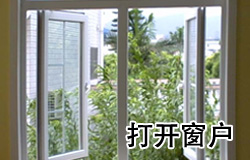
How do we say, "Can you open up one of these windows?" ?

bohan2007June 25, 2013
ok thanks. How would it sound if I say 个 instead of 扇 in the sentence:
你能不能打开一扇窗户?
Better, worse, or the same?

light487March 4, 2012
The simple answer is to wear layers. If it's too hot, strip off a layer or two; if it's too stuffy and you need to open the window, then you can leave your layers on and open the window for a little bit. Having recently spent some time in very small town within the Hebei province during the tail-end of winter, I know the difference between having air-con (proper heating) and having fresh air all the time. You get used to it very quickly.. and then you head back to the big city and almost die from the heat in the shopping malls and other buildings. :) haha
The most common thing I heard in places like that is "leng bu leng?" (are you cold?).. every time someone would meet, come over to visit or whatever, that little catchphrase would come out.. no "ni hao ma", no "chi fan le ma", no "gan me ne".. always "leng bu leng" :) hehe.. After spending time there, everywhere I went seemed warm (or hot) by comparison. Even the sub-zero temperatures around the iced over lakes of Chengde seemed to be bearable when the sun was out; Beijing was didn't feel cold any more (except at night) and Hangzhou/Shanghai were like paradise by comparison.
I'm back in my office in Sydney now and the 21 to 22 degrees (celcius) we constantly have in the office feels cool.. and at times a little chilly when you sit on teh air-con for so long. It's interesting how the body can adapt so quickly.
That double "le" sounds very logical but I'll have to explore it in a little more depth before I get as confident to use it as I do my "yòu (adj) yòu (adj)" and other set syntax chunks. Are there any other lessons that use this double "le" in the same way so I can hear it used more?
flamesyMarch 1, 2012
I have had this exact experience with my in-laws in Taiwan. At CNY, they like to sit in unheated rooms with coats on and all the windows open. Thanks for letting me know I am not alone in this cultural confusion.

chrisFebruary 25, 2012
A question on the ba3 structure. In the Grammar tab, we have the formula:-
把 (bǎ) N/Pronoun V [other]
It is the [other] that I often struggle with. The Grammar tab goes on to say that the [other] usually takes the form of a resultative or directional complement. I'm most familiar with using this structure when asking someone to put something somewhere else, e.g. put the book on the table (把那本书放在桌子上). In this example, the [other] is the 在桌子上, i.e. a directional complement.
What I am getting confused about is whether the [other] can simply be a 了 on its own. From this lesson's dialogue, I assume this must be ok, since in Greg's first sentence we have 你怎么把窗户打开了。
I guess my question really boils down to this: if a 把 sentence is incorrect if there is no [other] after the verb, can we always simply throw in a 了 after the verb to make the sentence correct if we can't think of anything else to put there?
Thanks, Chris.

chrisFebruary 24, 2012
Full transcript being worked on here:
https://chinesepod.com/community/conversations/post/12662
All welcome to participate in the effort.

zhenlijiangFebruary 15, 2012
Just a thought--does this desire to open the window for fresh air have anything to do with fear of death by carbon monoxide poisoning? We have that in Japan, or at least I do, because we are reminded to 换气 all the time during the winter. This differs of course with what sort of heating a home or office depends on. In some homes hot water is provided by gas-burning heaters. I guess some people still heat rooms with kerosene stoves. So we stay mindful not to keep our rooms airtight, to make sure the air can change enough. I don't like to use the fan above the gas kitchen stove, I prefer to open the window for a bit. But such facilities are retro, from another century, and new, cost- and ecology-conscious home heating/hot water systems are available now so perhaps this particular concern is becoming extinct ...In any case "fresh" air here doesn't refer to a level of unpollutedness but to new or different air doesn't it?
peterinchangshaFebruary 19, 2012
Good question. Does anyone know where this obsession for fresh air comes from? (I don't think it's fear of CO poisoning.) I think it must be something Confusian or something? I sure is one of those things where tradition beats common sense.
cowenparkseattleFebruary 9, 2012
In this dialog situation, what is the "air conditioning" doing -- heating or cooling?
susana9February 14, 2012
I may be wrong, but after long experience with this need of Chinese for fresh air, I had come to the conclusion that they felt it was unhealthy to be breathing each other's air in too close quarters for so long--and that they consider it unhealthy because it's easier to communicate illness that way. This doesn't just happen when there's an air-conditioner on--friends visiting my un-airconditioned living room in hot or cold weather will often throw open my balcony doors--rather unconsciously--assuming I must also feel it's stuffy.
But even if there isn't a thought-out logic to it, it's all what you're used to. And if you are brought up with mother throwing open the window every so often to let in fresh air because she says it's healthier, then you naturally feel concerned and worried when you don't have fresh air.
cowenparkseattleMarch 11, 2012
In English "air conditioning" always implies cooling, never heating. That makes 空调 hard to translate.


shanghaichangesFebruary 5, 2012
Could we have a lesson on annual medical checks?
Some expats here don't have the luxury of going to expat friendly hospitals to get their annual medical or "physical health check" done.
It will be nice to try and find out how to ask the nurse or receptionist where should I go in the hospital to carry out the check and also knowing the different procedures that will be carried out e.g. blood check, check weight and height, x-ray, eye check etc. etc.
Hope you can create this lesson in an Intermediate or Upper Intermediate context!


rodsFebruary 1, 2012
I like to open the windows for a bit and let some fresh air in whenever the temperature is warm enough (say, -10° C and up). I'm with the ladies on this one. Maybe John and Greg can buy themselves a couple nice warm toques.

richJanuary 31, 2012
Went to the huge building in Pudong, Shanghai where one handles visas to help my fiancee extend her visa...the Exit-Entry Administration Bureau... it's a huge glass building, and of course, even though very cold yesterday, 1/3 of all the huge glass panels on this building were open...couldn't help but think of this lesson. This image is just a model of it....imagine it with tons of windows open in the winter.

satsarbatJanuary 30, 2012
Since there is almost no maintenance of the air conditioning system in big buildings in China, you can feel very fast that the air is 闷! Also, the materials used for construction contribute to the "inside" air pollution by producing small particles. Whatever is the level of the urban pollution outside, it seems better to open the window regularly to change the inside air. The Chinese way seems very healthy.

GrambersJanuary 30, 2012
Wow, that is A LOT of buildings you are making that claim about. What kind of maintenance is usual in your home country?

veronique21January 30, 2012
7'56: I don't understand the word at the end of the sentence.
为 了 加 强 她 的 what ?


in_montrealJanuary 30, 2012
I could imagine this same conversation, word for word, in my office. Nice to know that this is just the China normal. And I am committing every sentence to memory.
mapleleafnomadJanuary 30, 2012
I am also from Los Angeles and I have this exact same "opening windows" problem in my Chengdu Office. It seems totally illogical to me. Unfortunately, I sit next to the windows in a large cubicle farm: so in summer I experience 30°C with suffocating humidity and in winter I experience 10°C while wearing 6 layers of clothing. In my opinion, it's easier to get sick sitting in 10°C for 8 hours because you're freezing to death.
Besides the issue of heating/cooling efficiency, there's also the air "cleanliness" described above. I have to wipe down my desk and computer fairly often because the particulates from outside form a thick layer of soot on my monitor and keyboard.
Another thing I've observed is that birds have also flown in through these windows - especially if you leave any food-looking like substances around.
I'd offer to change places with the perpetrators who sit in the middle of cubicle-land... but they're bracketed by the cushy air conditioners and sit in "fresh-air, temperate bliss".
Then I face the problem once more when I return home and my Chengdu'ian girlfriend has openend the windows to the apartment all day. There is no winning, is there? =)
veronique21January 30, 2012
As the French humorist Pierre Dac would say: "请 您 把 门口 关上, 外面 冷极了。可是门口 关上了以后, 外面还是冷极了。"If anyone needs to see the French version, just tell me !

hanksJanuary 30, 2012
I see a pattern here which seems to pointing out the irony in the fact that the very same people who are obsessed with having the windows open to get fresh air are the same ones who say nothing to smokers who sit next to them at dinners and meetings.
I am from Los Angeles and I can tell that Shanghai air quality is worse. I have read warnings from Chinese doctors that the air quality here can cause all kinds of health problems. There seems to be another kind of disconnect from reality going on here when my coworkers say they want to open the windows to some get fresh air.
GrambersJanuary 30, 2012
Given the modern Chinese context, there seems to be an obvious failure of logic in the following exchange.
A: 得呼吸点儿新鲜空气。B: 那开着窗
I think a more logical, though not necessarily more practical answer,would have gone.....那就去新疆吧

vitruvianmanJanuary 30, 2012
Comment on this:The Head Doctor at the Chinese Center for Respiratory Infections is leaning against a "no-smoking" sign in the lobby of this center.Go ahead and talk all the talk about "air quality control"...as I walked in, he smiled and offered me a smoke.
How about this one: I go swimming to the University's pool to try to clear my lungs and the swimming coach and the lifeguards are sitting around, again underneath huge "no-smoking" signs, all smoking.
...when I say something they start laughing. When I get angry they get defensive. When I suggest they stop using offensive language, they threaten to call all their friends. When I propose a one-on-one fight, they start calling all their friends...while still smoking.

tvanFebruary 4, 2012
Hello @vitruvianman, the Chinese government is great at passing tough-sounding laws that are never enforced. The passed a law forbidding smoking in all restaurants that took effect last year. No effect. As you say, people light up next to the no smoking signs. It's sort of like watching the police cars running red lights.
Also, your point on one-on-one fights is a good cautionary tale. I've learned that if you get in a serious argument, and the other guy pulls out his cell phone, take it away quick. Kung fu movies notwithstanding, one-on-one fights are not part of the Chinese code of manliness.
getthroughwinterJanuary 29, 2012
interesting topic. I'm a westerner, and I actually enjoy heat on, with the window cracked open, because it feels really good. Here in China, whenever I get on the bus, I've noticed that Chinese people almost never open any of the windows, even when the bus is packed full of people, and the windows have fogged up. I'm usually the only person who opens a window. For offices, I think it's very likely that since Chinese people smoke cigarettes EVERYWHERE, that this causes heaters/air conditioners to smell really gross , and it permanently causes carpets to smell like smoke, so this might be why office women like to open windows . Cigarette smokers are the worst part about China
GrambersJanuary 30, 2012
THAT'S THE ANSWER! Open the window AND put on the air conditioner. The air-con will ensure a reasonable maintenance of comfortable air temperature (though it'll have to burn a few more watts to do so) but the stale air from the air-con will naturally intermingle with the polluted air from outside leading to an approximation of 'fresh air'! Genius:)
Good point, well made on the issue of bus windows. I noticed this too during my years in China. Certainly in Guangdong people are obsessed with opening windows for 'freshness' but the rule doesn't apply on buses. 'Tis a strange one, for sure.

pretzellogicJanuary 29, 2012
I suppose in the interest of fairness and objectivity, one could use data monitoring of the air quality outside vs. monitoring of the air quality inside to determine whether to open the windows, and let the money fly out the window. Certainly indoor vs. outdoor humidity is a concern, but other data about indoor air quality is harder to measure without the approriate tools.


wotingyuJanuary 29, 2012
但是外面的空气也很差
pretzellogicJanuary 29, 2012
Yes, right now the Beijing air PM2.5 is at 127 and ozone is at 186: UNHEALTHY.
getthroughwinterJanuary 29, 2012
I'll tell you one thing about the air in Shanghai. Chinese smokers do a hell of a job making sure that Shanghai smells like cigarette smoke. Not only do they smoke everywhere, they also never put out their nasty cigarettes by stepping on them ; they just throw them on the ground, which is also littering, and the half-smoked cigarettes continue to let smoke out until they completely burn out.
mrzhouFebruary 4, 2012
OK, the outside air may be bad, but does it get any better by being sucked into an air conditioning system and blown into the room?

deroxFebruary 9, 2012
在中国大城市基本上没有办法找到新鲜空气;在马路上有太多汽车,工业污染很厉害!中国人应该尽快了解这个情况,每一个人都要帮助为了保护环境,让中国城市有新鲜的空气。

babyeggplantJanuary 29, 2012
I'm curious about how the Northern Chinese view this topic. I know that in the North, 暖气 is very common. Do people still open the windows there too?
What did you notice in this lesson?
You are posting as a guest. Your reply is reviewed before it appears. Log in to post without review.