
bobm112August 18, 2012
Jenny,
How do you say supply and demand. That would be a great intermediate lesson. Is there an economics lesson. Take care. Thank you!





GrambersJune 25, 2012
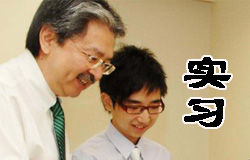
The picture makes the lesson appear less about 实习 and more about 童工...a subject covered at length in the 'Noodles and Child Labour' lesson on March 2011.
he2xu4June 24, 2012
3:23 - 两个 ... 要加 - whatever is in between 两个 and 要加, I really didn't need to understand the meaning, but what is in between? It was spoken so fast, I didn't understand.
I have the same problem with this sort of speed when listening to newscasts. How do you learn how to pick up words spoken so fast?

bababardwanJune 24, 2012
I think it's 都 which would also make sense, but I'm not certain mate. Here, while it doesn't add anything extra to the meaning or your understanding, it adds emphasis to John's question...it's like " why do these two BOTH have to be added"
"How do you learn how to pick up words spoken so fast?"
...good question, and one that is an eternal struggle....but I do think it gets easier with both just plain old listening practice but also a recognition of patterns of speech...it becomes easier to almost predict what's going to be said to the point you don't really need to hear it clearly...like here a dou just slots nicely in as it's often used for emphasis like this. Furthermore, often its the same little culprits that sneak in there in the fast staff...I think there's a limited number of usual suspects, hehe.

markJune 24, 2012
I agree with Bababardwan that the word you missed was 都. It is usually required when referring to a collection of things. (Chinese requires something like "All men 都 are created equal." or more like the sentence in question, "Sam and Harry 都 are created equal.) Mostly, it seems to be grammatically rather than semantically required. I always get corrected when I revert to English thinking and leave it out, though.
My personal feeling is that John, the speaker here, in general, doesn't speak particularly fast. It is not uncommon to encounter native speakers who habitually speak two or three times as fast as he does. However, given that the particle in question is just a bit of grammatical glue, and his Chinese is near native quality, he naturally doesn't spend a lot of time on it.
I'm sure that when you speak English, there are many such particles that you give short shrift to without thinking about it.
Anyway, I don't have any short cut to suggest. Just roll up your sleeves and listen to lots more Chinese.
he2xu4June 24, 2012
Yes, newscasts are spoken much faster than the dialogue here so I've got alot of sleeves to roll up. My complaint isn't about John, he speaks just fine, as it's about my own level of comprehension. I've been at it for a year, I was hoping I'd be able to pick up more than I do know. Anyways, I have been a tad casual in my effort. Time to pick it up a notch.

chrisJune 24, 2012
hexu, if you've only been studying a year and you're at the level you're indicating above, then personally I don't think you have anything to worry about at all. That is incredible progress - particularly if you're not studying full time. Listening comprehension is comfortably my worst area of the four, but I've been studying almost 6 years now and still massively struggle with UI dialogues the first half dozen times or so. This is part of the reason I spend so much time in the cpod transcripts group, just to try and drill my listening skills. Admittedly, I don't study anywhere near full time and have a pretty demanding job to boot, but it always depresses me somewhat that after 6 years I still struggle with UI lessons. So, again, well done on getting to this level in a year!
bababardwanJune 24, 2012
hexu, I have another bit of good news for you on the horizon. I just came across a new word "大鱼大肉" from the expansion of the popup ads lesson. Each character was easy and obvious to me and though I didn't know that expression the meaning was easy enough to deduce from context and it was said at a comfortable speed. However, if I hadn't struck it before now and first struck it at speed, it may have slowed me down slightly and I may have missed something following. Or I might not have caught every one of the four characters, So, my point is, the good news is that as your vocabulary builds, I think you hear a lot of stuff in lexical chunks, so you almost get ahead of the game then. For example, in this instance if I hear 大鱼大肉 again in context, by the time I'm hearing the d sound of the second da, I know that it's likely to finish off with darou to complete the expression and I'm fully primed for whatever is coming after that. [But I'm not sitting around playing guessing games...this process just happens naturally I think] Make sense?
he2xu4June 25, 2012
bababardwan ,
Yes, thanks for the tip and the one above. I can see how the more you spend time learning, the more you easily anticipate upcoming words. I think there's some of that principle in speed reading and obviously, your native tongue.
he2xu4June 25, 2012
chris,
Thanks. To be honest, I'm an ABC and had exposure to the language, although it was mostly Cantonese as a kid, plus church sermons. I didn't use much Chinese since I started university many moons ago, but I still have a bit of a head start in terms of reading and writing.
Anyways when I started, I was more focused on reading/writing, but now realize that I can learn faster listening and talking.

pham11166June 25, 2012
But writing Chinese is an art. I know I can't learn fast by hand-writing again and again but the activity itself brings a lot of joy.
he2xu4June 25, 2012
OK, now that I listened to it again (3:23), it is pretty obvious.
To be honest, with fast English dialogue, like Aaron Sorkin or old B&W movies, I sometimes put the subtitles on.
I'm curious what native Chinese speakers say about quick tempo dialogue like in the movie "The Social Network". I am just able to keep up - I get the words, but so many ideas are expressed in one go, my brain struggles to keep up not with the words, but with understanding the concepts behind the words.
floalvarezJune 25, 2012
Since you learned Chinese at a young age, you have a head start on the language construction and an intuitive understanding on the grammar, and Chinese Pod is a wonderful resource! The more you are exposed to Mandarin the more you will pick up on it. We speak Hookien at home but learn to read Mandarin and Hookien at school. And yesterday at the workshop, the Chinese teachers were chatting in Mandarin and a dialect similar to Hookien. The process is like substituting one dialect with another.
Today if my daughter's 10th birthday. I am taking the day off to celebrate and to rest from the worshop.
chrisJune 23, 2012
I am struggling with the following expansion sentence 2b:-
你放假以后一天到晚不是吃饭就是睡觉,快成猪八戒了
I have the following questions:-
1) I first translated the "放假以后" as "after the holiday was over", but the Cpod translation is "since the vacation has started". Could it be either, depending on context? Or is it definitely "since the vacation has started". How would one make clear that we're talking about "after the holiday was over"?
2) Cpod gives the full translation as "Since vacation has started you've done nothing but eat and sleep all day. You'll turn into Zhubajie in no time". When I tried translating it I came up with "......you've not eaten at all and just sleep all day". I thought the "不是" was referring to not having eaten and the "就是" was referring to just having slept all day. Am I wrong? I just can't get my head round the grammar for Cpod's translation.
3) Are we meant to infer from the name reference at the end that the person's name is simply "Ba Jie", but that the person speaking is saying "Ba Jie" will turn into "piggy" Ba Jie in no time (because he/she is just eating and sleeping all day)?
thanks, chris
bababardwanJune 23, 2012
I can help with the second part Chris.
the bushi is being used in the ...if its not A then it's B sense
[so there's an implied "if" before bushi}. It's a common construct. Now you've noticed it, you'll strike it not infrequently
and Zhu bajie is the character pigsy from Monkey
chrisJune 23, 2012
thanks mate, makes sense. And for the help with the pigsy character! Clearly need to brush up on my cultural references...
floalvarezJune 23, 2012
猪八戒 is a pig character in a famous story called "西游记". If I remember correctly, it is about a monk going on a pilgrimage and faces many challenges along the way 猪八戒 is one of his bodyguards. This is one of those stories that every Chinese child knows about.
floalvarezJune 23, 2012
Chris, I can give you my view:
1) "放假以后". 放假here refers to the start of the vacation, 以后 means after. So this means after the start of the vacation. To say that a vacation is over is, for example, summer vacation, it is 暑假结束了.
chrisJune 23, 2012
What function does the 总 serve in the following sentence of the dialogue:
那助理不给招,招个实习生总可以吧
Does the sentence work ok if we omit it?
floalvarezJune 23, 2012
I think here 总 means the overall picture; after considering the slow market and budget cut discussion . "Overall you can't go wrong with an intern". You can omit 总 and it will simply mean "Could we hire an intern?"
floalvarezJune 22, 2012
下面的词汇对我很有用。现在就跟大家分享一下吧!
供需
gōng xū
supply and demand
衰退
shuāi tuì
decline; recession
floalvarezJune 22, 2012
实习生这个话题使我联想到白宫以前克林顿总统和实习生莱温斯基之间的婚外情丑闻.

chracolJune 22, 2012
I'm not exactly sure what you are saying. I'm just making a joke. Maybe it's not funny; maybe it fell on deaf ears. It's a play on words.
Clinton was hardly a 'playboy'. Throughout his life he dallied, for sure. He was, still is, attractive to women. Lewinsky was smitten and he took advantage but he didn't hold her down. It was voluntary. What he did wrong was lie - "I did not have sex with that woman".
If you are saying, and I may have read the Chinese wrong, that ML was a 'heroic beauty who faced up to difficulty' then I would disagree.
floalvarezJune 23, 2012
I am kidding but referring to a Chinese saying which means that a hero though brave has a difficult time resisting a beautiful woman.
floalvarezJune 23, 2012
Chris, I can give you my view:
1) "放假以后". 放假here refers to the start of the vacation, 以后 means after. So this means after the start of the vacation. To say that a vacation is over is, for example, summer vacation, it is 暑假结束了.
bababardwanJune 23, 2012
no worries at all. I was going to delete my comment once you'd seen it, but I had to duck off and now I've missed my chance. Soz
floalvarezJune 23, 2012
It's OK. Just came back from a workshop about teaching and motivating Amercian-Chinese children to learn Chinese. This is sponsored by the Taiwanese organizations. Got many good ideas which I can work on my daughter too!
he2xu4June 23, 2012
I dunno, JFK was a playboy. 克林顿, to me, was a serial philanderer. But that's a subtle distinction in the eye of the beholder.
In addition to that woman, Ms Lewinsky, there's Chandra Levy. Sad. Very sad. Tragic.
chracolJune 23, 2012
OK good thanks ... we're both kidding (he's a Clinton and she was a Clintern) and now I have a funky Chinese saying that I can memorize for the future ... :))!
hanpihhwaJune 24, 2012
JFK SO was a serial philanderer!
Anyway, why do people in America have such hangups about politicians' extra-marital relationships. Take the newly elected French President, François Hollande. He had an over 30-year relationship with Segolène Royal, the Socialist presidential candidate in 2007 and, inspite of having 4 children together, they never got married. In 2005 Hollande began an affair with Valérie Trierweiler, a twice-divorced journalist with Paris Match, while still living with Royal. François Hollande then dumped her for Trierweiler 3 years ago and now SHE is the official French First Lady and they aren't even married to each other!!!
chracolJune 25, 2012
I'm not sure that they do have a hang-up? Presidents having oral sex in their office is just not such a good look. Not exactly presidential. JFK's antics seemed to enhance his reputation and Clinton remains in the 'inner circle' now no matter whether the Democrats or Republicans are in charge. It's the British who are a little more puritanical but they usually get caught being whipped or chained up to a bedpost in Soho by a dominatrix. Benjamin Franklin and a host of early Amercican Presidents had chequered histories where bedtime was concerned. The South African president is a practicing polygamist and he changes wives and girlfriends like some presidents change their opinions. Of course, when is comes to the French they have always been somewhat loose with their libidos almost as a matter of style. C'est la vie, n'est pas? 人生就是如此!
What did you notice in this lesson?
You are posting as a guest. Your reply is reviewed before it appears. Log in to post without review.