
nietoerickJanuary 23, 2014
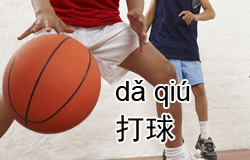
can dǎqiú be soccer?
Thanks,

veronique21January 23, 2014
I think you've got to use a foot to play football / soccer ;-). 踢足球 tī zúqiú would be "to play football / soccer".

podsterJanuary 23, 2014
I think the equivalent of the more generalized dǎqiú ( 打球)would be tīqiú ( 踢球). Although I can't think offhand of any ball sport that exclusively uses the feet other than soccer, so its probably automatically less ambiguous. 踢足球 is of course, also correct as the more literal translation of "to play football / soccer".

verazhang100January 24, 2014
dǎqiú can't be soccer. dǎ+sport should be something you play by your hand. If it's American football, it works.
giu79February 9, 2013
Hi
this is not a big deal but my two Chinese teachers (north east China) keep correcting me when I say that I am learning 中文 and I should be using 汉语 instead?
Thank you
Giusi
verazhang100February 10, 2013
To be honest, it's not a big deal for me at all. I think people in different area have the different words for Chinese. As far as I know, some areas are very sensitive on this topic because of the political, history, culture issue. When I taught in Philippine, I was taught 华语。 Because people there are filippino, just heritage is Chinese. So some of them don't like to call Chinese as 汉语 or 中文.
For you case, I didn't get why your teachers corrected you that often. Maybe you can check with them. And I appreciate if you can share with us the reason.

RJFebruary 10, 2013
perhaps zhong wen refers more to the written language and han yu includes speech?

bababardwanFebruary 10, 2013
I could be wrong but I'm ready into it that it has different connotations for different groups. That is that the Zhong in Zhongwen refers to the country of China, but if you don't live in China you don't want to refer to it that way. The Han in Hanyu refers to the Han race...so the language of the Han race, but if you're not ethnically Han then you may not want to view it is just their language. Yeah, I've noted Malaysians seem to prefer Huayu also, no doubt for similar reasons. I guess in such situations putonghua wouldn't work either because while it may be the predominant [the common ] language in China, it isn't the case in these other countries.

floalvarezFebruary 10, 2013
You taught in the Philippines? In Manila? Since they filipinized the Chineses school, it is much more difficult to find competent Chinese teachers. I know my alma mater hires teachers from China.
giu79February 11, 2013
For the reason RJ mentioned! In their view 中文 is more of literary thing...
Thank you for your replies they did make me think...

verazxlFebruary 11, 2013
Yes. I used to taught one Chinese school in Manila. The one which is pretty big. :-)

ecleu1November 20, 2012
In the expansion set:
他打球打得很好。
What does 得 mean here? Is it just a connector word for the adverb (很好) and the verb (打)?
Can 得 also mean "must"?
Just trying to work out the grammar structure of 得.
Thanks for any help!
verazxlNovember 21, 2012
得(de) here is a particle word. It doesn't have any meaning but helps to structure the sentence.
Here is the structure: verb + 得 + adj. '得+adj' is to modify the verb. It's kindly like '-ly'
得 could be 'must'. But in this case 得 is děi. Different pronunciation.

PurrfecdizzoNovember 15, 2012
Hi guys, I noticed in the vocab section that 桌球 is pool, but I alway see 台球. Is this a regional thing, or maybe refers to somewhat different forms of pool?
verazhang100November 19, 2012
Seems not a huge difference. Some says ‘桌球’ is used more often in Hongkong. But to be honest, we use that a lot in Shanghai, too.
What did you notice in this lesson?
You are posting as a guest. Your reply is reviewed before it appears. Log in to post without review.