
songboMarch 23, 2013
I'm pretty sure that theres a mistake in the pinyin of the last sentence of the dialogue. It should be Bu2Guo4 and not Bu4Guo4. Also wrong in the new words section.

Right-WingnutMarch 23, 2013
Its not a mistake, just a stubborn refusal by CPod to reflect the tone changes in writing. They do this because 'this is the way it is done', using the passive voice to hide the fact that there is no official source for this edict.
songboMarch 24, 2013
If that where the case then CPod would educate their speakers incorrect spoken chinese. But i have seen this in multiple dialogs, call to CPod to take action on this.

connieMarch 24, 2013
Elementary - Tone Rule: Changes for 'bu'
https://chinesepod.com/lessons/tone-rule-changes-for-bu#sthash.89ZUgmHz.dpbs
iaingMarch 24, 2013
"no official source for this edict"? 中文拼音正词法
songo: also here was further info: https://bit.ly/YyML9u
Right-WingnutMarch 25, 2013
This takes me to a Google search. Which of those entries is the OFFICIAL site?
Who is responsible for making this 'rule'? It is one of those things that people just quote without ever being able to quote the original source of the rule.
iaingMarch 26, 2013
"The Basic Rules of Hanyu Pinyin Orthography" are issued by the National Standards Commission in China http://www.sac.gov.cn. If you click on the first link you will see them listed.
You can lead a horse to water...but if the horse is about as useful as their avatar.. then...
iaingMarch 26, 2013
mate, you call cpod out for being stubborn and hiding things, and it is pointed out to you on multiple occasions, that this isn't right...
Right-WingnutMarch 26, 2013
The first link in the Google search was not an official source. And I did a search for 拼音 in your Standards Commission site and came up with nada. So you have not given me proof. Not saying it doesn't exist, but it is not evident yet.
Also, why do CPod write 好好 as hǎohāo, and 一会儿 as yīhuǐr? Why do they ignore every dictionary I have found regarding these two words for the sake of accurate pronunciation, yet insist on representing 不 and 一 inaccurately for the sake of some arbitrary rule?
Pinyin is not a language of communication, merely a teaching aide. So there in no need to get bogged down in uniformity as there is with our hideous English spelling rules.
Anyway, back to my question which you chose to avoid ...

toianwMarch 26, 2013
This source looks pretty official: 《中文拼音正词法基本规则》
Here's the relevant section:
4.11标调
声调一律标原调,不标变调。
yī jià (一架)
yī tiān (一天)
yī tóu (一头)
yī wǎn (一碗)
qī wàn (七万)
qī běn (七本)
bā gè (八个)
qīshàngbāxià (七上八下)
bù qù (不去)
bù duì (不对)
bùzhìyú (不至于)
So, the rule certainly exists, though there is also the following caveat:
但在语音教学时可以根据需要按变调标写。
Interestingly, all the Chinese childrens books I have (which give the pinyin above the characters) do indicate the tone changes for 一 and 不, though not for anything else (e.g. the MW 个 is still marked as 4th tone, whereas the CPod pop-ups show it as neutral).
I think it's a bit unfair to label CPod as stubborn on this though. Maybe consistent is fairer - in the sense that they set out the rules they're adopting clearly in the tones lesson and stick to it. At any rate, it would certainly be a unenviable job to go over all the lessons and make changes at this stage. :)
toianwMarch 26, 2013
As a side note, some of the above examples I find interesting:
How common are the (implied) tone changes for 七 and 八?
iaingMarch 26, 2013
yeah, or here,
http://www.hdedu.gov.cn/zy/hdsdyzxxx/E_ReadNews.asp?NewsID=166
Also interested to here from a native speaker on qi and ba examples.

RJJanuary 2, 2013
John,
I always interpreted the le on guole as signifying that it is really talking about the future, (future perfect aspect) as in "it will be enough". Same with bie wangle. You cant forget until the future time arrives.Dont forget to take your money when you leave. If you have already left, its too late. You can not know if an amount of food is enough until you eat it. So you guess, it will be enough. Works for me anyway. Or is it truly just a habit?

tingyunJanuary 2, 2013
Hi Rj,
It would seem most likely to be a 语气词 tonal particle conveying a tone of command or remonstrance here (了often appears at the end of commands and warning reminders).
But in other circumstances, 忘了 could experience the sort of 'tacked on to the end of 1 (more rarely, 2) syllable verbs in certain emphatic statements', ie 我会杀了你 even though talking about the future...a quick internet search on 我会忘了你 turns up similar examples of the sappy but determined lost love blog post variety.
I'm not sure I fully follow your suggested explanation (just woke up and my mind always takes a little while to defog), but I'm sure John will be able to offer greater insight.
RJJanuary 2, 2013
Hi Tim,
In the lesson banter, John and Dilu decide its just a "habit." I was just wondering if that's all there is, or they just left it at that since its an elementary lesson. Of course grammar comes after the fact, so I suppose there may be somebody somewhere with a formal explanation. For me at this point it just feels right, just like English quirks that I cant explain, and its not terribly important either, but I was just curious.
tingyunJanuary 2, 2013
Possibly because it's an elementary lesson, possibly because they hadn't themselves thought about it in further detail (think for a second about how much of english usage you might pass off as habit and have no further explanation for - being a native speaker doesn't mean perfect clarity on such matters, and often things coming naturally leads to a high degree of murkiness as to the reason) though really there is nothing incorrect in saying it is a 'habit', it's just that most everything about language (maybe all?) is habit, yet there are most always explanations behind these habits, greater patterns of consistent habits to be found. Though you said the same point better in "grammar comes after the fact", which is all the two different usages I note above are (or all most grammar is it seems).
I will note the first usage, command/remonstrance tonal particle, is one you'd find in any dictionary, while the second I don't remember seeing written anywhere, and is more my own synthesis and summary from experience (so perhaps trusting it less would be warranted, though I find myself convincing ;) )
tingyunJanuary 4, 2013
Hi RJ,
You didn't seem to get an answer - I hope it wasn't because my jumping in? I know you're still waiting for Cpod input, so hopefully they stop by.
RJJanuary 4, 2013
Tim,
No worries, you gave me enough to think about, and I trust your judgement over my hurried attempts to pound a square peg in a round hole any day. Your input is always welcome and appreciated.

verazxlJanuary 5, 2013
John不在,Let me try to explain it. For me, Chinese never say: 忘something. It always 忘了something. It doesn't matter future or past. I think here 了 here is for the result. 忘 is just a process. But we need 忘了 as a result. So it doesn't matter future or past.

beibaoliDecember 30, 2012
So if we DO leave tips, we are imposing our Western values and culture. Sheesh. I think in our service industry, you try to do as good a job as possible so as to get as good a tip as possible. But maybe that puts an American server in a subservient position to the whims of the customer. Whereas, a Chinese server maybe just does the job for the basic pay. Just shows up and does the job, gets paid, and goes home. Maybe that system actually is more respectful to the worker! Wow, what an epiphany! What do my fellow Poddies think about this idea?

mafanniDecember 23, 2012
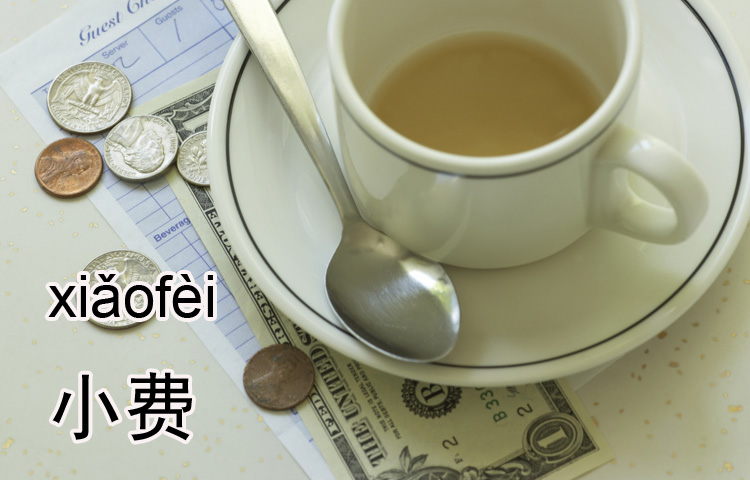
I guess I have been messing it up for you folks I have yet to met a fuwuyan, bellman, cabbie, return or refuse a xiaofei!
and a BIG reason why 'hospitality' workers here in the USA aren't beating down the doors to service Asian country tourist.

TalDecember 23, 2012
This topic always reminds me of my very first day in China. My Chinese minder was booking me into a hotel as my accommodation at the school was 'not ready'. For the first time in my life (信不信由你) I experienced having my luggage carried to the hotel room by a local 小伙子 wearing one of those dinky bell-boy outfits. My minder came up to the room too, I assumed to get me settled in. So we get to the room and the boy puts down the bags and stands there. I'm running the scenes from movies I've seen where people do this and I remember that the next thing is the tip. But then I'm like: wait, didn't it say specifically in the Lonely Planet Mandarin Phrasebook my ex had given me that you don't do that? I looked at the kid, he wasn't for budging. I looked at my minder, who simply stood there saying nothing and doing a wonderful impression of oriental inscrutability. It was one of those moments when the absurdity of life is suddenly crystallized.
So finally I put my hand in my pocket and found about half a Hong Kong Dollar in coins, the only Chinese currency of any kind I had on me. I gave it to the kid, he looked at it like I'd handed him my dirty laundry and bounced. 呵呵, I guess it wasn't much use to him in deepest Guangdong.

bababardwanDecember 23, 2012
haha, great anecdote Tal.
btw I guess it's mostly at the more expensive hotels that you get Bell-boys and the like in China? I can't say I'm a fan of such unnecessary services [unless you are incapacitated in some way].
TalDecember 23, 2012
呵呵, yo, it's generally the places that want to be 'classy' that put the staff in monkey-suits. Come to think of it, I don't recall my bags ever being carried to my hotel room in such fashion again, so either my own choice of accommodation is way down-market or this was some kind of special 'rite of passage' that fate had arranged for me.
What did you notice in this lesson?
You are posting as a guest. Your reply is reviewed before it appears. Log in to post without review.