User Comments - huatuo

huatuo
Posted on: Trip to the Vegetable Market
September 22, 2008 at 5:29 AM
@ Calkins: Thanks loads for the texts. I can really use them. BTW, 丝瓜 can also be translated as “Edible Luffa Gourd”, hence the towel reference. Actually, the luffa sponge is Luffa Cylindrica, while 丝瓜 is Luffa Acutangula. It is much thinner, with definite ridges along the length of the vegetable. Its organized fiber content is much less than cylindrica, when harvested and eaten in its juvenile state. More trivia from my cesspool of knowledge. Regards, Huatuo
Posted on: Trip to the Vegetable Market
September 14, 2008 at 12:57 AMNi Hao, 冬瓜, Winter melon, has the taste and texture of watermelon rind. It also is found in a round shape. About the size and shape of a pumpkin.

It has a waxy cuticle on the outside when ripe. It resembles snow, hence the winter reference.
There is a related vegetable, that has an oblong shape, similar to the size of a zucchini. Mao Gua, or Fuzzy Gourd does not have the waxy appearance, but has small hairs on the outside

The interior is of similar texture and taste.
冬瓜 can be stir-fried, steamed or pickled. It has a very subtle taste, and picks up the flavor of other ingredients. Soup is the most common use for 冬瓜. The flesh can be cut into cubes and cooked with chicken broth and salt cured ham. Quite good! Some chefs hollow out the entire gua, carve a design on the outside, fill it with soup ingredients, and steam the entire gua until tender. To serve, the interior flesh is scooped out with some of the soup and ingredients. An impressive banquet dish to be sure. YUM!

Posted on: Prescription Drugs and Overseas Chinese
September 13, 2008 at 5:56 AMAmber, Wow, thanks a bunch for the link to Chinese translations of generic drugs. Very useful for me in communicating with my Chinese colleagues.
Posted on: Trip to the Vegetable Market
September 12, 2008 at 9:27 PMPink Jeans, I used to grow and sell many of the Chinese Veges, including the ones that you have photos of. You can't believe all the different cultivars there are! Your photo of Mini 白菜 is what we call 菜心 in the USA. The Cantonese name is Choy Sum, Mandarin: Cai Xin The heart of the white vegetable. The Large 白菜 is what the Cantonese call: Bok Choy, Bai Cai in Mandarin. Believe it or not, there is a large 白菜 that has green petioles (stalks)...I only know the Japanese name for that one: Komatsuna. Good part about growing Komatsuna is that it is extremely heat tolerant. Will grow all summer long here without going to seed: bolting.
As for taste, the relatives of canola are all sweet without the spicy bite that 白菜 or 菜心 has. Komatsuna is even more spicy! The small green petioled 上海青菜 has no spicy taste, but has almost a buttery flavor. I prefer it steamed and prepared, as you say: 油菜 style, oil and oyster sauce! YMMMMMMMMMMMMM! Soy sauce and sesame oil is also good! Double YMMMMMMMMM!
I think it would be great if Jenny can do a session on the variety of green veges available. Maybe we can arrive at a concensus about what to call these delicious plants. Cheers!
Posted on: Trip to the Vegetable Market
September 12, 2008 at 6:50 PMFor those who are interested, 油菜 looks like this:


上海青菜 Shanghai Qing Cai looks like this:
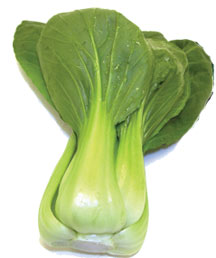
You can use the latter for an edible decoration
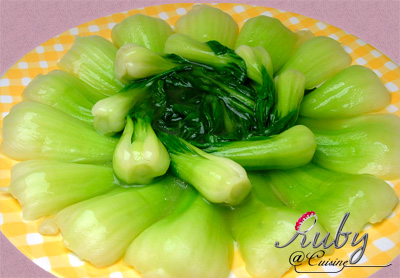
Enjoy!...
Posted on: Trip to the Vegetable Market
September 12, 2008 at 5:58 PMAndrew, I too have been served other greens when I ordered 油菜 in restaurants around China. I just assumed that it was embarrassing for them to say meiyou. Instead, I got what they DID have. Mei Guanxi! Not too sure if the folks in Tianjin call things by another name.
Posted on: Trip to the Vegetable Market
September 12, 2008 at 5:23 AMAndrew, 油菜 is an edible form of canola or rape. It is on the thin side, about 8 inches tall (20 cm) and quite sweet and delicious when cooked. It has a yellow flower when over-ripe.
上海青菜, or 上海青. are heading mustards, also sweet, but more stout and compact. Look somewhat like a small flower vase.
It is my impression that 青菜 is a more catch all, generic term. ANY green vege. My two fen worth.
Posted on: A Very Special Day
October 3, 2008 at 4:22 AMCongrats to all at CPOD. 1,000 thanks for your excellent work! I look forward to CPOD each day and am learning more and more. Can't wait for the next 1,000 lessons. Cheers!