Lesson Introduction
Comments
To comment, please login.
Comments Policy
Allowed comments do not necessarily represent the views of ChinesePod.com. We also reserve the right to reject personal attacks, false/unsubstantiated allegations, spamming of any kind, and comments that include vulgar language or libelous statements.
Out of consideration for our Newbie and Elementary users, English translations should be provided with any Chinese (characters or pinyin) written in Newbie and Elementary lesson discussion posts. New lesson idea? Please let us know on our contact page.

JohnT says
The MP3's are still missing.April 19, 2007
jaysea says
dear jenny and ken, just to let you know, there is a problem downloading either mp3 QT dialogues.. error text appears. enjoying all lessons otherwise! JCApril 16, 2007
says
SandraFebruary 15, 2007
Egads! I didn't mean to be this early. I'll check back later for the additional vocabulary. But it sounds like a red hot lesson.
says
金平 Tsin_PingFebruary 15, 2007
Again, great lesson we have today!!! I kinda notice that your dialogues are getting way better than last year.. It has background music.. sound effects and there's too much drama, as if it's like I'm listening to a radio drama show... hehehe!!! Great job again, guys!! Anyway, Jenny, I agree to what have you said that 爸爸 and 妈妈 are 4th tone and Neutral tone, and it reflects on their mood! Both are angry but sometimes calm... :) By the way, ChinesePod, looks like we got a competition here... I came across this site >> Active Chinese (http://www.activechinese.com/) and it's all about teaching Mandarin Chinese too!! Guys, we need to do something to prove that we are still the best language podcast in the whole 世界!! (Now I remember the 手 around the 世界 of Aric) But no matter what happens, I'll gonna stay in ChinesePod forever and ever and ever... That's a promise!! 新年快乐!!! 恭喜发财!!!
says
Mike in JubeiFebruary 15, 2007
Jenny/ Ken and the CPod Factory Team - Happy New Year Hard to sleep here in Jubei because of the firecrackers at night. Now I am trying to ponder the verbs of this lesson. Here is my problem except for the new words for firecracker and dangerous all the rest are in my comfort level. However, If I were to write the lesson in Hanzi from listening to the English translation of the dialogue only, my guess is I would have gotten the verbs right only about 50% of the time. I know your Academic Team puts alot of effort into these dialogues so lets take a look at my problem: A Line 1 我 要 wǒ yào --> I want B Line 2 不行 bùxíng ---> you can't A Line 3 我 可以 wǒ kěyǐ --> can I B Line 4 你 得 nǐ děi --> you must A Line 5 你也 要 nǐ yě yào --> you need to be Perhaps it is the English but can and can't in this case different verb not 不 可以 but 不行 ; want, must, need to be. I might have used 必须 bìxū or 應該[应该] yīnggāi or 須要[须-] xūyào for must Line 4 or 5 would I have been wrong. Any help on what seem like simple verbs would be helpful. Ah Half a day more and then time to relax for a week. Except for studing Chinese of course. Mike in Jubei
says
ChinesePodFebruary 15, 2007
Supplementary vocab for this lesson: 烟花 (yānhuā) fireworks 焰火 (yànhuǒ) fireworks 放烟花 (fàng yānhuā) set off fireworks 太巧了。(Tài qiǎo le.) It's such a coincidence. 太响了。(Tài xiǎng le.) It's too loud. 热闹 (rènao) loud and lively 春节 (Chūnjié) Spring Festival; Chinese New Year 过年 (guònián) celebrate/spend Chinese New Year 拜年 (bàinián) pay a New Year's call; wish someone Happy New Year 新年快乐!(Xīnnián kuàilè!) Happy New Year! 恭喜发财!(Gōngxǐfācái!) May you be happy and prosperous! (traditional Chinese New Year greeting) ~Connie
says
ChinesePodFebruary 15, 2007
Many of the staff have already gone home to their families for Chinese New Year. Starting tomorrow, we'll all be on vacation. Of course, the podcasts will continue, but we thank everyone for your patience if we're a little slower about replying to comments in the podcasts. Happy Chinese New Year! -John
says
ChinesePodFebruary 15, 2007
Mike in Jubei, I think when approaching a question like this, the most important thing to remember is that translations are always approximations. Thus the question is which words are most appropriate to the context, and the emphasis moves from the exact meaning of the words to the level of formality of the words chosen. With this point in mind, let's look at your questions. 不可以 (bù kěyǐ) would also work instead of 不行 (bù xíng). 不行 (bù xíng) has more of a "not gonna happen" feel to it, where 不可以 (bù kěyǐ) has a "that is not allowed" feel to it. 必须 (bìxū) is too formal and a little too strong for this situation. 应该 (yīnggāi) is too weak for a father telling his son what to do when safety is a concern. 需要 (xūyào) would not be really wrong here, but it's more formal than 要 (yào), and so is less appropriate to a casual father-son exchange. In this case, both sentences also end with 哦 (ō), which is a good indication that it's definitely an informal exchange. -John
says
Bob MrotekFebruary 15, 2007
Charles, I really appreciate the way that you and Mike in Jubei use the characters, the pinyin, AND the English in your posts. That makes it much easier for Newbies and Elementaries like me to follow. You guys are real leaders. Thank you.
says
LantianFebruary 15, 2007
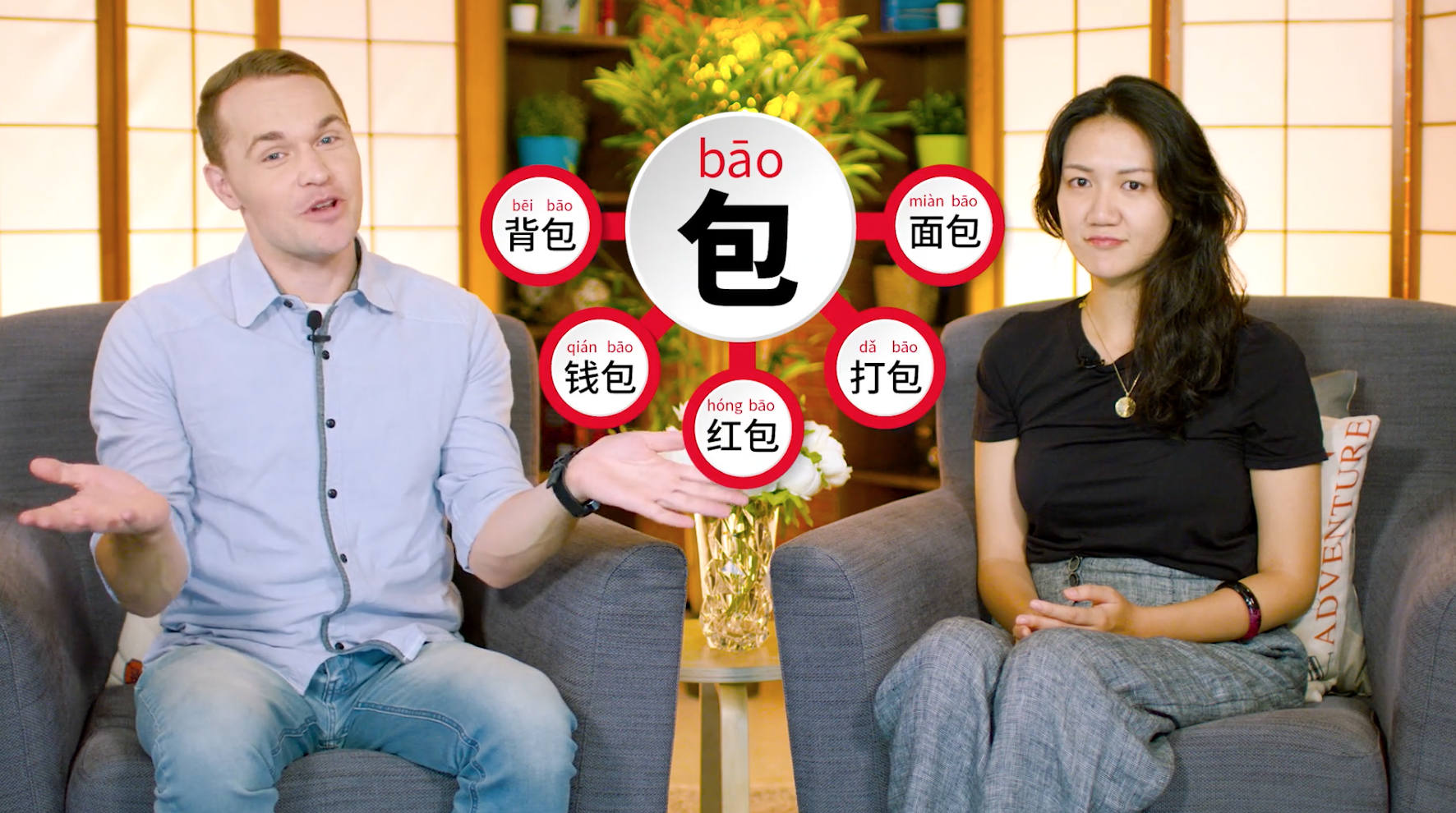
Banner Hanzi - Bian1 Pao4 鞭炮 爸爸!我要放鞭炮! bian1 pao4 ba4ba5! wo3 yao4 fang4 bian1pao4! firecrackers Notes: Take notice of the 便 bian phonetic in the first character. And the 包 bao/pao phonetic in the second character. Nicely it is also coupled with the 火 huo component for fire. And it's a fourth tone like a sharp cracking explosion 'POW!' The 革 ge2 in the first hanzi is a little more obscure, but as the character means whip/lash or string of firecrackers, it makes sense as firecrackers in China often come tied together in long strings, the component means leather or expel/dismiss 放鞭炮!
says
ChangyeFebruary 15, 2007
Hi ChinesePod ! On this occasion, I would like to shout again "thank you" for your great help in learning Chinese. I am sure of your taking the first place in Top 10 podcasts of Time Magazine this year. Of course, you are my best podcast. As for firecrackers in China, they are really headaches/earaches for me. Every time local children light and throw firecrackers innocently on the street, not-jokingly I almost suffer a heart attack. If you gather all the firecrackers in China, the total fire power might surpass that of the Chinese People's Liberation Army. Just joking ! Anyway, thanks to China I can enjoy celebrating New Year's Day by both the new and the old calendar.
says
yidanFebruary 15, 2007
Kudos to you all at Chinesepod. Not long ago I wrote to suggest that perhaps Chinesepod would consider producing more lessons this way: natural pace dialogue (to train our ears), with relevant sound fx to make it "sound" real and natural (to help us immerse in the situation). I realize it involves a lot more "producing" effort and therefore more time consuming, but the result is also more lively and memorable. Great stuff you guys! -- yidan
says
LantianFebruary 15, 2007
TWITCHING - I guess it's a lifetime of exposure, but I'm constantly amazed that people here don't flinch. They don't jump, turn their heads, or twitch. Me on the other hand, one little firecracker 'pow' and I'm in duck and cover stance. Hmm...I realize I have no Chinese vocabulary for words such as duck, cover, look out, flinch, twitch, shake; a new idea for a future podcast?! With all the thief grabbing, firearms, and boyfriend stealing going on around here lately I think it will be necessary vocab. BTW, I thought John's remarks to Mike's question were so extremely well explained it's scary. 我要放鞭炮!
says
金平 Tsin_PingFebruary 15, 2007
Hello, CPod!!! It's me again!! Wow, CPodders really do comments fast!!! Anyway, ChinesePod (especially to Jenny, Ken, Aric, Coleen, John, and everybody there!) where's my 红包? Hehe... Just kidding... though, I really want it... :) Maybe Aric can do a little pig sound for us this Saturday Show... you know, for the year of the pig... 猪年快乐!!! Hi! Jenny! You look like 章子怡 (Zhang ZiYi) to me!!! Maybe you can endorse ChinesePod in a commercial or two. (I'll be expecting that in YouTube.. hehe.. :)) Who knows... the greatest international Chinese actress coming from Shanghai, China!!! Enough already!! :P 新年快乐!!! 恭喜发财!!! L.L.C.P.!!!
says
Bazza 白锐February 16, 2007
I think I'll print a 猪年 tattoo and put it on the back of my hand. :)
says
KaixinFebruary 16, 2007
新年快乐! 恭喜发财! Happy Year of the Pig for everyone! In Finland we have firecrackers too, the smaller ones are called "small chinese" and the bigger ones "big chinese". So that clearly shows that we know where they come from ;) This year we have a very special celebration here in Helsinki, we have a live connection to Beijing via video screen and we have that kind of "temple market" that I think is traditional in China. There will be Lion dance and all kinds of wonderful things. Can't wait to be there :) All the best for everyone, enjoy your holiday! -Kaixin
says
Bob MrotekFebruary 16, 2007
爸爸(bàba) Papa says: 一定要小心哦!。Yīdìng yào xiǎoxīn o! You must be careful! 小孩子 (xiǎo háizi)small child says: 你也要小心哦!Nǐ yě yào xiǎoxīn o! You need to be careful too! It is my understanding that 哦, ó, means “oh” or perhaps the Canadian “eh?” (Sorry Canadians, no offense, eh?). Would it also be acceptable to use 啊 , meaning “a”, the Chinese “ah” sound?
says
Bazza 白锐February 16, 2007
My printable tattoo paper works pretty well. :) http://www.flickr.com/photos/-bazza-/392164487/
says
Bob HsiangFebruary 16, 2007
It seems the server at CP is down or there is a glitch because no downloads are possible Friday 02/16 PST/U.S.. My broadband and LAN are working fine. Xin nian kuaile to all. Thank you so much for your great website. As I have stated in other blogs, CP has motivated me to get serious about conversing in Chinese.
says
CONNIEFebruary 16, 2007
great lesson cpod!! i wish here in argentina we had firecrackers... let's see what they do in the china town on sunday... anyways, xïn nián kuài le!!! (even if is too early to say it ;) )
says
ChinesePodFebruary 16, 2007
Bob Mrotek, I wouldn't equate 哦 (o) with the Canadian "eh." It's very similar to 啊 (a), but has a more cutesy Taiwanese feel to it. So yes, you can replace 哦 (o) with 啊 (a). Bob Hsiang, Our database server had a hardware failure that couldn't be fixed immediately because of time differences. Sorry for the inconvenience! -John
says
jenny zhuFebruary 16, 2007
Dear poddies in every part of the world, I just came back from the cpod annual lunch. A 25 people hotpot feast. We were seated to 4 tables pulled together with 4 boiling pots. Everyone had a blast. Now I worry about the ensuing dinner. Will probably survive 7 days without food after today. You've made 2006 a very special and gratifying year for us and we wish all of you a very happy and fulfilled year of the pig! 猪年快乐! loads of hugs, jenny
says
LantianFebruary 17, 2007
SERVE IT UP - Hi John, that was a woosy excuse. I hope you guys make your hosting service work a little harder than that. Have they heard of RAID 5 hot-swap server tower, cluster-arrangement and backup power supplies. For a stock server farm there are almost NO parts that aren't redundant in a properly built room. A mission-critical outage usually has a service agreement of 15 minutes for initial response and less than one hour for restoration. This was not the first such similar-outage for Cpod. I don't know if in that time Cpod has had that same host continuously. Minus some pilipala crackers going off inside the rack I say it was the on-call tech too drunk to come in in a timely fashion and type on the pullout keyboard to move the files after the disk failure. pilipala...now there's a word not in any textbook that is crying out for a Cpod podcast. Happy eating and eardrum damage everyone!
says
AntonioFebruary 18, 2007
Happy new year to you!. I also felt the server dawnfall.
says
Best Chinese New Year Podcast for Learning Chinese | Sinosplice: Life in ChinaFebruary 18, 2007
[...] I may “hate” Chinese New Year, but it’s inescapable. We also do coverage of it at ChinesePod, of course. This year we did an Elementary lesson on Chinese New Year Firecrackers, but the one I especially liked was at the Advanced level, called 春节采访 (”Chinese New Year Interview”). [...]
says
LantianFebruary 20, 2007
TO GIVE - I'm a giver not a taker. I have a feeling Jenny may delight in answering the following question. How do I ask about "giving hong bao"? I wanted to ask people today how much they got and I realized I'm not sure I know the proper verb combo. Is it: 1. 你的老板送给你红包吗? 2. 你的老板送你红包吗? 3. 你的老板给你红包吗? My hunch is that 1 and 3 are okay, but 2 not so good. Yah? 那,凯嗯老板给你们的红包给了多少钱?! (I'll translate just in case Mr. Carroll makes the excuse he can't read hanzi. "How much did Ken give you for the lucky packets?") ;-)
says
LesFebruary 26, 2007
So... When would one use 哦 (ō) at the end of a sentence? Father and small child. Okay. Older sibling and younger sibling? Husband and wife? Boyfriend and girlfriend? Or is it appropriate for less intimate, simply informal dialog? Thx Les
says
ChinesePodFebruary 27, 2007
Les, Sentence-final 哦 (ō) doesn't have to be used in an intimate situation; it can be used in any casual situation. So it's fine for friends, lovers, family members, etc., but would be strange for a student to say it to a teacher, an employee to a boss, etc., unless the relationship were quite informal. -John
says
Jinny the Jade QueenMarch 1, 2007
Sorry having a little difficulty with the "to stand" verb in this dialogue, can someone spell it in pinyin for me with the correct tone. (Thanks in advance) I want you to know I find C-pod very interesting--it helps me stay motivated in learning Chinese, and also very useful--I have managed to squeeze in phrases and words I've learned here into my daily conversation. C-pod ROCKS!!
says
ChinesePodMarch 1, 2007
Jinny the Jade Queen, Glad you're enjoying! Here you go: 站 (zhàn) to stand -John
zhongwen says
I can't download this mp3 - I get a file with these contents:May 5, 2007
NoSuchKeydavidhallgren says
The mp3 is back online, thanks!May 29, 2007
rino says
Great Website! Thanks for all the nice and very informative lessons!August 19, 2007
Joachim says
Weird anonymous tags here ... Will there be a lesson on the upcoming year of the rat (in 2008)?January 12, 2008
calkins says
Wow, this expansion sentence blew me away: 车上人很多,吵吗? chē shàng rén hěn duō, chǎo ma? There are a lot of people in the vehicle, is it noisy? Can anyone explain the 车上人很多 (chē shàng rén hěn duō) structure? To me, it says "car on people very many". Also, I'm half-expecting a 的 (de) somewhere in there.March 11, 2008
auntie68 says
hi calkins. Does the phrase make more sense to you if you try splitting up the components in a different way: [车上] [人很多] (chē shàng rén hěn duō) Literally: [car/bus on board] [people very many] = "On board the car/bus, there are many people." My guess is that you half-felt the need for a 的 (de) somewhere because you understood the phrase in THIS way: [车上人] [很多] (chē shàng rén hěn duō) Literally: [the people on the car/bus] [very many] = "The people, who are on the car/bus, are very many" Now that (ie. latter) meaning would definitely require a 的 (de) to flow correctly in Chinese: [车上(的)人] [很多] (chē shàng rén hěn duō) = "The people, who are on the car/bus, are very many" Any better?March 11, 2008
calkins says
My personal tutor Auntie68, thank you! ;) Ah yes, this makes much more sense. I guess the "shàng" threw me off - I've never seen it used in the sense of boarding/getting in. And you hit the nail on the head with my thinking of using a "de". Get out of my head!March 11, 2008
auntie68 says
You're welcome. 上 (shang4) used in this sense is a very "Chinese" thing. Eg. you would refer to your classmates as 班上的同学 (ban1shang4de tong2xue2). It would sound completely weird if you used 里 (li3; in/inside) instead, as in 班里的同学. Please don't ask me why! Other examples: 船上 (chuan2shang4) = on/in the boat 社会上 (she4hui4shang4) = in society 世界上 (shi4jie4shang4) = in the world 海上 (hai3shang1) = at sea Unfortunately, I don't think there are clear, reliable rules to tell us when to use 上, and when to use 里. I could tell you that 上 seems to be more "abstract" as a location marker, whereas 里 tends to emphasise being physically inside something. But that's not really helpful, because Chinese brains seem to have different notions about what is abstract, and what is not! Good luck!March 11, 2008
ewong says
October 10, 2008
hello, audio review here is not working.Thanks
amber says
October 12, 2008
hi ewong,
Just tested it and it's working here! Maybe try reloading.
ewong says
October 12, 2008
it's ok now thanks!