
go_manlyMarch 27, 2010
Regarding the Expansion sentence:
他是我们的好榜样,我们要向他学习。(Tā shì wŏmende hăo băngyàng, wŏmen yào xiàng tā xuéxí.) He's a good role model for us. We should follow his example.
How does 向 used here corresponds with its dictionary meaning of 'to, towards'?


stevemischFebruary 16, 2010
Yes, I'm certainly no authority, but I also heard that, of course formally, in the past, it had one meaning, but that now, in a more informal sense, or maybe with a younger generation or more of a "street language" sense it has this second meaning--perhaps related to context.
stevemischFebruary 15, 2010
The word tong2zhi4 was used to mean comrade. Is this the same word as "colleague?" They sound similar. I've also understood that the chinese word for comrade can also mean homosexual--same word?

catherinemFebruary 15, 2010
@stevemisch The word for colleague is 同事 tóngshì. This is different from the word for comrade, 同志 tóngzhì. They do sound similar, but there's that sh vs. zh sound. To say homosexual you can use the word 同性恋的 tóngxìngliànde. You're right to notice that the first character in these three words is 同, or same/common/together.
eupnea63355February 16, 2010
I'm glad Steve brought this up. My former CHI 102 teacher (Taiwanese) said that the meaning of 同志 changed from comrade in the days of Mao) to now mean homosexual. Now, when I told an acquaintance from Shanghai this, she insisted it was incorrect, as did her husband, a well-educated medical doctor. I wonder if that reference to homosexual was very local, not universal enough to be more widely accepted.
otomikJuly 3, 2009
This is one of my favorite lessons. Please don't shy away from 20th century chinese history, I quite enjoy it. I also enjoy books like Jonathan Fenby's Modern China which can supplement ones understanding with viewpoints from outside the mainland.
We could talk about other periods of modern chinese history with songs like The Story of Spring and DaDao March.
Karaoke with Pete?
kaixin_in_tampaJuly 1, 2009
^__^
http://new.music.yahoo.com/zhanyou-song-and-dance-ensemble/tracks/learn-from-lei-feng-the-role-model--183450231

bababardwanApril 9, 2009
Pete,
Excellent point re assuming good faith.I'm a great believer in this.You could take nearly any comment in a bad light if you adopt a negative frame of mind.A better exercise for mine is to see a comment that would naturally be interpreted negatively and see if you can find a positive way of looking at it.I really think that most disputes arise from miscommunication.

pearltowerpeteApril 9, 2009
Hi stanimal (and everyone discussing provocative lessons)
We can do worse than follow the Wikipedia principle: Assume good faith. The overwhelming majority of CPod users are interested in learning, and in making the site as good as it can be.
If we were racists or dullards, we wouldn't be paying our hard-earned money or using precious time to learn such a challenging language.
So thank you all for your suggestions. Frankly, we have to reject at least as many as we implement. But your feedback and suggestions are invaluable as we try to provide fresh, useful lessons.

miantiaoApril 9, 2009
pchenery, 好的, 那我可能误会了你的意思吧!其实你的意见也不错啊,但是在这里的网站做我倒认为不行。来这里的网络警察英文都非常好,想一下嘛,他们英文水平非是高级那就没用。

pcheneryApril 9, 2009
miantiao,
我绝对不是那个意思
the comment was intended to apply to both cultures
a significant percentage of our daily language usage involves "symbolic speak" which requires an in-depth understanding of the culture before you can understand the meaning
for example, I did not understand the real meaning of "你喜欢吃豆腐吗" 或者“你老婆给你戴绿帽子”...until a Chinese person explained it to me.
apologies to my Chinese poddies if my meaning was interpreted to be a "slight on their intelligence"...
it was intended to be in good fun, but thanks for pointing that issue out to me
miantiaoApril 9, 2009
mmmm,
'I think they are quite smart, but not smart enough to discern the subtleties of hidden meanings in language'.
chinese philosophy and literature are probably some of the most suggestive prose ever written.
although pchenery's intentions are admirable, the above comment is nevertheless a ridiculous statement that accuses chinese people of lacking intelligence, and furthermore that western literature has a monopoly on creativity.
I would have thought that 鲁迅 was critical of the nationalist government, since they were the government of the time.

matt_cApril 9, 2009
Oi @miantiao @reigau Play Nice! ;>
@pchenery I appreciate your witty suggestions.Hypothetically, if we could write stuff of Lu Xun's calibre, it would have to be so subtle that only the most perceptive would grasp the hidden meaning behind the euphemisms, and their comments would be so cryptic ... Suffice to say that if such tales were told, nothing would be mentioned about their nature and thus the effort and message would almost be for naught.
As Pete said, it's probably easier to consult the myriad of resources available to you elsewhere. Or you could use the linguistic skills that you've honed here and do some digging in the primary and secondary Chinese language sources available to you. :-)
stanimalApril 9, 2009
pete, thank you for your comment and apologies if mine was unnecessarily provocative. to be clear: my suggestion was rhetorical. some topics might be better avoided altogether if they cannot be discussed in their entirety. the last thing any of us wants is to see the CPod site shut down.
i lived in china and actually admire the PRC government for many things, tian an men being emphatically not one of them.

miantiaoApril 9, 2009
that's a bit harsh ole boy!
ever get that sense that the more you speak the deeper the hole gets?
pcheneryApril 8, 2009
I think they are quite smart, but not smart enough to discern the subtleties of hidden meanings in language. As an example, Lu Xun did this with great success in his writings, and was even praised by the government he criticized.
TalApril 8, 2009
Just how dumb do you think the Chinese censors are dude? (Nice ideas though, you should try working them up into a book of your own!)
pcheneryApril 8, 2009
CPOD could do a political lesson "in disguise".
For example, create a fictitious place (like in the Ji Zhou series) just re-name some of the places, people and events, in order to avoid being censored. Euphemisims could be employed strategically too (which would be difficult for Chinese censors to translate and therefore difficult to determine censor-worthy status). Double-speak could be employed to maximum effect.
The Tianamen story could be labelled "The Tea In A Minute Messy Scare"...a story about spilling tea (as opposed to blood)..
CPOD could even do a story on the "Far Loose Gone" movement.
Creativity knows no bounds !
TalApril 8, 2009
Well said pete. Frankly I'm always (a little) offended by the presumption of folk who suggest that ChinesePod hosts should comment on such issues. Most such folk have almost certainly never been to China, have no true understanding of how totally non-U it is for Chinese people with any kind of 'public profile' to endanger their livelihood, reputation, future career, (and of course maybe even their health and freedom) by acceding to such suggestions. Such 'suggestions' are just in rather bad taste imho.
"surely, the tragedy of tian an men will be engraved in chinese history." Not a chance stanimal, a huge section of the population has no idea of it, or if they do they do not know it as it is reported in the west. This will appal you (and many others) of course, but along with your distaste, take a few moments to offer up a silent homage to the literally countless similar incidents from western history of (possibly) justifiable uprisings which were quashed and then forgotten and are now wept over by no one. Oh and don't bother trying to tell me I'm just trying to make two wrongs make a right (that's so last week) because my point is simply that this is what humans do, this is the way history works, this is what people are like. Wanna cry for the moon? Go ahead, but don't go asking others (who don't have the privilege you have to speak your mind) to put themselves at risk.
pearltowerpeteApril 8, 2009
Hi stanimal,
The chances that CPod will discuss student uprisings and massacres are slim to none. And slim just left.
This is a for-profit enterprise that operates behind the "Bamboo Curtain." We love frank discussion and touchy subjects. The PRC government does not. It has blocked the site before, and would not hesitate to do so again. The good news is, there are hundreds of articles, books, and documentaries that will teach you all about that tragedy.
It sounds like your friends are similar to some of mine- highly educated in the West, to the point where "they should know better." But they strive for Party membership and high paying jobs-- usually dependent on, but not directly in, the government.
My theory is that this is a sort of Stockholm syndrome. It would be too horrifying to think of the people in charge as "evil." So people either support The Man, or at least numb themselves to his predations. As long as they have their iPods and their Volkswagens, they will keep their mouths shut.
Of course people's political views are extremely complicated. I can't presume to speak for everyone.
lamps5jam3April 8, 2009
This lesson and the song have become an institution in our house (along with "Shei fan pi le?" and "La duzi!" -- we have kids!). I may not understand all of the meaning and context represented by Lei Feng, but I do think it's very helpful to be exposed to some of these pieces of history because a slogan or melody will pop up somewhere and it makes a huge difference to a foreigner or student to be familiar with it. While living in China for 4 years there were numerous occasions when something a local Chinese person did just didn't make sense to me no matter how I imagined it. But the more I read about history and learned about culture, the more I could see how history shapes society. It helped me understand the mindset of Chinese people, which helped to understand some of their "mystifying" ways.
stanimalApril 8, 2009
listening to the lesson, i was going to comment that CPod is doing PR for the PRC government.. having read the comments, i am glad that all views have been expressed. the consensus seems to be that language-learning through comprehensive cultural immersion is a good thing.
still, tapping into controversial areas like this puts pressure on CPod.. pressure to be comprehensive. surely, the tragedy of tian an men will be engraved in chinese history. will we get a lesson on it? maybe on the official chinese view of the events? all my chinese friends, incl. western-educated ph.d.'s, support the decision of the chinese government in 1989... now THAT'S a "cultural goldmine" if you are really looking for one. perhaps jenny could even share what she thinks.
davidmitchellMarch 7, 2009
@rjberki
Lei Feng‘s tomb is at the Fushun(抚顺 Lei Feng Memorial Hall. The director of this museum informed me that among the frequent visitors are Qiao Anshan, the man who accidently killed Lei Feng who was himself the subject of the 1990s movie "The Days of Leaving Lei Feng" (离开雷锋的日子). Other than this there are numerous people who claim to have known Lei Feng, including a former girlfriend of his and many army buddies. There are however no family, this is actually an important aspect of his story, all his family were (supposedly) killed or died as a result of oppressive features of pre-1949 Chinese life.
As for the "relish" that was added to his life, well I think "bull****" would be a more appropriate term. But surely this relish is every bit as interesting as the truth.
I would say PLEASE PLEASE PLEASE Chinesepod more lessons that deal with these aspects of Chinese history! Are we just supposed to pretend it never happened? Actually I find that vocabulary related to this helps you to communicate with Chinese people, especially older ones, about their life experiences and who are actually surprisingly candid about this period if you are willing to listen.
bluealvarezMarch 6, 2009
bababardawan,
Point taken, and like I said, I'm not sure Cpod is at the point where disclaimers are necessary. And sure, it drives me nuts too to see "Caution: contents may be hot" on a *refillable* coffee thermos. Like, wouldn't I know what I put in my own thermos?
It was just the first thing that sprung to mind after reading this thread, because what one of the commenters said about having lived through enough communism and not wanting to pay for it here - it was a legitimate complaint, but not a rational one, if that makes any sense.
Anyway, these things are inevitable when learning about a living culture, since no living culture is without its faults, as many have more eloquently said here. It would be like learning english in a pop-culture vacuum - grammatically correct, but not socially useful.

bababardwanMarch 5, 2009
bluealvarez,
I know what you mean and agree with you to a point as I believe in being senstive to others and to cultural differences,but with respect it reminds me of the plethora of signs appearing in the world due to increasing litigation fear.Signs such as:
What happened to common sense and personal responsibility? If one is careful to listen to what others are saying and respect different points of view,then if someone is not trying to be offensive I don't see a problem.IMHO.
bluealvarezMarch 5, 2009
This whole phenomenon reminds me of a quote from an old movie: "Even David is not as handsome as David." Meaning, 雷锋,榜样extraordinaire, 和 雷锋, 真的人, 不一样. Ken and Jenny even touched on this in the lesson.
The other thing I thought of is that the offended parties here don't seem to truly believe that Cpod is trying to celebrate communism, historical or otherwise. Rather, they were triggered, which is a whole 'nother ball of wax.
There's really nothing you can do about another person's triggers, and while I would have thought the title of this lesson made it a dead giveaway for those seeking to avoid communist references, maybe there's an extra step that can be taken?
Many blogs I read often touch on sensitive topics such as violence against women, etc, so they run up against this all the time. They have to post about something important, but realize not everyone will necessarily have the stomach for it, even if the post is not meant in any way to be offensive. Sometimes the sheer nature of a subject matter is enough to trigger someone if they have suffered something similar. They usually put a line saying *** trigger warning *** at the very top of the post, so people are duly warned.
I don't know if Cpod needs to take it that far just yet, but if you do consistently see people being triggered, you may want to add somewhere on the site a quick note about how "Cpod aims to cover Chinese culture as well as language, since the two are inextricably linked, and therefore some subjects may be challenging for listeners who have lived through some of those events. However Cpod does not endorse nor espouse any political or cultural viewpoints itself," etc. It would both help vulnerable parties, and 覆盖你们的屁股.

cassielinMarch 5, 2009
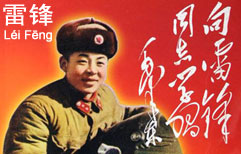
今天是雷锋日,大学校园里的学生们开展了各式各样的活动,大家都在用实际行动向雷锋同志学习!今天我的学生们在宿舍生活区帮助其他同学缝补衣服,书包,床单,雨伞等破旧的物品。
RJMarch 5, 2009
heruilin,
I have to agree. I believe Lei Feng was real (thanks davidmitchel) but the story may have been embelished a little. As we used to say, they put a little "relish" on it. I have to wonder though, why it would be so hard to prove the existence of someone who lived so recently. Is there no family? No grave? No records? I still like the hat.:-)
heruilinMarch 5, 2009
I for one really appreciate the discourse that has transpired in these comments。
On a much lighter note, this lesson with has forever eliminated for me the confusion I had in remembering the difference between 雷锋 (lei2 fang1) and 浪费 (lang4 fei4).
何睿林
ilearnben2March 4, 2009
http://news.163.com/09/0305/07/53KHABCB00011229.html
check this out.
the cartoon version of Leifeng is going to stage on CCTV.
bababardwanMarch 4, 2009
RJ,
So which one are you going to wear then,the yellow or the pink? Oh please do indulge us with a pic when you're donning your choice.
davidmitchellMarch 4, 2009
I have conducted research in China into Lei Feng and the mythology that surrounds him. Actually, despite the numerous claims of people in this page, I found little evidence to substantiate the claim that he was a pure invention of the communist party. In fact there are numerous photographs, artefacts, eye-witness accounts of his life. To dismiss these out of hand based on the evidence of such writers as Jung Chang, who are largely discredited amongst serious Chinese historians, demonstrates the degree to which people outside China are also subject to there own forms of propaganda.
It should also be noted that despite the fact the several posts have mentioned the Cultural Revolution, Lei Feng was not popular during this period, for a number of reasons such as his association with Lin Biao, and also his passivity which did not appeal to the iconoclastic red guard generation.
However this does not mean that substantial areas of the Lei Feng story were not been embellished. For example his diary was supposedly discovered posthumously, however there are innumerable pictures of him performing his good deeds. Recent Chinese scholarship has addressed the Lei Feng myth (see the book 雷锋 1940-1962).
Lei Feng has not remained as a Maoist anachronism, actually the way his life is taught in modern China has far more to do with traditional Chinese confucian values than it does with class-war and hatred of capitalism. His persistence despite ideological transfromations in the Chinese state is remarkable. So of course it is relevant to talk about him and it would be an act of Ostrich like stupidity to do anything else.
Good Lesson!
ilearnbenFebruary 18, 2009
wow,so familiar! i learned this song when i was second or third grader some 17 years ago.
March 5th is learning Lei Feng Day in China.
mmgalitzFebruary 17, 2009
Lyrics:
学习雷锋好榜样, 忠于革命忠于党,爱憎分明不忘本, 立场坚定斗志强。
学习雷锋好榜样, 艰苦朴素永不忘,愿做革命的螺丝钉, 集体主义思想放光芒。
学习雷锋好榜样, 毛主席的教导记心上,全心全意为人民, 共产主义品德多高尚。
学习雷锋好榜样, 毛泽东思想来武装,保卫祖国握紧枪, 努力学习天天向上。
Pinyin:
xué xí léi fēng hăo băng yàng zhōng yú gé mìng zhōng yú dăngài zēng fēn míng bù wàng bĕn lì cháng jiān dìng dòu zhì qiáng
xué xí léi fēng hăo băng yàng jiān kŭ pŭ sù yŏng bù wàng yuànzuò gé mìng de luó sī dīng jí tĭ zhŭ yì sī xiăng fàng guāng máng
xué xí léi fēng hăo băng yàng máo zhŭ xí de jiào dăo jì xīn shàngquán xīn quán yì wéi rén mín gòng chăn zhŭ yì pĭn dé duō gāo shàng
xué xí léi fēng hăo băng yàng máo zé dōng sī xiăng lái wŭ zhuāngbăo wèi zŭ guó wò jĭn qiāng nŭ lì xué xí tiān tiān xiàng shàng
CharlesChineseJanuary 6, 2009
My first introduction to Lei Feng was being told about him by a student. Unfortunatly after enthusticaly telling me his story my student finished by telling how he died "and then he was run over by a truck" was a very unexpected end and I let out a laugh. I thought he would have died in some heroic act helping someone. My student to say the least was not impressed my my display of mirth.
The other strange communist hero who's name i can't remember held a bomb to the bottom of a bridge with his hand to blow up a pill box on to.
Strange heros...

changyeJanuary 4, 2009
Hi rclinton,
You are right. 互相帮助 means "help each other". There are some other "互相" phrases, such as 互相鼓励 (gu3li4, encourage), 互相安慰 (an1wei4, comfort), 互相保护 (bao3hu4, protect), 互相交流 (jiao1liu3, communicate, exchange), and 互相尊重 (zun1zhong4, respect).
changyeJanuary 3, 2009
Hi wchan,
There are some other Chinese words that can be used for "office politics". 办公室斗争 (ban4 gong1 shi4 dou4 zheng1) and "办公室权术" (quan2 shu4), although I feel they connote more negatively than 办公室政治. (zheng4 zhi4).
wchanJanuary 3, 2009
嗨!
不久之前 有一课提及"办公室政治"( Wang's Office Intermediate December 15 )
我曾经在留言版说过 我个人觉得"政治"这个词用在办公室不太自然。
如今 在这一课 如果要说"教室政治"或者比较合适一点
changyeJanuary 3, 2009
Hi inland,
榜样 is basically used for people, and also aften used figuratively for things, such as companies,organizations and some art/literary works. But I'm not sure if 榜样 is used for a car..... I don't feel it's so natural. Incidentally, 典范 (dian3 fan4) also has the meaning similar to that of 榜样. I would appreciate other guys' advice.
stiginshanghaiJanuary 2, 2009
I love this lesson!
I sang the first sentence of song to my wife on bed new year morning, and she ran screaming away!
My ayi blushed and then laughed, and a woman on the corner looked back and laughed crazily.
Shame the lesson only covers first sentence though.

inlandJanuary 1, 2009
is 榜样 used for thijngs other than people, in a broader sense of good example? Like, this is a good example of a well made car.
kencarrollDecember 29, 2008
@andr3y,
Let me assure you that this isn't propaganda. I know this because it was my idea! (I have been accused of many things, but 'communist' isn't one of them.)
Remember there's over 1,000 lessons on CPod.
pearltowerpeteDecember 29, 2008
Hi andr3y
Thanks for sharing your opinion. I hope my earlier comments made it clear that CPod is not endorsing Communist ideology.
This topic (and other lessons on topics such as the Long March) are presented so that our learners, who overwhelmingly did not grow up behind a "curtain" (Iron, Bamboo or otherwise) can get a taste of these culturally significant concepts. Like them or not (like many commenters on this board, I do not) these stories and legends are a part of modern Chinese culture.
You can't fully understand your own position without understanding your opponent's. Often, exposure to your opponent's views will clarify or strengthen your own opinions, and make it harder for anyone to trick you. There's nothing a dictator or propagandist likes more than an ignorant audience.
Again, thanks for commenting. I hope to see your questions and comments on the boards.
sarahlctDecember 29, 2008
@andr3y Having grown up in the GDR, I understand your sentiments, but don't you think there is a fundamental difference between the endorsement of an ideology and the more innocent classification of something as a historical fact?
andr3yDecember 29, 2008
Hello chinesepod,
I joined this site because I wanted to learn about chinese culture and language, not about the comunist propaganda.
I had enough comunist propaganda in my childhood so I don't what to pay for it in the adulthood.
to pearltowerpete:
Every group has it simbol: Americans have George Washington,french have Jeanne d'Arc, all are brave and altruistic, but we must see who is hidding behind these symbols.
Who is hidding behind Lei Feng?

tvanDecember 22, 2008
It's an old, dated book. but Red Star Over China, by Edgar Snow is a good primary English source. It includes interviews with Mao and is generally sympathetic to his views.
I think Snow would have liked the Lei Feng song.
bababardwanDecember 22, 2008
weibwo,
I loved your tale.Thanks for sharing.I'd love to know what the song was too if you ever recall or find out.

kimiikDecember 20, 2008
For illustration, here is the extract of a "chinese movie" that shows how 雷锋 was used in a conversation ten years ago. ;o)
人民的勤务兵
就像香港的董建华 (Tung Chee-hwa)
北京乐与路 (Beijing music on the road) aka Beijing rocks (2001)
huasenDecember 20, 2008
pearltower pete
Thanks for summing up in such an articulate fashion just why this lesson is so valuable. xigua, without wishing to be disrespectful to your views on the subject, I think you perhaps underestimate the extent to which we non-native Chinese are able to understand the cultural context of the cult. The simple fact of knowing that it was initiated by Mao is enough to indicate a large cultural warning sign. But Lei Feng clearly is an influence on today's China, as the tone of Jenny's comments throughout the lesson makes clear, and thought this was a fantastic and really valuable peek into the phenomenon.
Perhaps also the notion of Lei Feng contains something that makes it bigger than the intentions of creating the cult. Think of Wittgenstein's comments about the man kissing the picture of his absent wife, he does it not because he believes she feels the kiss but as a ritual to demonstrate the persistence of love. Maybe the value of a symbol of altruism, which has deeper resonances in Chinese culture, lives on, although Mao is long gone.
Oh and I can't wait for the lesson on poetry.
changyeDecember 20, 2008
Hi mikenotinjubei,
Regardless of nations, people usually have much interest in past experiences as victims, but not anymore in those as victimizers. In this sense, Chinese young people naturally have more knowledge about their past, without knowing much about wrong acts of their own country, than Japanese young guys have.
P/S. Hachiko is a 好榜样 for my chubby dog!
mikenotinjubeiDecember 20, 2008
I saw Hachiko today as my wife and I did some errands in Tokyo. It is sad but I think most of the people who come out and wander about Shibuya Station have no interest in the story or statue.
Changye, you may be in a good postion to comment. Which country do you think the younger people (<40) have more interest in their history of the last 100 years? China or Japan?
changyeDecember 20, 2008
Hi evasiege,
In this case, 偶像 (idol) and 榜样 (model) are not interchangeable. It seems that "学习XX好榜样" is a kind of a set phrase, which probably originated in the lyrics of this song.

tvanDecember 20, 2008
Did Lei Feng exist? I don't know. However, many countries have founding myths that, in retrospect, are constructed of whole cloth. In the U.S. it's George Washington and his cherry tree (ironically, a lie). The Romans had Romulus and Remus... etc. etc. They're still nice stories.
Changye, actually, I was somewhat touched by the Hachiko story.
changyeDecember 20, 2008
There were a lot of so-called “national heroes” in Japan before the war, when Japan was a garrison state, although younger generations don’t care much about them anymore in modern Japan. Here are some Japanese “Lei Feng” heroes. Upper one, a faithful dog “Hachiko”, will be made into a movie “A Dog’s Story” in 2009, starring Richard Gere.
https://en.wikipedia.org/wiki/Hachik%C5%8D
https://en.wikipedia.org/wiki/Ninomiya_Sontoku
wchen97December 19, 2008
Great lesson! Chinese Pod does a great job at teaching the language and the culture. Keep up the good work! :)
huai_houziDecember 19, 2008
That was fun singing along. It made me feel like a little Chinese kid or something. lol
BTW...found a video of this song...anyone find an MP3 without a 老外destroying the song?
http://v.youku.com/v_show/id_cj00XMTI3NzQyNDA=.html
user1196December 19, 2008
its all part of the history isint it?
cant erase it from history thats for sure.
Anyway love this lesson
matt_cDecember 19, 2008
Cleaver,
I drew the connection with 'The A-Team' song too :)
I think all moments in Chinese history are of significance, whether constructive or deconstructive. Certainly whether events are/were positive or negative depends on from whose perspective one is viewing them from, and yet these perspectives ('histories' as it were) will change too - thus everything is important. Again, it depends on your interests, your passions etc as to what each individual wishes to study/learn about.
I myself prefer an even smattering of the more dated histories and the ultra-contemporary. The 20th century history is very interesting but, comparably, not as alluring as my aforementioned.
Mao Era history is something that is studied with a great amount of bias no matter which point of view one studies it from, thus people are quick to accuse and/or excuse.
There is so much more to the unraveling of events than we can gather from the sources at our disposal and thus as a historian, one must keep digging, gathering all kinds of data, and, above all, try to remain objective.
oooook. So I meandered a little. Who was your favourite 'A-Team' hero?

lydia1981December 19, 2008
btw, my girlfriend is getting crazy of me singing the Lei Feng song all the time..
lydia1981December 19, 2008
bababardwan,
thanks, yes, i was referring to the 'who's mike' from the intro
so michael jordan was america's 好榜样? :-)
cleaverDecember 19, 2008
I think these relics of Maoism are no less culturally significant in studying modern China than classic Chinese poems. The thing I like about Chinesepod is the insight into the culture rather than just learning words and grammar.
Bad things have happened in the time since 1949, as is true for all the other eras of China. I don't think we should try to pretend the past 60 years didn't happen.
As an aside, I notice the tune bears a slight resemblance to the theme from "The A-Team". Perhaps some hidden link from Maoist China to Reagan-era America? The "great helmsman" and "the great communicator" togeter at last!
moniqueinchinaDecember 19, 2008
Great, sorry, fantastic lesson ! Thanks very much !
All I can tell you, whether Lei Feng is good or bad to be remembered, all Chinese just KNOW him and like him.
My son's Chinese friends and fellow students and all Chinese guests all recognised him at first sight (we had a poster of him well placed in the living room, while living in Beijing). He IS part of China, that's it.
and some Westerners DO know him and like him (but in fact, we have been in touch with China for over 25 years now)
changyeDecember 19, 2008
Hi barto,
合久必分,分久必合
I don't know how many words I need to say the same thing in English or in Japanese. I'm always impressed with the word-saving manner when they say something profound in Chinese. Brevity is the soul of wit!
johnsDecember 18, 2008
I thoroughly enjoyed this lesson. You're not going to get this stuff in any other language course. I remain a huge fan of Jenny's teaching ability. Her enthusiasm and clear pronunciation makes her lessons all the more memorable. Great job!
weibwoDecember 18, 2008
You can actually buy an MP3 file of this song:
http://www.amazon.com/gp/product/B000QZSMJK/ref=dm_sp_alb/178
bababardwanDecember 18, 2008
Changye,
"Foreign learners of Mandarin are not so naive"
Thanks for giving us this credit.I think Pete has more than adequately shown above the veracity of this statement.Interesting discussion and always interesting to hear both sides.
If there is doubt as to Lei Feng's existence,then I'm wondering who is in the photo?
kesiruiDecember 18, 2008
I agree with jingdezhen comment I would love to learn some Tang poetry!
I also think if you are learning Chinese all Chinese history is worth studying, whether you agree with what took place or not, it still happened, it still affects the culture today, even if you only care about the way in which it affects speech. Celebrate the good and remember the bad so that way the same mistakes wont be made again.
weibwoDecember 18, 2008
There is another song that was sung when the PLA army came sweeping down from the north, capturing several KMT soldiers. The PLA would teach their prisoners this song. The song essentially said to the KMT soldier, not to steal from the peasants, treat them well etc. This song was made very popular by Pete Seeger the American folk singer in the late 60's. I know the tune but I have forgotten the words.
When I went to China the first time I was on the Great Wall. I was whistling the song kind of to myself. An elderly woman came up to me and very surprised asked where I learned this song. I told her. I also told her that I forgot the words to the song. She smiled and said "I know the words". Everyone in china knows this song. So she started singing the song. Pretty soon more people gathered around. I was starting to learn the song. Suddenly a crowd gathered and we turned in unison and marched up the great wall, all of us singing this song at the top of our lungs. I can tell you it was quite a moment. I will always remember that day. Can you find out the song and the words? I am sure some older Chinese know this song. Great Lesson
chrisinguamDecember 18, 2008
Great Program! You had my Chinese wife in stitches, laughing her head off, marching up an down the living room, waving imaginary flags. "We sang this in school when I was seven years old!" She suggested I entertain eveyone with my rendition at the next family reunion.
Chris
pearltowerpeteDecember 18, 2008
Hi barto,
Thanks for an insightful comment. As this is an elementary lesson I'm afraid some poddies may not understand your comments, so I've taken the liberty of translating the last part. The whole comment is interesting, but the part I feel is most relevant to the conversation is:
"Would anyone seriously say "Well, the Qin dynasty was bad, so we shouldn't study Han Feizi (a Legalist philosopher and major classical scholar of that era -ed.)!" Whether Lei Feng was real or fake, he's already become a part of Chinese culture. For that reason, this guy is worth studying."

lstarDecember 18, 2008
Thanks for this interesting piece of cultural history. I had read about Lei Feng but I assumed that his story was no longer celebrated. The fact that it remains current suggests to me that a strong socialist ethic still permeates Chinese society despite all the evidence to the contrary.
bartoDecember 18, 2008
説實話,華夏文化就是這個樣子,
天下合久必分,分久必合,
有個戰國必有個秦朝,有個六朝必有個隋朝,
既然如此,誰能說軍閥時期不可能有個共產黨時期隨之而來?豈不是天命?我說清楚點,歷史上中國崩裂久,一個暴力的政府會站起來。而且你看司馬遷怎麽指桑駡槐,挑秦的毛病,而意於漢。中國的朝代之中(包括唐在内)沒有一個是無辜的,其實大部分的跟共產黨差不多。現在的中國比古代中國的很多時期好得很,這是真的。
中國又換了朝代,現在有新的“非王之王,” 可是中國的情況不是跟以前一樣嗎?難道我們應該說,“哦,秦朝是坏的,我們不可以學韓非子!” 這個雷鋒,不管是真的假的,已經變成了中國文化的一部分,因此這個傢伙值得學習。

Michael KrzykowskiDecember 18, 2008
zhexuejia, I'm not sure that's a tire Lei Feng is holding!
ishineishow, 谢谢你改正我的句字。
Jennyzhu and Connie: 谢谢你们翻译。
changyeDecember 18, 2008
Hi xigua2,
I know what you'd like to say, but don't worry. Foreign learners of Mandarin are not so naive as to easily get fascinated by Lei Feng propaganda, haha.
bababardwanDecember 18, 2008
Pete,
I think Lydia was referring to the intro at the top of this page:"be like Mike". Michael Jordan ,famous basketball player.
pearltowerpeteDecember 18, 2008
Hi xigua2
Thank you very much for your insights and perspective. This conversation is richer because of your comments.
Like you, I am doubtful that Lei Feng ever existed. And you're justified in seeing something sinister about the way he was used to inspire loyalty in the Party and its Chairman.Having said that, I still believe that lessons like this are valuable for Chinese learners, especially those living in China. This is because the mainstream Chinese perspective on Lei Feng is not your perspective. He is a part of the "moral education" curriculum in school. People these days jokingly refer to someone who does something admirable as a "living Lei Feng." A big part of learning about another culture is understanding aspects of the other side's widely held views that strike you as absurd. You don't have to share them, and in fact you can actively oppose them. But it would be a mistake to ignore them.
I'd like to say something about whether Mao was an abberation or an extension of Chinese culture. China has a long and painful record of cruel, cold leadership. And the Cultural Revolution was not the first politically motivated backlash against art, culture and education. There was a similar spasm of violence in the late Tang under Wuzong when hundreds of Buddhist temples were destroyed.
The CCP didn't come from outer space to invade China. It's true that Mao had significant foreign support (mostly Soviet). But to a large degree Mao's revolution, and even more so the Cultural Revolution, were home-grown. This was chaos and destruction that the Chinese inflicted on themselves. For all their (largely justified) complaints about foreign aggression, the Chinese have always been their own worst enemies.
So let's celebrate the beauty and elegance of Tang poetry. And let's mourn the tragic cruelty of China's civil wars. And let's recognize that these two phenomena come from the same deep wellspring.
pearltowerpeteDecember 18, 2008
Hi jingdezhen
If you like Chinese poetry, do we have something good in store for you! I can't tell you any more now. But I think you're gonna like it ;-)
urbandwellerDecember 18, 2008
xigua2
I am familiar with Tang poetry...
静夜思 was the first Chinese poem i ever learned. I believe this to be one of the most popular ones...its simple and beautiful...
静夜思 jing4ye4si1 by 李白li3bai1
床前明月光 ;疑是地上霜。举头望明月;低头思故乡。
chuang2 qian2 ming2 yue4 guang1 yi2 shi4 di4 shang4 shuang1 ju3 tou2 wang4 ming2 yue4 di1 tou2 si1 gu4 xiang1
"Before the bed, bright moonlight light;Doubts is the ground frost.Raises the head looks at the bright moonlight;Lowers the head thinks of the hometown."

jingdezhenDecember 18, 2008
Thank you xigua2 for the tang poems. I've always heard about how beautiful they were, but hadn't really had time to look into them.
I would love if we could have a chinese pod (elementary or intermediate) lesson learning a tang poem.
urbandwellerDecember 18, 2008
xigua2
sorry, i wasnt trying to offend you or any of the other native chinese on this site...judging by the tone of the lesson, I just assumed it was a positive thing...i geuss i need study your history to better understand the whole story behind this lesson.
Thanks for sharing a different point of view and helping us foreigners understand it.
-Adam
tvanDecember 18, 2008
Well, I'm not native Chinese, but I sympathise with xigua2's comments re: culture. Maoism was an aberration in Chinese culture, which is now reverting back to center. At the same time, Maoism's historical significance cannot be denied and, as such, it seems a worth lesson topic, regardless of one's personal likes and dislikes. Its effects are still felt.
Also, to quibble, I don't believe China has ever claimed to be communist; rather, as I understand affairs, the claim is that China is socialist being guided towards communism by the Communist Party.
xigua2December 18, 2008
urbandweller, i am native Chinese and don't like this lesson - as you can see from my comments.
urbandwellerDecember 18, 2008
this lesson was full of great "cultural density"...its so cool to learn the language and about the culture at the same time! I've never heard of the gentlemen until today. Thanks for another interesting research topic.
i look forward to hearing some more native peoples comments about this topic...Cassielin??
:)
user1895December 18, 2008
I love the lessons and always like to learn more about the culture and history...thanks.
standukeDecember 18, 2008
@xigua,
As they say, 'winners write history' so until there's another revolution it looks like 雷锋is part of Chinese culture. Regarding persecutions in general (especailly big ones, like the Cultural Revolution, Jews in Europe or American Indians) it is often informative to think about how the forces of optimism contribute to these tradgedies. I really hate the 'Dr. Evil' model where every bad thing is due to some really Bad People with a really Dastardly Plan.
xigua2December 18, 2008
eight8isenuf wrote: "I love learning about the culture ..."
Well, 雷锋 and this propaganda song is "a true relict" of communism or maoism, and has nothing to do with Chinese culture.
If you are interested in real Chinese culture, you should study poems of the Tang era, like this one.
More can be found here and here.
That's Chinese culture - not a song from those who are responsible for the Cultural Revolution and the Tian-An-Men-massacre.
Just my 2 cents...

xiaohuDecember 18, 2008
This lesson, like the Death By Ninja episode truly shows off David's talents! 小品演得很好,歌曲唱得好听,音响效果剪辑得挺专业!不瞒你说大卫简直是个万能的人啊!
eight8isenufDecember 18, 2008
I agree with our Chinesepod listeners- I love learning about the culture and history and learning songs makes memorization really easy. There is hardly any dialogue I haven't immensely enjoyed.
billbagDecember 18, 2008
that works jamesian, thanks.
excalibur is that you singing?
Great set of links there.
jamesianDecember 18, 2008
Thanks for another great lesson CPod.
I always find learning through songs (no matter the subject) so much more fun, not to mention the great job it does for retention. Pete, the link doesn't work here either. Luckily for us BaiDu is choc full of MP3 goodness.
This one worked:http://www.cbg.cn/include/mp3/red2_21.mp3

light487December 18, 2008
Haha.. you really captured the singing ability of most people well, that is a serious lack of singing ability. :) Hehe.. reminds me of singing "happy birthday" at work. :)
pearltowerpeteDecember 18, 2008
Hi kesirui
I just tested it again, and it works for me. Maybe try clearing your cache and trying again? If that fails, you can go to Baidu.com, choose MP3, and then search for this: 学习雷锋好榜样。
Let me know if you have more trouble.
bababardwanDecember 18, 2008
matt_c,
Well you've gotta be quick to be on that elite list Matt ! lol.Just after posting I guessed what I think may have happened.I was on FrenchPod yesterday and downloaded the new lesson for the day just after release.Lo and behold shortly after that it disappeared ! Couldn't find it under Me,Lessons or Search. I wondered if I'd accidentally stumbled on an old lesson.But it was Christmas themed and FrenchPod wasn't going Xmas last year.I came to the conclusion that they must have accidentally released a lesson that was meant to be released later in the week and then quickly retracted it.I'm now wondering if the same thing happened with this lesson yesterday.I could be wrong ,but this is the only conclusion I could come to.Otherwise it's a mystery.Feeling pretty privileged right now with my French lesson ahead of time.hehe
ps Don't know why my posts are displaying in bold and italics ,as they're not like that in my edit box.Perhaps it's a sign...
matt_cDecember 18, 2008
Bababardwan,
Although it would provide more ammunition to launch a new class struggle, I have trouble believing that there could have been pre-release previews of lessons for 'elite' users. :)
lol
kesiruiDecember 18, 2008
This is one of my favorite periods to study in Chinese history, 谢谢 Cpod!
Pearltowerpete, I cant get your song link to work

connieDecember 18, 2008
Hi architpol,
你是说那些字吗?
它们是:
向雷锋同志学习。——毛泽东
Xiàng Léi Fēng tóngzhì xuéxí. ——Máo Zédōng

jennyzhuDecember 18, 2008
The very elaborate and imcomprehensible writing on 雷锋's photo reads "向雷锋同志学习"/xiang4 lei2 feng1 tong2 zhi4 xue2 xi2/learn from comrade Lei Feng. It was written by Mao Zedong.
BillJefferysDecember 17, 2008
Dear Changye,
Thanks so much for reminding me of the exact words of the slogan "工业学大庆,农业学大寨". I've mentioned that I first started to learn Chinese in 1961-62 from some books published in the PRC, and both the story of Lei Feng and the slogan above were, if I recall, in those books. I was searching for the slogan but forgot that the first character was '工', which made my search difficult. I remembered every character except that one. But your note brought it all back.
Another slogan in those times was "为人民服务", "serve the people," which was also in those old textbooks.
By the way for those watching, the '服务' above is the same as that in '服务员', which is used to refer to a waiter in, at least, North China, according to some recent ChinesePod broadcasts.
changyeDecember 17, 2008
On the other hand, there were other political slogans such as "工业学大庆" (gong1 ye4 xue2 da4 qing4) or "农业学大寨" (nog2 ye4 xue2 da4 zhai4) in China. In this case, the "学" means "follow, imitate", but not "study, learn". So you can say "我们应该学雷锋".
Anyway, it seems that there are a lot of things people have to learn/follow in a communist state.
changyeDecember 17, 2008
There are mainly two versions of slogan about 雷锋.
(a) 向雷锋学习 (b) 学习雷锋精神
You can say "学习雷锋精神 (Leifeng spirit)", but not "学习雷锋". You can't place a person as an object after a verb '学习". So, you have to say "向雷锋学习".
xiumuDecember 17, 2008
Architpol, he's holding a truck tire, isn't he...since he belonged to a transportation unit.

pearltowerpeteDecember 17, 2008
Hi miami_meiguoren
Here you go!
Baidu even shows a techno remix, but the link wasn't working.
pearltowerpeteDecember 17, 2008
Hi poddies
As Ken and Jennie mentioned in the podcast, Lei Feng was apparently killed by a truck backing up onto him. The wags at Danwei.org (can't find the exact link, sorry) speculated that his last words might've been:
到...到...到...停 (嗯)
billbagDecember 17, 2008
ok ill be humming the tune now for the rest of the day...
can someone link me to an mp3 of the full tune?
great lesson guys!!
Michael KrzykowskiDecember 17, 2008
在雷锋的照片前面的东西是什么?
okay, I tried. In case I didn't get this right; What is that object in front of Lei Feng?

linfeng2008December 17, 2008
I can remember witnessing Lei Feng Day. Initially I was skeptical, but can't we all learn from the message just the same? I wondered about his existence too. But then again, I have my children believing in Santa Claus and that he only brings presents to good little boys and girls.
Great cultural lesson just the same. My classroom in Canada now has the slogan in Chinese caligraphy, "Learn from Comrade Lin Feng!"
Sadly, nobody gets it.
pearltowerpeteDecember 17, 2008
Hi xigua2
The stories we tell about ourselves and our heroes reveal a lot. Despite all the talk of 5,000 years of history, the modern PRC is a very young country.
Before war and scandal kicked a lot of the idealism out of us, Americans loved syrupy stories about their founding fathers. Think of Mason Weems' George Washington-- "I cannot tell a lie, I did it with my little hatchet." It's obviously a bunch of malarkey, but it was required reading for generations of young Americans.
bababardwanDecember 17, 2008
xigua2,
Well that's a pretty neat trick ! How did you manage to post a comment 1 day ago to this lesson that was only released 8 minutes ago? Was there an advanced listening session for special guests? :)
xigua2December 16, 2008
Lei Feng (doubt exists as to whether he ever really lived) did not commit great deeds by which he was remembered, but taught the people how to be happy with what they had, to obey the Party and to let the Central Committee, or better still, Mao himself, do their thinking for them.
The result later was the Cultural Revolution (1966-1976), where everybody obeyed like Lei Feng would have done...
Sorry, but in my opinion this lesson was unnecessary. The few new words could have been better taught in other contexts.
What did you notice in this lesson?
You are posting as a guest. Your reply is reviewed before it appears. Log in to post without review.