
WarszawskiJuniorAugust 14, 2011
How could a foreigner that doesn´t live in China learn chinese without Chinesepod?? Imposible!!
Anyway, reading how John learned chinese (http://www.sinosplice.com/life/archives/2007/05/06/how-i-learned-chinese-part-1) is really inspiring.
igomesJanuary 28, 2011
May I point out some English grammar? The lesson's introduction has "In today's handy Chinese lesson, you'll learn how the ups and downs of the first tone," which is a fragment. I suggest removing that "how."
Not trying to be a grammar nazi, just trying to improve my favorite language learning website!

JohnJanuary 28, 2011
You're right. Not sure how that rogue "how" slipped in there. Anyway, it's been removed. Thanks!


azzoteOctober 26, 2009
I agree with Xiaophil about the tones in the pdf. I know, I know, the rules of the pinyin. But in this lesson, not showing them is... well, makes me quite angry.

tohokubenSeptember 18, 2009
Is it just me, or are none of the mp3 sound files downloadable? I can download the PDFs, but not any of the sound files (from https://s3.amazonaws.com/...)
Sean

williampSeptember 16, 2009
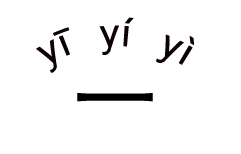
Although it is not that it is a big deal, I have always found it odd that transcripts do not reflect the tone changes for 一 (yī) and 不 (bù).
I have several text books from the Beijing Language and Culture University Press as well as my kid’s textbooks from People's Education Press which all have pinyin that reflects these tone changes. So the rule does not seem to be universal.
It also makes more sense on a practical level to reflect the changes. It seems that pinyin should represent the sound of Chinese more so than the written language – and it can do so more accurately with the changes.
JohnSeptember 16, 2009
adventurer,
If all your other tones were right, and this is all you messed up on, it wouldn't be a big deal.
But yes, getting this tone rule down will definitely help make your accent more natural.

adventurerSeptember 16, 2009
If you get this tone rule wrong, would it be like talking with bad foriegn accent?


lujiaojieSeptember 15, 2009
mudphud:一个人 should be yí gè rén.wjefferys is right."Even if you pronounce 'ge' in neutral tone, it's really fourth and that will carry through."

mclartySeptember 15, 2009
wjeffreys, and rjberki
Thanks. Yes, the key here, which I had not noticed, is that the vowels around the consonant somehow agree with the consonant or "encourage" it as wjeffreys says. I would like to understand that better. I do understand how to prononunce each, when I see it written in pinyin, but am less good at recognizing them by ear. I need to key in better to the vowels with them.
As John says on the site rjberki gave, it seems that getting retroflex versus right is not as crucial as many other points of pronunciation.
BillJefferysSeptember 15, 2009
@Mclarty
Chinese 'ch','q', etc. For example, Chinese 'ch' is pronounced farther back on the hard palate than English 'ch'. You have to curl the tongue back to the middle of the hard palate to pronounce Chinese 'ch', whereas in English, it is pronounced with the tongue more forward. The technical term is 'retroflex'. 'ch' is regularly followed by back vowels (e.g., 'i', 'u' as in 'boo') that are pronounced in the back of the mouth. On the other hand, 'q' is pronounced with the tongue more forward than the English 'ch'. This is because it is followed by front vowels that encourage this position (e.g., 'i' [ee as in 'see'], 'ü'). Vowels following 'q' etc are almost "palatalized" in Chinese pronounciation.
I think that understanding how to pronounce the vowels after these consonants is a key to understanding how to articulate those consonants. So I recommend listening to the ChinesePod podcasts and paying attention to the difference in the vowels. This will help you with the consonants.
@mudphud, who asks:
yi plus neutral stays first tone, yes?
e.g., 一个人 yi1 ge ren2.
My inclination is to pronounce 'yi' in this sentence as second tone. Even if you pronounce 'ge' in neutral tone, it's really fourth and that will carry through. But I'm not a native speaker and I will defer to those that are.

RJSeptember 15, 2009
Mclarty
John teaches:
http://www.sinosplice.com/lang/pronunciation/03/
and the pinyin program does as well:
https://chinesepod.com/lessons/section-10

mclartySeptember 15, 2009
There is another pronunciation issue I cannot find anywhere on Chinesepod. That is recognizing and rehearsing the difference between palatal and velar consonants: ch/q, sh/x, and so on. I understand the difference and sometimes I hear it very clearly, but I do not always hear it right and probably do not always say it right.
No Chinese pronunciation resource I know of makes much of this.
eight8isenufSeptember 15, 2009
Thanks, John, for adding where the other two classes on tones were. I felt kind of dumb that I must have been "absent" from "class" on those days!
genebildSeptember 15, 2009
I believe the expression 万一 ("on the chance that"; "what if...") is also an exception, as it is wan4yi1. Correct?

JohnSeptember 15, 2009
everett,
Definitely possible. We don't always consciously know what our brains our doing, but as stevemisch points out, even linguistically, we're always seeking the path of least resistance.

osckeezeeSeptember 15, 2009
This is one of the beauties of chinese language. My suggestion is to hang out with your chinese friends and try to say something with yi.
If you said it right, the conversation will continue smoothly. On the other hand, if you say it wrong, most likely they will ask you ni3 shuo1 shen2me5? (what did you say?) and will correct you.

jennyzhuSeptember 15, 2009
These tone lessons are really helpful in getting the basics right. But it must be quite stressful if you had to think about all the rules before say anything. So like Ken always says, remember them as words or lexical chuncks rather than disembodying the language.

stevemischSeptember 15, 2009
I think these tone change "rules" stem from the anatomy and function of our "voice box," and our tendency to save effort, e.g., it's easier to go "down" in 4th tone if you've just gone "up" with a preceding 2nd tone. Doctor Steve :-)

everettSeptember 15, 2009
About diyi, could the reason that yi doesn't change tone be because yi is emphasized? The yi slot in the expression diyi could be substituted with any other number, and therefore that slot is the focus, or what you really have to hear to understand the word and distinguish it from similar words. This emphasis brackets it off from the following word. Or perhaps it's the other way around: bracketing yi from the following word is what creates the needed sense of emphasis.

JohnSeptember 15, 2009
xiaophil,
We do have the parenthetical breakdowns for each word in the PDF. It's really important for the learner to understand that the tone changes are not reflected in the pinyin. They must be learned.
So this PDF is consistent with all other lesson PDFs, which follow he proper rules of how to write tone in pinyin.
xiaophilSeptember 15, 2009
I thought I would make a friendly suggestion. Your pdf for this lesson says first tone for all cases of yi in the vocabulary. I think you will confuse some people. I know you said that you won't normally see this tone change written, but I think this episode is special. So I guess I'm saying you should change the pdf.

JohnSeptember 14, 2009
misterjess,
You mean is there an internal logic behind what tones are used for what word? No. That's one of language's inherent properties: its arbitrariness (with a very few exceptions).
Jess_AndersenSeptember 14, 2009
Is there a reason that some words are one tone and other words are another?
JohnSeptember 14, 2009
Also, this series was quite spaced out. This was part three of three. Here are the other two:
Tone Rule: Two Third Tones
Tone Rule: Changes for 'bu'
What did you notice in this lesson?
You are posting as a guest. Your reply is reviewed before it appears. Log in to post without review.