
mafanniSeptember 29, 2013
sizes,
how do you say, small pizza, medium pizza, large pizza, extra large pizza.
and would this apply to men's clothing? like shirts and pants.

j65smithFebruary 14, 2011
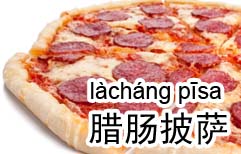
Here in Qingdao, pizza is called bi sa - 比萨
Is it regional to use pi sa and not bi sa?

rjbrown85March 13, 2011
There is a small pizza chain in Beijing called 吉吉熊比萨 that also differs with this lesson's transliteration for the word pizza.
What gives China?!

bennyboykNovember 8, 2010
Useful stuff, will definatly review again soon. Now need to learn how to say 'Texas BBQ' and 'Meat Feat'!!

pretzellogicNovember 8, 2010
there is a barbeque lesson, but I don't know how to say Texas. Although I could just put it into MDGB and get it that way...

everettSeptember 29, 2010
Hi, great lesson!
Could you ask the guy who recorded the audio review to enunciate more clearly? "I bought", for example, gets reduced to a kind of slurred "abut". There's no need to sound conversational by reducing vowel values and doing bunch of consonant sandhis (like didja for "did you") on what is basically a prompt in an exercise. It's annoying and sometimes hard to understand. Crisp and clear please. Just my 2cents, thanks.
angepangeAugust 26, 2010
Is the word 起司 only used in Taiwan? I haven't heard 奶酪 before.
(I was gonna make a healthy salmon pie with fresh salad for dinner - but now I got hungry for pizza!)



isthatmeJuly 30, 2010
Kind of surprised the measure word for something round or flat (even though pizza's not truly flat) isn't used for pizza. I guess measure words for food are exempt from the ordinary.
wasschinaJuly 28, 2010
Hi there ! i just came back home from a nice and amazing trip over China ! Beijing , Shandong & Shanghai
well , i could make it with my chinese there , which was quite surprising actually ! thanks to all chinesepod staff
i spent 10days in china , and i didnt really like the chinese food and was struggling with the chopsticks lol
the best solution for me is to get a sea food pizza for lunch and a sea food burger for dinner lol it became a routine for me ! really delicious ! Missing china already been there from July 16-26 !^_^
hope i could go back very soon !
cheers

bluesky3064July 17, 2010
In some of the online dictionaries, bǐsa 比萨 is used instead of pīsa 披萨 - is this a regional difference?

xiaophilJuly 17, 2010
I don't think so. I think that the Chinese language hasn't settled on a word. Similarly, I notice that different places have different words for sundae. But this is just conjecture.

waiguorenJuly 17, 2010
A-ha! Keen observations people! I remember at my old canteen asking for 比萨 (as apposed to 披萨) for some kind of 并。
Also, I remember that KFC and McDonald's had different words for sundae - but I can't remember what they were...I think KFC used 圣代 shèngdài, and McDonald's used something else...

kimiikJuly 17, 2010
Once again Google may be of some help here ;o)
"披萨" has 1.440.000 results on Google
"比萨" has 1.660.000 results on Google
But, I also invite you to check "披萨" and "比萨" around Shanghai, Beijing and Guangzhou with Google Map. The proportion of the restaurants with each type of transliteration is quite interesting around this cities.

bababardwanJuly 18, 2010
using google map...awesome tip kimiik...i'll have to adopt that trick. I guess it'll work well in a situation like this. But are there any good ways to determine regional differences for everyday words that won't turn up on a map?

ma_taiJuly 19, 2010
Yeah, I have only ever heard "bǐsa", as in 比萨饼, in the couple of places I've spent time in in China, Xi'an and Xiamen. The "pīsa", was quite a suprise to me in this lesson.
jeanettengJuly 16, 2010
I heard that its inappropriate to call a young lady xiaojie in China as it may imply certain connotations. The more polite term is gu niang. Any comments on this observation?
david19710922September 6, 2010
Seems right, or we could give the full name, Sun4 Xiao3jie3, where Sun is the lady's family name.

derekrhodesJuly 16, 2010
In the lesson the pattern "A 还是 B" was presented. But, what if there are 3 choices? "A 还是 B 还是 C" . Is there an abbreviated form such as English's "A, B or C" ?


bababardwanJuly 18, 2010
thanks changye...I don't know why I don't recall striking 或是 before..it seems like it should be common enough. Good question derek
pretzellogicJuly 16, 2010
erichuang, if there's one topic Cpod has in abundance, it's lessons on food, and food related topics. See below. The only thing you can't do in these lessons is order grits and chitlins (not that you'd want them in China anyway):
Elementary - Fast Food
Newbie - That's enough tea
Newbie - Pumpkin Food
Elementary - Hungry Traveler: Inner Mongolia
Newbie - Really Good Food
Elementary - That's Not Your Food
Elementary - Waiting for Food
Newbie - Salt and Pepper
Newbie - Napkins
Elementary - Ordering Pizza
Shanghainese - Food Flavors, Shanghai Style
Elementary - Having Food Delivered
Newbie - What'll it be?
Newbie - Friends for Dinner
Newbie - Too Many Cooks
Newbie - I'm not hungry
Newbie - Requesting a Fork
Newbie - Buying Bread and Butter
Newbie - I like beef
Newbie - Cold Beer
Newbie - Intro 5: Do you have a menu?
Newbie - Ice Cream
Newbie - Chinese Green Eggs and Ham
Newbie - Does it Have Bones?
Newbie - What Would You Like to Eat?
Intermediate - Shanghai Expo Pavilions
Elementary - Getting a Date
Elementary - American Breakfast
Elementary - Thanksgiving
Elementary - Hungry Traveler: Xinjiang
Elementary - Going Dutch
Newbie - Dialect Party Mix
Newbie - Vegetarian Eating
Newbie - Black or Green Tea
Newbie - Thirsty for Water
Newbie - I'm really full!
Newbie - Have you eaten?
Newbie - Eating Tofu
Newbie - Hot Soup
Newbie - Can You Use Chopsticks?
Newbie - I'm hungry!
Newbie - Baby Talk: Eat up!
Newbie - Noodles without Cilantro
Newbie - Requesting a Napkin
Newbie - Sweet Watermelon
Newbie - What meat is this?
Newbie - How do you take your coffee?
Newbie - Chinese Breakfast
Newbie - Hold the MSG
Newbie - What will it be?
Newbie - Ordering Noodles
Newbie - Fruit Salad
Newbie - Please speak slowly
Intermediate - Street Food
Intermediate - Organic Food
Upper Intermediate - Choosing a Wine
Intermediate - Fighting over the Bill
Elementary - How embarrassing!
Elementary - Ordering Xiaolongbao
Elementary - Chinese Seasonings
Elementary - Instant Noodles
Elementary - Ordering a Steak
Elementary - Expired!
Elementary - Chinese Fruits
Elementary - The Doggy Bag
Elementary - How spicy?
Elementary - Hungry Traveler: Hainan
Elementary - Too Picky
Elementary - Diet Coke
Elementary - Pearl Tea
Elementary - Hungry Traveler: Shanghai
Elementary - Dinner with Friends
Vocab Tour - Street Food Buffet
Elementary - Discussing Eating
Elementary - Cooking
Elementary - How is this sold?
Elementary - Hungry Traveler: Hong Kong
Elementary - Hungry Traveler: Macao
Elementary - Hungry Traveler: Hangzhou
Elementary - Hungry Traveler - Dongbei
Elementary - Not Cooked Enough
Shanghainese - Big Darn Crabs
Elementary - Hungry Traveler: Sichuan
Elementary - Do you have vegetables?
Elementary - Barbecuing
Elementary - Hungry Traveler: Hunan
Elementary - Clearing the Table
Elementary - Hungry Traveler: Beijing
Elementary - Medicine Doses
Elementary - Office Lunch Options
Elementary - Hungry Traveller:Yunnan
Intermediate - Buying a Drink
Intermediate - Going on a Diet
Intermediate - Making Dumplings
Intermediate - Washing Dishes
Intermediate - How was your flight?
Intermediate - Cooking Wings
The Menu Stealer - Guilin Mifen
Intermediate - Snacks
Intermediate - Pricey Beer
Intermediate - Taipei
Intermediate - Fat Camp
Upper Intermediate - Bad Service Restaurant
Upper Intermediate - Rating Restaurants on Dianping
Upper Intermediate - Dog Meat and Animal Rights
Intermediate - Sheep, Wolves, and Fruit: a Riddle
Intermediate - Ordering Chinese Take-out
Upper Intermediate - All You Can Eat and Drink
Intermediate - The Perfect Sandwich
The Menu Stealer - Hot Pot
The Menu Stealer - Kungpao Chicken
Upper Intermediate - Outdoor Survivor(Part 1)
Intermediate - Sydney, Australia
Intermediate - Fortunate Cookies
Intermediate - Bangkok
Intermediate - Sweet Roasted Chestnuts
Intermediate - Chicago
What's the Story - 去北京玩儿
Advanced - 冬季进补
Advanced - 连锁咖啡店
Advanced - 白酒和黄酒
Elementary - Li Yan's Diary: Love and Italian Food
Elementary - Wang Wei's Diary: Food and Girls
Qing Wen - Measure Words for Food
Advanced - 健康饮食
Advanced - 中国八大菜系
Dear Amber - Buying a Pet and Food Poisoning
Dear Amber - Food Regions of China
Dear Amber - Food Oddities and Eye Exercises
News and Features - Fingers, Food and a Mystery Video
Media - 猪肉涨价
Dear Amber - Chinese Hospitality and Finding Vegetarian Food

bodaweiJuly 16, 2010
Haha, nice list. But you can't have too many lessons on food. There are lots more topics to cover. :)
pretzellogicJuly 16, 2010
There are plenty more day-to-day topics on other areas besides food that haven't been covered in as much detail as food. Maybe we can have lessons in areas that haven't been covered as often as food, like life in the village, kung fu fighting, the sewer system, calling a locksmith, construction site activity, and other areas before another food lesson is generated. :)
stellacadenteJuly 16, 2010
Wow, thanks for putting all those lessons in one place! And btw, I went to a Chinese-American breakfast once, and almost all the Chinese (from China; not the American citizens of Chinese heritage) were loving the grits. I was amazed. I prefer my grits more pudding like, but the attendees were loving the ones there that were a bit soupy.
pretzellogicJuly 16, 2010
holy cow, are you from the southern US? was this Chinese American breakfast in the US or in China?
Personally, grits are ok, as long as they don't have lumps! But I was already told once that "you have lost your roots", because I put butter and sugar on my grits, which is apparently simply not done in the South.
Did the Chinese just eat the grits plain? Or were they more Southern than me, and put butter and salt/pepper on their grits?
bodaweiJuly 17, 2010
The Chinese probably love the grits because it is very common here - at least corn ground to a meal is common (I eat it often myself - okay, nearly every day.) Corn is a staple in China, and it is sold in the supermarket with the description 玉米糊 yu4mi3hu2 (lit: corn paste). It no doubt has a different texture to grits but it would still be familiar.
pretzellogicJuly 19, 2010
Well, in that case, I guess the Chinese can have their grits, but it sounds like they'll be waiting a while for their chitlins and haggis pie :)
Of course, some well meaning soul will tell us how to order chitlins and haggis in Shanghai somewhere. Hold the pepperoni.
bartoJuly 16, 2010
你們都沒說到
中國人會把玉米放在皮薩上面的怪事兒!
還有雞蛋,雞丁,美乃玆。。。
在中國吃皮薩真蠻可怕的!

bartoJuly 16, 2010
在美國,皮薩上最異常的配料大概是鳳梨!比較常看到的配料有黑橄欖,青椒,辣椒,各種各樣的奶酪,胚根,牛肉,意大利香腸,等等。我猜,西方人對皮薩配料的印象是:第一,需要奶酪和番茄醬,第二,往往需要肉,各種各樣的肉是可以的,但一片一片的肉(類似臘腸)是比較常見的,你也可以加很多蔬菜,但“奇怪“的蔬菜,譬如玉米,就是不可能看到的!更不用説雞蛋,哈哈。我現在住在臺灣,然後雖然他們的皮薩又跟中國不一樣,但我就是無法喜歡上這樣的怪風格~
但我同時卻很喜歡臭豆腐~哈哈哈
luoerJuly 16, 2010
可能他们都是根据每个国家的人口味不同而设计的吧!
我就觉得那样的皮萨挺好吃的,你竟然会觉得可怕,你真是太可怕了~~~
我反而觉得你说的放什么凤梨之类的东西比较奇怪,哈哈!
pretzellogicJuly 16, 2010
Boy am I glad Cpod likes pizza. I guess i'll figure out how to say green (bell) pepper on my own, and then i'm all set.
bodaweiJuly 16, 2010
青椒 qīngjiāo
(I am assuming the 'on my own' was rhetorical, if not I apologise for taking away from your excitement of discovering it on your own.)

pretzellogicJuly 16, 2010
No, it was rhetorical. You saved me the trouble of looking. Thanks! But now that I think about it, I haven't seen too much bell pepper on pizza in China.

xiao_liangJuly 26, 2010
I'm not sure everyone in Cpod loves Pizza :-p I seem to remember a previous lesson where a certain host expressed an extreme dislike for it! (and then hastily apologised! hehe)
bodaweiJuly 16, 2010
Don't want to start another extended culture discussion but I have never heard of 'green' onion. In Australia the common onions are white and brown, and spring onions of course. China has white and brown onions, never seen green ones.
In my experience out in the South West sausage is more often referred to as香肠 xiang1chang2, thanks for 腊肠 la4chang2. I would think you need a descriptor before腊肠.For example we might get 大蒜香肠 da4suan4xiang1chang2 (garlic sausage); actually I can get 无谷蛋白的大蒜香肠 wu2gu3dan4bai2 deda4suan4xiang1chang2 (gluten free garlic sausages).
kimiikJuly 16, 2010
Actually, the "green onion" is a sort of small white onion. But you use all of the plant (bulb and leaves). It's called Ciboule in french and, according to Wikipedia, Schnittzwiebel or Winterzwiebel in German, Welsh onion in english , Cebolleta in spanish, Cipolletta in italian, 葱花 in chinese.
And, in case you were wondering, I assure you that Ciboule and Ciboulette are different plants. The Ciboule is cooked while the Ciboulette is used raw.
bodaweiJuly 16, 2010
Thanks kimiik
Then John's commentary is a bit off the mark - he referred to 洋葱 as 'green onions' - now you have defined 'green onion' for me I would say that the term 洋葱 is used to describe either white or brown onions, not green onions. Green onions (we call them spring onions in Australia) are 葱 in China in my experience. I have not yet heard them referred to as 葱花 - have you actually heard this or did you consult a dictionary? :)
I didn't think there were any rules about onions being cooked or used raw. :)
kimiikJuly 16, 2010
Yes, I think you're right. I checked many pictures on Google and 洋葱 seems to describe either white or brown onions.
Also, green onions, spring onions and ciboule seem to be the same thing.
I heard about 葱花 from someone who were cooking and thought it was the name of this type of onions. But, on the pictures, it seems to be "green onions" cut in small pieces (ready to use.)
stellacadenteJuly 16, 2010
In the US, green onion and spring onion are used interchangeably for relatively small young onion plants. From a regular grocery store, the white part is generally only slighly bulby, or not at all. Both green and white are used and are not cooked very long, or used raw in salads or as a garnish. If you go to some specialty stores, like an Asian store, organic produce store or farmer's market, you might get "green onions" where the white part has a noticeable bulb. These plants are generally older and bigger and have a stronger scent and flavor.
kimiikJuly 17, 2010
I just listened to this lesson and didn't noticed any mistakes in what Jenny and John said about the onions. It sounds 100% correct to me.

bodaweiJuly 17, 2010
we usually say spring onion based on the above intelligence, :)
have to say that Australians are just as uncertain about what to call many vegies as the Chinese. The name police have recently regulated what we call fish and other seafood - it will eventually do the same for vegetables.
bababardwanJuly 18, 2010
I grew up calling the upper green hollow part of the plant "shallots" and often this was used raw. Later it became common to cook using the less developed bulb and we called this spring onion or green onion [the former more common I think]. Interestingly I guess the "green" refers to the upper hollow part of the plant , but I can't help but also think of how "green" can mean young or immature which would also be apt.
alexlexiluJuly 25, 2010
Here in Canada, in French we say "échalotte" I have never heard of "ciboule" and French is my mother tongue...
kimiikJuly 26, 2010
Hi alexlexilu,
Ciboule and Echalotte are totally different plants.
The Ciboule is sometimes called Cive or even Ciboulette (it's a mistake).
https://fr.wikipedia.org/wiki/Ciboule
alexlexiluJuly 27, 2010
well green onions / CONG are definitly Échalotte in French in Québec... Ciboulette is completely different

wenjongJuly 28, 2010
Here in Quebec, green onions are long thin onions usually eaten raw, that are white on the bottom and long green leaves on the top, less than a cm wide at the bottom, and maybe a foot long... you would cut off the roots, and any of the tops of the leaves that aren't nice and fresh, and slice the rest to put in soups (esp asian type soups), salads, and sandwich fixings like "egg salad sandwich" "salmon salad sandwich" (ie mixed with mayo). Called echalottes in French canadian. Scallions are different, and are perhaps 2+ cm across on the bulb part. Green onions "bulbs" are not usually wider than the leaves, looking a lot like tiny leeks.
Ciboulette (correct or not) is chives, which are thin little onions like grass, maybe a mm or two wide. You don't eat the bulb part (there actually isn't a bulb part... they grow in clumps like grass, and you just pick off the top/leaf part). One usually grows chives in the herb garden. Nice snipped onto sandwiches or salads. Never cooked. Never ever heard it called "ciboule". Totally agree with alexlexilu.
erichuangJuly 15, 2010
I like the food related lessons, it would be great to learn how to order Chinese food
jennyzhuJuly 16, 2010
Try the lessons under these tags:
https://chinesepod.com/lessons/tag/restaurant
https://chinesepod.com/lessons/tag/food


TalJuly 15, 2010
Next stop: 麦当劳!màidāngláo = McDonalds
and don't forget the milkshake vocab!
我最喜欢的餐厅是麦当劳,因为那的汉堡最好吃。

brendaninausJuly 15, 2010
I heard that when American fast food (KFC and MacDonald's) first came to parts of Asia, people would dress up to go eat at them. They were initially seen as exotic food restuarants for people.
ma_taiJuly 15, 2010
Pizza Hut still is a classy place in China, in terms of decor and price. Much classier than it is in Australia and I'm sure in the US too.
luoerJuly 16, 2010
最近有调查发现,洋快餐麦当劳的麦乐鸡含有橡胶化学成分“聚二甲基硅氧烷”, 但麦当劳方面称无碍健康。并不只有麦乐鸡问题,麦当劳一直以来各种问题层出不穷,含毒玻璃杯、汉堡含防腐剂过多、炸薯条中反式脂肪酸含量增加、被英国营养 协会列入“黑名单”等等。
JohnJuly 16, 2010
It's not just that people dressed up to go to them; in Pizza Hut's case, at least, the brand was repositioned to appeal to a wealthier demographic. If they didn't do that, they couldn't offer the same product (with non-Chinese ingredients) for a price which could actually yield decent profits. Many other foreign brands are doing the same. Zara is one example.
bababardwanJuly 17, 2010
Interesting and makes sense. I seem to recall a similar thing [people getting dressed up and it being a special outing] as a kid with Pizza Hut at least [not with McD or KFC] when it was all pretty new.
kimiikJuly 17, 2010
That would be interesting to have a lesson about dress codes and what's considered formal clothes, formal shoes and formal hairstyle in China. ;o)
bodaweiJuly 17, 2010
Good idea kimiik - I get caught out in China on what is appropriate dress. Though I think the Chinese themselves are not quite sure themselves - this is one part of their culture where there does not seem to be clear rules. Generally they are more relaxed than we are in the West, but there are exceptions (that I would like to know more about.) I have bought my 'western suit' which looks incredibly Chinese so I am prepared for 'formal'.
JohnJuly 19, 2010
We have a lesson on that very topic coming out in less than a month, although it's not super in-depth because it's Elementary. We could also take a look at dress code intricacies at higher levels, though.
What did you notice in this lesson?
You are posting as a guest. Your reply is reviewed before it appears. Log in to post without review.