putonghualoverJanuary 9, 2019
*Question: Even though the couple in the conversation is ordering coffee (drinks), do baristas in China still ask "两位是在这边吃还是带走"? Could they replace the verb 吃 with 喝? Thank you.

ElshaYiuJanuary 10, 2019
Actually, the baristas could still ask "两位是在这边吃还是带走". They could replace the verb with 喝. The verb 吃 could include eating and drinking, but 喝 is usually used in a condition that only consists of drinking.

Ed2010XJune 11, 2017
The day that 星巴克 opened in my neighborhood in 上海 was a very happy day indeed. In fact I had never lived close to a Starbucks in America, Studying for my Mandarin lessons on Saturday and Sunday mornings at Starbucks became a long standing routine. I got to know the staff, and they would help me with language questions. I saw many people come and go, and sometimes you would see an old friend show up as a manager at a different location. Never the best coffee, but I will always have a special place in my heart for the friendly people and warm atmosphere. And the patience of those poor souls dealing with the 老外。
tony.cpodAugust 6, 2014
I'm curious why the "是" is required in the sentence "两位是在这边吃还是带走". Is this a set phrase perhaps?
sclimJune 19, 2011
CHINESEPOD: in the additional vocabulary section, you gave this transcription for the "Macchiato" word brought up at the end of the lesson :
玛奇朵 mǎqíduo
When Jenny pronounces the Chinese version, it seems she is adding an "ā" syllable between the 奇 and the 朵, i.e. FOUR syllables, but the transcription only gives THREE SYLLABLES. Are there some variants out there? And is Jenny inadvertently using the 4 syllable variant but we are given the 3 syllable variant in writing? Or is there an error somewhere?

sclimJune 19, 2011
CHINESEPOD: You kind of danced around the 貓屎咖啡 Māoshǐkāfēi citation (of different varieties) of coffee. Perhaps if you bring it up at the end of a list of varieties for which you have given written transcriptions of, you might as well give the written transcription for "Cat-poop Coffee" as well, even though perhaps you thought it was more amusing than informative, or were afraid of offending the more squeamish Podsters. In the spirit of edification, here is the wiki link to "Kopi Luwak", which is the most expensive kind of coffee you can get (and in Chinese is 貓屎咖啡):https://en.wikipedia.org/wiki/Kopi_Luwak , (you can also look it up in Chinese under 貓屎咖啡, but I couldn't get the link to display properly in this comment box).

zhenlijiangJune 20, 2011
Hi, Kopi Luwak has been discussed actually, in this lesson from 2009.
https://chinesepod.com/lessons/city-series-bali
sclimJune 21, 2011
Oh, I'm new to ChinesePod and I didn't realize Kopi Luwak had already been discussed to death, and that's why Jenny only made an amused and oblique mention of this coffee. Although I note, in going through abovementioned discussion, despite lots of questions and answers how to say Number 2 in Chinese, I didn't see mentioned the "s" word 屎 (too coarse for polite company?) which embodies its own incredible mnemonic for English speakers to remember how to pronounce it, nor any reference to the 貓屎咖啡 term, which apparently is the Chinese specific name for this coffee.

chrisJune 19, 2011
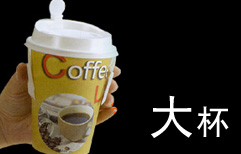
I'm confused by a measure word point in the final sentence of the dialogue - when summarising the order the waitress says "一杯大杯的每日咖啡,一杯超大杯的香草拿铁。。。"
Now, I would have said the following: "一大杯的每日咖啡,一超大杯的香草拿铁"
I don't think the waitress's first "杯" each time is necessary since the measure word already follows the size classifier. Would my version also be grammatically correct (my own coffee each day at SB is a large Americano and I have always said 一大杯美式 and nobody has ever corrected me - so please do let me know if I should be saying 一杯大杯美式 instead!).
Thanks, Chris

bodaweiJune 19, 2011
(I reckon) this is a pretty good question Chris..
The dialogue is correct I think, and the way I would explain it is that the second 杯 is not a 量词, 大杯的 is an adjective describing the noun 每日咖啡 .. but I am the first to admit that I have a grammatical tin ear.
Although it soooounds fine to me I would not normally say this - I say it like in the second line of the dialogue: 一杯每日咖啡,小杯的 - this is what I commonly hear. The size, qualifying the order, comes straight after - particularly if you are ordering two or three different sizes. I think maybe people say it this way because the other option is a bit of a mouthful.
zhenlijiangJune 19, 2011
I think the 大杯 here is the same as the English "a Large/Tall"--as opposed to "a large cup of." I wonder if it wouldn't be natural to use 个 as the measure word: 一个大杯(的)每日咖啡. No?
Not trying to show you up or anything but I noticed that you referred to 一大杯卡布其诺 in an earlier comment (not ordering or repeating an order there). It does seem preferable, more intuitive, to avoid the double 杯's doesn't it. I'm also reminded of a measure word discussion we had a while back (which won't open now) on 一盆花 VS 一个花盆:
https://chinesepod.com/lessons/the-pen-and-paper-mystery#comment-158327
Measure words aren't that easy sometimes. So I agree, a good question from Chris.
bodaweiJune 19, 2011
zhenlijiang
Thanks for reminding me of that conversation about flower pots etc. - and Changye telling me that 假花 is okay, but look out for 假发 (wig). :) Yesterday I heard 假牙 (false teeth.)
'Large/Tall'
After acronyms, these words are my second biggest 'hate'. :)
The smallest drink you can get at Starbucks is called 'Tall'. But I take your point - they are probably equating 大杯 with one of these copyrighted words that have no meaning.
And I agree it sounds less of a mouthful if you use 个 - really people are not too fussed about that. But I can imagine a waiter saying it all out properly as in the dialogue - I still think it is correct.
I did say 一大杯卡布其诺 above, well spotted. :)
As I was in writing mode I was being reductive (is that a word) - I should have actually dropped the 一. If speaking I would have said either 一个, or 一杯。
sclimJune 20, 2011
I think bodawei nailed it elegantly,
"and the way I would explain it is that the second 杯 is not a 量词, 大杯的 is an adjective describing the noun 每日咖啡 .."
despite his protestations of a "grammatical tin ear".
So, Chris, if you, as you proposed, would have said the following:
"一大杯的每日咖啡,一超大杯的香草拿铁"
this would offend Chinese syntax in that the 量词 is missing, (the 大杯and 超大杯 in your sentence being, as bodawei says, definitely adjectival in function.) They can't be both adjectival and 量词 at the same time, so the 量词 is glaringly and jarringly missing in action in your proposed construction, as it would be in, say, 請給我一書. It needs a 量词, in your case another 杯 for each item, although, I guess 个 would be ok, as an alternative, I think.
chrisJune 20, 2011
Thanks for the thoughts everyone! I actually tried 一杯大杯美式 this morning and it didn't raise any eye-brows, although to be honest after several years of being pretty much the first customer each day, the staff on the morning shift know my breakfast order off by heart anyway.....

oranginaJune 20, 2011
small non-sequitur... They don't tell you this or show it on the menu, but you can order a "small" at Starbucks. I used to order it all the time. A double short non-fat latte. No one would bat an eyelash. Hmmm.... how do you say that? 一杯免油牛奶俩量拿铁,矮的。
bodaweiJune 20, 2011
Orangina - this is fantastic news! Seriously.
Not that I ever go to Starbucks. :)
Really? I thought that would be like asking for a hamburger at McDonalds without the bread roll.
Now .. about your .. drink. I take it this is a joke, right? (Remember I am Australian.) Why don't you just make yourself a cup of tea at home? :)
If it is not a joke, you have serious problems getting one in China, unless you live in one of those fancy cities in the east.
Do you ask for this drink in China? I have never heard ..矮的. Do they have that language at Starbucks? 免油牛奶 and 俩量 ?? If you mean a double shot you have to say 双份, okay? Far easier to say and nobody gets hurt. I can't comment on 免油牛奶 because we just get 'milk' where I live. :)
oranginaJune 20, 2011
呵呵,That is my actual drink in America. Really? two shots of espresso with a bit of steamed milk equals a cuppa? I haven't ordered it here.... but I have had pointless conversations about nonfat milk, and cannot find out what to properly call it. I have given up. But I did find lowfat at the store! Yay for fancy eastern cities! I've decided I don't order fancy coffee enough to worry about it. Not that I ever worried about it.... but I do need to keep my 小女人 status and not turn into a 母老虎。
By the way, you can order a meatless hamburger at McD's.... not sure about bunless. Not that I would, why bother? But the meatless McMuffin is pretty good! They don't show it on the menu either, but are quite happy to oblige. I found out about the meatless hamburger when I tried to order a meatless McMuffin at 10:01.
oranginaJune 20, 2011
Oh, and I don't know if they call it 矮的, but it is called a "short" in English. Also, in China I order a cappuccino just because I like saying 卡布奇诺。This is also why I like Greek food. Misithra. Tsadziki. Baklava. How can one resist?
bodaweiJune 20, 2011
'two shots of espresso with a bit of steamed milk equals a cuppa?'
Well no, I was trying to say that if you drink a "double short non-fat latte", in China I would give up and go home for a cup of Bushells. I think it would definitely be 小的 rather than 矮的.
Certainly things are changing fast in China - I can go not far down the road in a couple of directions and get very good coffee, but the best coffee was always in Yunnan.
I also like saying 卡布奇诺 .. and I like asking for a 芒果普丁 :)
zhenlijiangJune 20, 2011
Ah so Starbucks in China has the "Venti". I do understand what you mean about the naming. Seems the largest size now available in the US is the "Trenta" (916ml), for iced drinks only.
I have no problem with the grammar of 一杯大杯的~ actually, but I'd prefer, if it's acceptable, to say 一个大杯(的)~.
I did use to go to Starbucks occasionally in Japan (they offer a smoke-free, generic, safe environment). I have never ordered any size but a Short--Starbucks Japanese sizes are Short, Tall and Grande. Those American supersizes 我们都喝不了. And a cappucino is as fancy as I will ever get. 没意思的咖啡更好喝
Hey it's not just me then. It's the "uo" vowel combo isn't it, that we all like to say?
oranginaJune 20, 2011
ah! Gottcha. (gottcha 的意思是“明白了”)You are right, I think. Ordering a double short nonfat latte in China may be an exercise in futility.
The "uo" is nice. But the whole word is a nice combination of hard and soft sounds.

bababardwanJune 20, 2011
I have been told 低脂牛奶 for low fat milk. So I'm not sure if no fat milk would be 无脂牛奶
bababardwanJune 20, 2011
hmm, just checked and there were 328,000 hits that came up under "无脂牛奶" except checking that out on google images the first 17 hits are of models [mostly on the catwalk] and it's the 18th that is a glass of milk:
http://www.google.com.au/search?hl=en&q=%E2%80%9C%E6%97%A0%E8%84%82%E7%89%9B%E5%A5%B6%E2%80%9D&gs_sm=e&gs_upl=10216l10216l2l1l1l0l0l0l0l286l286l2-1l1&bav=on.2,or.r_gc.r_pw.&biw=1280&bih=831&um=1&ie=UTF-8&tbm=isch&source=og&sa=N&tab=wi
chrisJune 20, 2011
That trenta sounds scary. I suspect you'd spend half the day drinking it and the half relieving yourself of it!
bodaweiJune 20, 2011
Baba
Your 低脂牛奶 rings true to me, like if it existed. Because the 低中高 terminology is used for 白酒 you get in jugs at restaurants - seems to me that it could translate to milk. 高脂牛奶 - I would try that for full cream milk. Actually, some terms like this that are not so common can be different from cafe to cafe. The names of different types of 'Western' drinks are not yet completely standard.

toianwJune 20, 2011
鲜牛奶 has become much easier to get your hands on in Beijing over the past few years. It seems to come in three varieties:
脱脂牛奶 - skimmed milk (not sure if it's totally fat free as I don't go near the stuff)
低脂牛奶 - low fat (semi-skimmed???)
全脂牛奶 - full fat (to make you into a real 男子汉)
zhenlijiangJune 20, 2011
Catherine posted a link to a Starbucks menu here. Translations they give are 全脂奶 for Whole Milk, 脱脂奶 for Nonfat.
https://chinesepod.com/lessons/nearby-tea-house#comment-177664
artkhoJune 14, 2011
Jenny and John,
Listening to this lesson made me realize how much I miss your lessons in the past two years. You two are a terrific pair of teachers, a dynamic duo! But John, I'd put Jenny on a pedestal and over you anytime! ;-)
How come there's no mention of 白巧克力摩卡咖啡 in this lesson?
527922180June 11, 2011
I am a sophomore student now,and I just want to improve my english ,if any foreigner wants to study chinese I will teach him for exchange,thank you !
527922180June 11, 2011
I am a sophomore student now,and I just want to improve my english ,if any foreigner wants to study chinese I will teach him for exchange,thank you !
bodaweiJune 10, 2011
最近一间咖啡商店开了,我很高兴,这家咖啡馆精彩极了!咖啡品来自巴西,咖啡机很大,很光泽的。 马上我说给我来一杯卡布其诺号码?啊。。不太热。。克雷吗正好。。还好色彩。老板有好的,我跟他被咖啡聊天了。一大杯卡布其诺是11人民币(US1.50),没有小的。

bobm112May 24, 2011
Jenny, right after the first dialogue, you say "超冷静". I've never heard this before - "super calm". Could you maybe give some more examples or some explanation. As always, thank you for your help!

jennyzhuMay 24, 2011
You can basically use 超 the same way as you would in English by adding it to adjectives, e.g. 超可爱,超有用,超漂亮,超贵, etc.
epyon18June 11, 2011
you can also use 超过 to mean "supercede" or "surpass" someone at something.
Like "哦, 你的英文超过我的中文了!“ Your English has surpassed my Chinese.
epyon18June 11, 2011
超人 - superman
超爽 - super pleasurable
超市 - super market
超牛 - super awesome!
超坏 - super bad
超清楚 - super clear
da_ma_xiuMay 24, 2011
John, Jenny, 你们好。下个月我第一例要去中国。由于我离不开咖啡,这节课就非常有用!我很爱收听你们的课程,因为听以后普通话像又有道理又简单!我在上海的时候,你门推荐我参观哪里?(我只呆几天)
谢谢。
bodaweiMay 24, 2011
How to make coffee on a home machine (for those who don't get excited by the Starbucks sign):
http://www.smh.com.au/lifestyle/homestyle/blogs/tried-and-tasted/tips-for-a-top-coffee-20110523-1f07l.html(Sydney Morning Herald, 2011 May 24.)
bodaweiMay 24, 2011
The staff at our favourite cafe just started wearing name tags.
Me: 那个名字的东西中文怎么说? 胸卡?
Her: uum, uum, er...
Me: 胸牌?
Her: er..
Me: 名牌?
Her: er..
Me: 标志?
Her: 不是。
Me: 胸卡?
Her: 可以,还是..胸牌.
Me: 胸牌?
Her: 胸牌..
Me: 胸牌.
Her: 对对对。。
cowenparkseattleMay 24, 2011
The male speaker says what is transcribed as 亲爱, but it sure doesn't sound like "qin1 ai4", either in the dialog MP3 or as a female speaker says it in the individual dialog sentences. (In the vocabulary words as individually pronounced, it is exactly "qin1 ai4".) What are they saying? It kind of sounds like one syllable, "qie4" or something.
da_ma_xiuMay 24, 2011
I think it's just spoken quickly, almost as though the 'i' in qin is missed out. Kind of how 'do you want' turns into 'dya want' or even 'ja want' in English.

zhong_bideMay 21, 2011
70块钱。这么贵!
At those prices coffee is more expensive than where I live in Australia, despite the lower cost of labour in China. But a jar of Nescafe is expensive for the locals in China too.

marcheyJune 6, 2011
I agree. Coffee is way too expensive in China. And quality is certainly not guaranteed. In some places the waiters just don't have a clue. I feel it will take a long time before there will be a real coffee culture in China. When I visit China I often get my cuppa at mcdonalds, cheap and not too bad if they make a fresh pot for you.
bodaweiJune 11, 2011
'Coffee is way too expensive in China'
Well, in Shanghai yes, apparently, although I never paid the prices quoted in this lesson. You can get a good large cup/mug of Italian style latte or cappuccino for 11 rmb ($1.50) - about 25% - 30% the price of a similar product in Sydney Australia. Given that the coffee and the machine are imported I would not describe this as 'way too expensive'. Another way to see this is as the coffee culture spreads here the prices come down, relatively speaking. But they were always cheaper than the West.
weibwoMay 21, 2011
In my past life I was part owner of a gourmet coffee roasting and distribution company. We had a retail outlet and sold roasted coffee beans. It would be fun to know the terminology of this kind of retail store. For example how would one buy a kilo of Columbian Supremo, Ethiopian Harrar, Java Estate Number 1, Jamaican blue mountain Wallensford Estates #1, Kenyan AA, Mexican Primo Lavado, Brazil Santos, Costa Rican Terrazu, Sumatran Blue Lintong etc. in Chinese.

tucsonmichaelMay 20, 2011
Nice lesson. You might want to mention how many fluid ounces or milliliters are in the various Chinese size coffees, because my experience that Chinese sizes are smaller than American sizes, so a Chinese 超大杯 might be equivalent to an American 大杯. Also I prefer to drink 美式咖啡 "black coffee", and I embarrassed myself in China when asking for 黑色的 咖啡 instead of 青咖 :-)
bodaweiMay 21, 2011
'Chinese size coffees'
There is no standard here in my experience. At least one chain follows the tradition of a 4.5 ounce cup, but others mimic the enormous cups sold by American chains. There is no indigenous coffee culture apart from that found in Yunnan.

yarajeevMay 20, 2011
Is 每日咖啡 used to say drip coffee (US)/filter coffee (UK)? I forgot the name 星巴克 used for this kind but I'm pretty sure it was rather different.
This lesson isn't much use if you go to 山岛 (UBC) coffee, there knowing your varieties is more useful (蓝山 is the only one I remember off the top of my head).


mjvitoMay 20, 2011
Chinesepod/John war on cilantro continues :) Will we ever see an expansion sentence where someone asks to add more to his or her 牛肉面?


jerryrockMay 20, 2011
Thanks to the lesson master(s) (谢谢) for the recent string of clear lessons. They make learning enjoyable. This lesson will be expecially useful since covers about a daily event in my life.

lidiluMay 22, 2011
Good to know it's useful :) Actually some of our poddies did ask for coffee ordering related podcasts. I was sent to a fancy coffee shop as a spy for this lesson. It was fun to listen and record real conversations there.
bodaweiMay 22, 2011
That's cool to get some background on how the lessons are made, thanks Dilu. 'fancy' coffee shops - is that code for Starbucks?
bababardwanMay 22, 2011
very cool. some on the ground research. It would be so funny if a poddie recognised the dialogue as a convo he/she had had.

veronique21May 20, 2011
请问, Jenny, 你 刚才 开始 说明 对话 的 时候 说 什么 呢 (1'34) ? 我 真 的 听不懂。即使我 不 喜欢 咖啡, 我也觉得今天的课程很有意思 ! 谢谢 你们 俩 !
jennyzhuMay 20, 2011
我说“这个男人超级冷静(chāojí lěngjìng/super calm)”。I was referring to the male voice actor. He sounded way too subdued to be on a fancy coffee date.
veronique21May 20, 2011
Oh, 谢谢。I thought you were saying that this man is macho. I still have work to do to improve my listening comprehension (especially 拼音).

xiao_ma1119May 20, 2011
Nice lesson. Want to thank you for your work, especially since my Chinese friends are starting to notice an improvement :-)
一份蛋糕和一块蛋糕有什么不一样?In my head I wouldn't use one at my friend's birthday party (份蛋糕).
我现在饿了.
jennyzhuMay 20, 2011
Very glad to hear about your improvement! 一份蛋糕/yīfèn dàngāo and 一块蛋糕/yīkuài dàngao both mean "one piece of cake". But the word 份/fèn is used more in restaurant settings. If you are dining at home, you would not really use 份/fèn to describe a portion of food.
What did you notice in this lesson?
You are posting as a guest. Your reply is reviewed before it appears. Log in to post without review.