graxMay 4, 2012
Hello,
I have a question about a usage. In the expansion, there is the sentence,
昨天他一直都在家学习,没出去玩。
Can you say
昨天他整天都在家学习,没出去玩。
Can you use 整天 when talking about the past?

mapabilityassociation183June 27, 2012
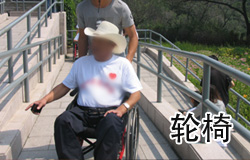
We are building the greatest crowdsourcing initiative on accessibility, with user generated mobile maps for wheelchair.
Help us spread the word and collect funding here:
www.indiegogo.com/mapability
For more information visit www.mapability.org
drbilllongApril 21, 2012
The evolution of the term "disabled" in American culture of late is interesting. It was the passage of the Americans with Disabilities Act (1991) that officially made government start using "disabled" rather than "handicapped" (the "official" term previously). The passage of the ADA, however, further sunk American English into a linguistic prison, as we struggled to determine if people really were "disabled" or "otherly abled" or some such word. It seems that the prefix "dis" is increasingly associated with the "dis" of "disrespect"--hence, we are not sure what word to use to describe--um--"them."

mantidMarch 11, 2012
A few years ago I went to 黄花城 (yellow flower great wall). Definitely no disabled access there...it had only just started being restored and was deserted. Fabulous!

blondjulkaFebruary 17, 2012
大家好!请问词典和字典有什么区别?谢谢!

jennyzhuFebruary 17, 2012
词典 focuses on different words whereas 字典 focuses on individual characters, it's way of writing, pronunciation and a few commonly used word formations.





markFebruary 9, 2012
In regard to wheelchair access to 八达岭, when I went there to become a 好汉 the summer before last, I only noticed a gondola to near the top. One would still have to go along a fairly wheelchair unfriendly path to get to the base of the wall, and the wall itself would be impossible to negotiate. I guess wheelchair accessible wasn't high on 秦始皇's agenda. There was a fortress area lower on the wall, that may have had elevator access, but not having been there, I couldn't promise.

xugandeFebruary 8, 2012
Hi John. In this part of the world "handicapped" is totally non-PC and unacceptable. As a cataloguer in an academic librarymore than 20 years ago one of my jobs was to change all of the subject headings containing the word "handicapped" to "disablec". Unfortunately at that time it also meant changing every individual catalogue record!


JohnFebruary 9, 2012
Yikes! I wonder how long before "disabled" is no longer PC either...?? (Fortunately we now have electronic text and "search/replace"!)
mattFebruary 9, 2012
I think a good part of Chinesepod is that it gives the listener a sense that the world is not a uniculture. Therefore Chinesepod shouldn't have to conform to, or be handicapped by, the union of all its audience's 'political correctness'.
rodsFebruary 9, 2012
I don't find either term offensive ... considering the alternatives. Don't worry about what you call the guy, worry about whether or not he can get through the door. :-)

wangaimeiFebruary 10, 2012
even now, people often forego the word 'disabled' and use 'differently abled' instead. I wonder if there is any end in sight to all this PC mumbo jumbo. It's one thing to be sensitive to others, but constantly having to walk on eggshells trying to figure out what is the most politically correct way to say something is a bit much.


wei_enFebruary 8, 2012
I've always been curious where you all find the great photos to match every lesson. Seems like you go to a lot of trouble for that.

jennyzhuFebruary 8, 2012
Taxi companies in Shanghai have started to add wheelchair access to taxis.

chrisMarch 4, 2012
I suspect it's just for those taxis they introduced just before the Expo, i.e. the ones with the higher wheel base. I can't imagine it would be too easy to add wheelchair access to the santana fleet.

zhong_bideFebruary 7, 2012
Last time I went to Mutianyu there was no wheelchair access.
You had to go up there via a chair lft, unless you were really keen to walk the steep walk to the wall. Then when you got there it wasjust step to climb - it would be difficult to make wheel chair access without spoiling the wall structure.

pretzellogicFebruary 7, 2012
Cool topic. Wheelchair accessibilty to sites is a challenge in many places worldwide still. I haven't listened to the lesson discussion yet, but would be curious if any wheelchair accessibility is an issue at all the Great Wall sites? It might be helpful to know that the Great Wall is not a continuous wall, but you go to a site where you access the wall, and that site's facilities might have what you need. So visitors would need to know if they're going to the Mutianyu, Simatai, Badaling Great Wall or one of the other sites.
What did you notice in this lesson?
You are posting as a guest. Your reply is reviewed before it appears. Log in to post without review.