

xiaomai4July 3, 2013
How would one say satsuma in Chinese? 'juzi' is tangerine and 'chengzi' orange but there doesn't seem to be a separate definition, thanks all

xiaomai4July 2, 2013
@Connie, thanks for your comments back. I was trying to say I like eating 'parsnips': is this 欧洲防风? I may have pronounced it wrong. Thanks
MingmaoJuly 1, 2013
Dragonfruit are readily available in specialty or high-end grocery stores in Vancouver. All the ones I've had have been exceptionally bland, however. Perhaps they don't travel well.
Similarly, I'm crazy about 山竹, but you just can't get good ones around here. I got some good ones in Beijing and some better ones in Sichuan. Locals told me that next time I go to China I should plan a trip to Yunnan in late May if I want to have really good 山竹 and other tropical fruits.
bohan2007June 25, 2013
so, 份 (fèn) can never be used for drinks?

rosamagliolaJune 25, 2013
Right, because 份means the portion for a person:人and 分combined。飲料Is served in a glass most of times, thus you order by 一杯or 一亇,ie一杯茶,一杯咖啡。to bartender, you may say 一瓶青島啤酒,or simply 一亇威斯基,一亇芧台⋯
rosamagliolaJune 25, 2013
亇is the most commonly used unit. It is non-specific, therefore very safe, generic in nature. I.e. 我昨天見到了一亇老朋友,or 一位is more formal. Or saleslady may ask you: "你要幾亇?",apples, bananas⋯
Rosa 髙宗玉traveling in flushing, queens borough,NYC this summer.
bohan2007June 26, 2013
Cool thanks. So, it's the same as 個, right? I haven't ever seen the variant that you typed out, though it resembles 个

veronique21June 27, 2013
I think that Rosa writes traditional characters. A good way to learn to read them.
xiaomai4June 29, 2013
yes but answering in traditional characters is not great for someone at ellie level! not sure I see the point in doing that really except to show-off?

Right-WingnutJune 29, 2013
Huh? There are Ellies out there who learn traditional characters exclusively. We are all given the choice of Traditional or Simplified PDF downloads. Why would using the character set that you are familiar with amount to showing off?
xiaomai4June 30, 2013
true, but clearly everyone was talking about basic learning and using simplified characters so to switch into traditional is a bit unneccesary. I'm not surprised you replied to this.
Right-WingnutJune 30, 2013
Not surprised? Really? Because you know I like replying to provocative posts?

bodaweiJuly 1, 2013
xiaomai,
'to switch into traditional is a bit unneccesary.'
RWN makes a valid point here .. your comment I highlight above suggests you misunderstand the use of simplified vs traditional sets. You can't assume someone is 'showing off' using the latter.

steeveepee33July 1, 2013
meh... I'm with Xiaomai in a sense... I don't enjoy someone trying to teach me Chinese in a setting where I cannot read or hear what's being presented. If the majority of individuals here are learning simplified characters, and also participating in elementary level lessons (1 level above the beginner level!!!), then I think it should be common courtesy to provide at least some pinyin.. "Showing off or not showing off" is not really the point, but I can understand the frustration.
Right-WingnutJuly 1, 2013
"If the majority of individuals here are learning simplified characters, and also participating in elementary level lessons, then I think it should be common courtesy to provide at least some pinyin."
Now I'm really lost. Paraphrasing your sentence:
IF I'm learning Simplified characters THEN please use Pinyin????
The issue had nothing to do with the use or non-use of Pinyin.
It was about the use of Simplified vs Traditional characters.
Whether it is about someone not using your preferred character set, or whether its about someone not using Pinyin - just download a mouseover dictionary - Perakun translates both Simplified and Traditional.

tingyunJuly 1, 2013
The cpod staff all reply in simplified already. Those users who choose to use traditional charecters are here for their own learning purposes, not to teach you or anyone else. They already have to deal with virtually everyone else's comment being in simplified - why try to claim that they are impolite for simply leaving a comment in the charecter set they prefer?
Right-wingnut's dictionary suggestion is a good one - alternativly cut and paste any comment into google translate and it can switch back and forth from simplified and traditional. All in all would take you about 10 seconds.
But really, I don't understand this obsession about getting every comment...foreign learners of Chinese make for a terrible choice of reading material to begin with, grammar and usage weirdness is prevalent even in very advanced learners, missing one traditional charecters written comment isn't going to hamper anyone's learning...
steeveepee33July 1, 2013
RWN, if you're not willing to consider anyone else's comment, then why do you yourself comment, only to repeat what you've already said? I don't understand it.. Anyway, to clarify what you may still not understand about my comment, the use of Pinyin on a site gives individuals a convenient method of learning a symbolic language that they may be unfamiliar with. Sure, we can download these little tools such as what you've mentioned to translate such things, but there are individuals that are not familiar with this. There's really nothing to debate about this. The comment was left as a very clear observation.
steeveepee33July 1, 2013
Tingyun, I don't recall saying someone was impolite. My comment was made as an observation for those on the other side of the learning curve. You are correct that they do not have to, and I never implied that they have any obligation to do such things. I just left my comment as an observation that it would help others in their learning if they are able to translate what is being discussed. Whether it does or does not hamper anyone's learning is also a matter of opinion. I myself believe that it would help. But again, I never said anyone is rude for not doing so. You guys seem a little hostile over someone making a small comment over how something may or may not help others. How do you expect to be part of a learning community? And by the way, your statement says that someone is there for their own learning purpose, but the person actually answered someone else's question, which is why this started in the first place. So she was also teaching.
tingyunJuly 1, 2013
Saying something is "common courtesy" implies that those not doing so are being impolite, no? Eh, no use debating subtle differences in english implications, perhaps we just have a different understanding of these words.
I don't think my comment was hostile, but I do have a rather direct style that sometimes comes off that way - rest assured I have no hostility or illwill towards you or anyone else here. :)
On your other point, I don't think answering someone's question subjects one to any sort of additional requirements - I still think we just set our own terms and people can take the help or leave it. Hence, my replies to people often get quite off topic and end up in long-winded academic musings...
Right-WingnutJuly 1, 2013
Allow me to address each of your 'points'.
* "There's really nothing to debate about this. " So why are you?
* "The comment was left as a very clear observation." Not very clear at all I'm afraid. Your 'observation' was that people should use Pinyin BECAUSE most people here use Simplified characters. You still haven't clarified that connection.
* "if you're not willing to consider anyone else's comment ...". Does 'consider' mean 'agree with' in your vocabulary?
* "only to repeat what you've already said". I can't see where I repeated what I'd already said, unless you're referring to the fact I accidentally double posted. I hope you're not being that petty.
* "but there are individuals that are not familiar with this". Then we MAKE them aware, like now. Teaching on this site is not limited to Mandarin.
ashaman5June 24, 2013
I'm just working from online dictionairies here, but is there any sense behind pineapple being composed of the characters for spinach (bo1) and radish (luo2)? all the other ones kiwi, mango, etc. are pretty comprehensible. but I can't wrap my mind around the "spinach radish"
veronique21June 24, 2013
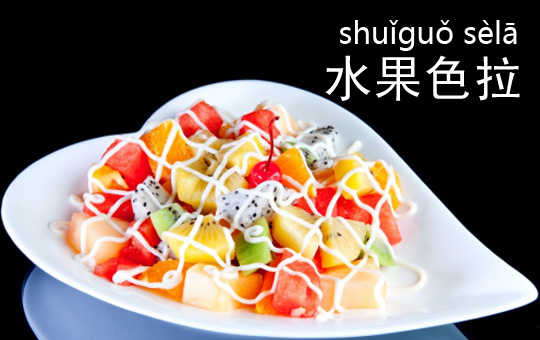
I know that Chinese people usually don't eat desserts. So is it possible to order a 水果色拉 in a restaurant ? In what kind of restaurant ? And when ?
bodaweiJune 24, 2013
As long as I can remember they've had dessert in Hong Kong and Macao, and elsewhere dessert is a snack; but it is certainly different to the western concept of dessert. Now desserts are common around China - various outlets like Honeymoon Dessert have a large menu with multiple variations on 水果沙拉。 Very good by the way .. I particularly like 西米 (sago) desserts.
veronique21June 25, 2013
Thanks, Bodawei, that's interesting. I've travelled several times in China but I've never noticed desserts in the restaurants I've been to. But I was more in the North than in the South... I had never heard about 西米.
xiaomai4June 29, 2013
they eat lots of desserts in the South, there are even restaurants just selling desserts solely! :)
MingmaoJuly 1, 2013
I was in several Chinese cities last summer; my experience in all of them was that desserts are often sold at separate outlets. It's sort of like we have ice cream shops in North America. They seem to have a lot of pudding-type shops with 西米露, double-boiled milk custard (双皮奶), or mango pudding, all with various extra options such as chunks of preserved, sweetened coconut, sweetened red beans, etc.
Some cities I went to actually had a chain of specifically fruit-salad restaurants. They were usually more up-scale, in malls; trendy hang-out places.
In general, going for dessert seems to be more of a social thing, rather than the last course of a regular meal.
Actually, most cities also had Haagen Dazs shops that sold fancy, tiny ice-cream cakes.
veronique21June 24, 2013
I knew the word 沙拉 shālā for "salad" but I had never heard or seen 色拉. Is there any difference between the two words ?

tysondJune 24, 2013
I've heard both in the same Subway store in Beijing (officially their menu uses 沙拉, I order using 沙拉, but often get 色拉 as a response).
bodaweiJune 24, 2013
Transliterations in general often use a variety of characters, even a variety of pronunciations, as in this case. See also the various expressions for cheese. Variety is the spice of life.
bohan2007June 25, 2013
I was about to ask the same question. I just did a word search on Chinesepod and saw that there are at least three lessons with 色拉(sèlā), but no search results for 沙拉(shālā) . Is it fair to say that mainland Chinese use 色拉 more often ? I think Taiwanese people only use 沙拉

mafanniJune 23, 2013
In the expansion section can you expand upon the use of '点了' to help us better understand it's use.
in this sentence '我点了一份披萨和一份蔬菜色拉。(I ordered one pizza and one vegetable salad.) ' how can we know the meaning?
also, it is one slice of pizza or a whole pizza? do they sell pizza by the slice in China?
我点了一份披萨和一份蔬菜色拉。
(I ordered one pizza and one vegetable salad.) - See more at: https://chinesepod.com/lessons/ordering-a-fruit-salad#expansion-tab
我点了一份披萨和一份蔬菜色拉。
(I ordered one pizza and one vegetable salad.) - See more at: https://chinesepod.com/lessons/ordering-a-fruit-salad#expansion-tab
veronique21June 24, 2013
In chinese, to order a dish is 点菜 diǎncài. So you can say: 点什么什么: 点一份烤鸭 (kǎoyā) / 一分红烧茄子 (hóngshāo qiézi) / ...
mafanniJune 24, 2013
xiexie
in this sentence
'他又点了一根烟。
(He lit another cigarette.)' , dian le means 'lit'? and if so, how?
mafanniJune 24, 2013
xiexie
in this sentence
'他又点了一根烟。
(He lit another cigarette.)' , dian le means 'lit'? and if so, how?
- See more at: https://chinesepod.com/lessons/ordering-a-fruit-salad#sthash.w1jTNPJ8.dpuf
rosamagliolaJune 25, 2013
奌菜和奌煙,the same 奌both are verbs, yet different actions; the former order, literally use the finger pointing the menu for the choice of dishes, the latter lit is the action of striking a match ...Chinese describes fire started with a star of fire, very small to begin with thus 奌火(point fire) indicate the motion of initiate the fire. In the literature:星星之火,足以燎原。le is only to show the tense (in grammar ), the present perfect tense :現在完成式,He has just lit a cigarette. 了is the sense of complete as in 完了。hope this may clear a bit.
veronique21June 25, 2013
That's right, 点 has many different meanings, such as 点名 (call the roll), 点火 (light a fire), and so on. Very interesting word, actually...
mafanniJune 26, 2013
thank you. this is the first time I have come across this pattern. do you have other examples? xiexie
mafanniJune 26, 2013
thank you....way above my pay grade(understanding)...LOL!
do you have other examples of this pattern being used? and the use of 定了 also be acceptable and which is more natural to use? xiexie
rosamagliolaJune 26, 2013
I assume you would like to know the patterns of present perfect tense (grammatically) by using the 了as in 完了(please note the differences between 完 wan and 定 din-- meaning certain):
你吃飯了嗎?
我吃飯了。
你信寫好了嗎?
我信寫好了。
你到家了嗎?
我到家了。
Just use it whenever you have the chance, they become yours...
Rosa, on my way to Philadelphia wishing you have fun;-)
veronique21June 27, 2013
Hey Mafanni,
Here is the definitions of 点 in Wenlin:
点(F點) [diǎn] dot; a little, bit; (点火) light a fire
点[點] ¹diǎn* n. ①a drop (of liquid) ②a spot ③dot stroke (in Chinese characters) ④dot; decimal point; point | sānshíqī ∼ wǔ 37.5 ⑤place ⑥aspect; feature ⑦appointed time ⑧refreshments ⑨〈lg.〉 node; peak; point ◆m. ①(for small amounts) | Gěi wǒ ∼ qián. Give me a little money. ②(of time) | sān∼ zhōng three o'clock ③(for items/matters) | Wǒ yào shuō de yǒu liǎng ∼. There are two points I want to talk about. ④(printer's point size) | Sì hào zì děngyú shísì ∼. No. 4 type is equivalent to 14 points. ◆v. ①put (a dot) ②drip ③sow in holes ④check one by one ⑤select; choose ⑥hint; point out; mention | Zhǐyào yī ∼, tā jiù míngbai le. You only have to mention it, and she'll understand. ⑦light; burn; kindle ⑧touch on briefly; skim | Lǎoshī ∼le zhè shì. The teacher touched on the matter. ◆cons. v. zhe ∼polite command/reminder to v. | Guò mǎlù ²shí kànzhe ∼. Watch out when you cross the street.
Can you see the general sense / idea of the character through these examples ?
mafanniJune 30, 2013
sorry that went over my head... your example of 点菜 was excellent in that I've noticed the Chinese language likes to recombine works-like Lego- and cutting out parts. so the dian cai I can see how it got to dian le by cutting out the cai.
is there other words starting with dian that fall in this category?
Hopefully I made myself clear.
veronique21June 30, 2013
You mean V.O. starting with 点, I think. Well, dian3ming2 is one. I'll have a look to tell you. You're right, Chinese vocabulary is sometimes like Lego and it's quite easy to remember vocab because it's logical.
What did you notice in this lesson?
You are posting as a guest. Your reply is reviewed before it appears. Log in to post without review.