emilmuellerSeptember 19, 2020
Hello! I wonder if you could also say 去几楼 instead of 到几楼. Or would that sound rather weird?

BeccaChuOctober 30, 2020
Hello! This is a very good question! You can say both in this case. 到几楼 and 去几楼 would mean the same thing in the context of saying which floor do you want to go.

MayHaNNOctober 18, 2018
Note to course team
I've been using Chinese Pod for a few days now, and although I'm learning a lot from the lesson and the dialogues, I feel that the exercises are not properly designed. Have a look at the last exercise in this lesson, it's a completely different level than the lesson and almost impossible for me at this stage. I had to look up most of it in the dictionary in the "tools" section, and many or most of the words corresponded to lessons in more advanced levels. The only part of the exercises I find useful is the first one, where you link words to their meaning, and the dictation; the ordering of the dialogue might be challenging for more advanced leves, but here it is really easy, whereas the final exercise is undoable for a newbie.
Since the exercises are one of the elements that motivated me to sign for the rather expensive Premium+ option, I feel a bit disappointed about them.
Thanks a lot.

Grace WongOctober 21, 2018
MayHaNN, I apologize that your experience with the exercises hasn't been good. I will say that this lesson was published almost ten years ago. I hope that our exercises have gotten better since this.
MayHaNNNovember 4, 2018
Grace, thanks a lot for your answer.
I guess I'm using the lessons as they appear in the "practice" tab linked to the ATWTI videos, so some of them might be indeed too old. I don't think I've come across yet a recent lesson using that method (I'm now in ATWTI 20).
One thing I've realized is that it is useful to learn the supplementary vocabulary and study the expansion sentences before trying out the exercises, since those include many words and sentences that are not in the dialogue, but in those other tabs instead.
Since I posted that comment, my experience with the exercises has become much more rewarding.

ElijahWNovember 5, 2018
MayHaNN,
I had a look at the exercises on this lesson, and actually, believe it or not, they are correct for this level - but it should not come as a surprise that they are super hard for you right now. Each of the 4 parts of the exercises come from different parts of the lesson: The "Matching" section is from the Vocabulary, the "Sentence Re-Ordering" is from the Dialogue, and both the "Dictation" and "Multiple Choice" come from the Expansion sentences. All of the multiple choice sentences came straight off of the Expansion tab for this lesson.
When you first begin a level, some parts of the lesson are significantly harder than others. Since the Expansion sentences aren't actually part of the lesson, those are incredibly difficult (impossible?) for someone new at a particular level. Don't let that bother you. As you progress through Newbie lessons, those sentences will get easier and easier, until they start to annoy you because of how easy they are. When that happens, it's a good sign that you are near graduating to the next level.
For now, when you get to the matching, just look back at the Expansion sentences for the answers. No need for a dictionary.
Also, don't let the age of this lesson put you off, either. All of my favorite lessons are from the 2008-2014 era. Some of them are downright hysterical!
MayHaNNNovember 11, 2018
Thanks a lot for that, ElijahW. Your suggestions, as always are very useful, and I have indeed started studying the expansion section before doing the exercises, and of course now they seem much easier.
What I do now with the expansion is listen to the sentences three times, hiding first the English and then the pinyin, and trying to translate them or even say them aloud in Chinese if I manage before revealing the English and pinyin again. What I have decided not to do is put those expansion sentences in my mp3 files (which I use for my walks or for commuting), since they are too hard for me right now.
And I agree about those old lessons, they are really great. I haven't tried any new content till now, since my method right now is going through the ATWTI lessons and to the practice ones linked to them, and all seem to correspond to quite old lessons which I'm really enjoying a lot.
ivor88August 11, 2009
The expansion section has the sentence 我住三樓 (wo zhu san lou) - could someone explain why is it not necessary to use 在 (zai) in this sentence?
Thanks

changyeFebruary 21, 2009
Hi triphazard
In that case, you would use the phrase 别客气 (bie2 ke4 qi) instead of 不客气 (bu4ke4qi), like 别客气,别客气了(le),你(ni3)别客气了, 你别那么(na4me)客气 etc.
Just for your information, 见外 (jian4wai4) is used to mean "Don't be such a stranger." So you often hear the following sentences in China.
哎呀(ai1ya1, interjection),别那么客气,太(tai4, very)见外了!
P/S "你不要(bu2yao4)客气" is also OK.

triphazardFebruary 21, 2009
I've heard bu4ke4qi3 be used more for saying something along the lines of "No problem" when someone says "Thank you", even though it means basically "No need to be so polite."
So I was wondering, could bu4ke4qi3 also be used if someone is just plain being too polite in normal conversation, like telling them (politely) to stop being so gracious?

bababardwanFebruary 19, 2009
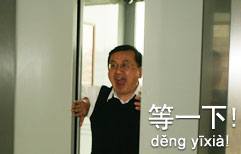
I love the irony here.The lesson picture shows the doors being held open....
trueatheartFebruary 19, 2009
if there is not going to be a chat option within a short time, then chinesepod will soon be dead...
sex sells :) even if its just words from men to women :)

dunderklumpenFebruary 18, 2009
Hi china4me,
have a look at this (scroll down). It is about the tone changes for yī and bù.

orkelmFebruary 18, 2009
missworldtraveler,
Maybe people giggled because they had seen the picture in your avatar!!!!
china4meFebruary 18, 2009
In 一下 is it first and fourth tone or second and fourth tone? On the lesson, they said it was second and fourth but when it was written in the dialogue it was first and fourth.
Thanks!
-china4me

light487February 18, 2009
Ahh.. right.. thanks! :) Glad you understood what I was asking.. sometimes I can be a bit cryptic, especially with asking about things I don't understand fully :)
changyeFebruary 18, 2009
Hi light487
The "一" in "一下" is grammatically different from that in "看一看". Actually, 下 is a measure word (量词) that indicates the number of actions. And of course, 点 is a measure word too, so 一下 is grammatically the same as 一点, as you expected.
light487February 18, 2009
This 一下 thing.. is it similar to
一点 yīdiǎn
看一看 kànyīkàn
From a etymology point of view?
giantFebruary 18, 2009
I frequently hear 等等, which is the usual repetition but I'm wondering if it's common in the north as well?
Once the 89 year old lady starts her sprint to the door, what would be an acceptable thing to say so she could take her time?
慢走
慢来
我会等你
你超快阿姨!
我很想小便快点
等等 (etc.)

paulinurusFebruary 17, 2009
During lunchtime, when there is a crowd getting in the elevator, many a times in a crowded elevator we may not get to push the button to a floor. Here in the West, we'll say "12 please" and normally the person acessible to the elevator buttons will push it for us.
When in such a situation in China, can I just say "不好意思,十二楼“ and someone will understand to press the button for me?

pearltowerpeteFebruary 17, 2009
Hi bababardwan
位 is a measure word for people that shows respect. So, for example, you might refer to 这位老师 (this teacher). Restaurants often ask you "你们几位”-- how many are in your party.
But you would not use 位 to refer to yourself-- for example "我是一位非常聪明的学生 ;-) Chinese care a lot about modesty (谦虚).
Hi tmod5862
Your question shows how "risky" it is to directly translate. 地板 refers to the floor beneath your feet, the part of the building. But 楼 is for the phrase "which floor do you live on" and so on. Please note, it can also refer to the whole building.
missworldtravelerFebruary 17, 2009
When I was in Taiwan, I never felt comfortable because everywhere I went the Chinese would giggle for no reason. For a long, long, long time I assumed they were giggling because I look a lot different from them. Finally, I read in a book (and the reading was confirmed by a Chinese co-worker) that when the Chinese get nervous, they giggle. The more nervous they are, the harder they laugh.So, when I would be alone in an elevator and then hear someone giggle, I would just tell myself, "S/He is just nervous. S/he is just nervous. S/he is just nervous...
For this and other reasons, I was thrilled when my assignment ended and I could leave Taiwan.
maureenFebruary 17, 2009
Xuchen wrote:
"I'm constantly amazed by the number of people that can fit into an elevator."
When we were in China to adopt our daughter in 2005, I was always astonished to see more people cram into what I thought was an already full elevator. In the US, people seem to shy away from any situation in which they will maybe be forced to (!) touch a stranger for a millisecond.
BTW, none of our adoption group could speak Chinese (except our guide, of course). So when we had to make it to an elevator that was ready to leave, we found that running toward the elevator and waving a hand like a crazy person was usually enough to get someone to hold the elevator for us! (Maybe carrying a cute one year old baby also helped.)
But it's always nice to know the right way to do it.
bobbenFebruary 17, 2009
我是中国人,“一”在汉语中是非常常见的,就像英语中的“a”一样,但词性不一样,英语的a不能放在句子中间,“一”可以放在边也可以放在中间,像“一天,一月,一年,等一等,坐一下,呆一会等”

chonglangFebruary 17, 2009
What is the difference
楼 and 地板
Thanks for your help.........Tom
One time I used 地板 in a elavator and the chinese couple looked at me like I was nuts......Thanks Tom
beaverFebruary 17, 2009
Hello Changye,
In the discussion you refer to 层 (ceng2) as a floor.
If you want to say that your appartement is on the 10th floor, should one use 层 or 楼?
changyeFebruary 17, 2009
Hi light487,
Wow, it's not a trip, but a tour (or a travel/journey?)! 兵马俑 are waiting for you in Xi'an.
light487February 17, 2009
Hehe.. cool :)
I am flying direct from Sydney to Shanghai on March 18.. and I will be in China for 30 days :) Going to Shanghai, Wuhan, Chengdu, Xi'an, Beijing, Suzhou, Hangzhou and back to Shanghai.. well actually I'm going back to Shanghai and then to Hangzhou on a day trip.. but I might stay extra in Hangzhou.. still working out the last week of my stay.
changyeFebruary 17, 2009
Hi light487
Your trip to China is just around the corner, isn't it?
You have to say "你去几楼?" even at the Oriental Pearl Tower in Shanghai. Don't ask me why, haha.
Maybe "几楼?" is the abbreviation of "第几楼?", but you can't say "第多少~", cause it's grammatically incorrect, so "几楼?" is exclusively used regardless of the hight of a building, perhaps.
Incidentally, "多少楼?" means "how many buildings?", but not "which floor/what floor".
When you would like to ask how many stories the Oriental Pearl Tower is, you say "东方明珠塔有多少层(ceng2)?, however in the case of the White House, "白宫有几层?" Haha, it's a bit confusing.
Another example : "你几岁" is used when asking a child his/her age, and "你多少岁" is for adults.
P/S 1
I've just come up with another "etymology" of "几楼". When there were only low-rise buildings in China, the phrase "几楼" deeply rooted in Chinese. And people still use it even when asking about high-rise buildings.
P/S 2
there is no requirement for elevators in buildings that are less than 8 storeys high.
You are right. The same goes for my small city here in northeast China. And this is the reason why there is the word "电梯楼" in Chinese, which indicates a building equipped with elevators. Unfortunately, my apartment building is not a 电梯楼!
bababardwanFebruary 17, 2009
From the expansion we have the word 位 as a measure word for people.I have seen 人 so many times now,and while 位 looks somewhat familiar[but I can't recall where now],I don't specifically recall it being used with ren.I would say ,at least,that there have been heaps of times that I have seen 人 used without 位.What's the story here? Are there any examples?
bababardwanFebruary 17, 2009
matthewfelgate,
Am I right in presuming that in your joke above ,you used 木 [the character for tree or wood] as a transliteration for move? If so,did you make this up or is this a standard transliteration?
light487,
恭喜 on getting your visa mate.好运 with your trip.
lotsofwordsandnospaces,
lol.Touche.:)

RJFebruary 17, 2009
Light,
whats odd is you will find that most buildings designate the floors by using 1F 2F 3F etc.
When is your trip?

WillBuckinghamFebruary 17, 2009
Chivalry is dead? Maybe, but then, who would want to share a lift with the unchivalrous?
Small correction in expansion exercises with the translation of "他住几楼?" which should read "Which floor does he live on?"
Will
light487February 17, 2009
From what I have read/heard, you will only find elevators in buildings that have more then 7 storeys as there is no requirement for elevators in buildings that are less than 8 storeys high.. so why install one if you don't need to? :)
I have heard 等一下 děngyíxià used in many contexts.. like when I went to pick up my L-visa this morning at the Consulate of China, it was used quite a bit as the clerks sorted through the paperwork and so on.
With floor number.. I notice that there is: 1. no use of 第 dì that prefixes the number to denote it as being an "ordinal" number like 1st, 2nd, 3rd; and also 2. there is no measure word to say that it is floor number 10 of the total number of floors. I assume this is one of those exceptions to the rule.
With the use of 几 jī I have learned that this is used when you are asking about an amount less than 10 but 多少 duōshǎo is used for amounts greater than 10.. so if I was in the lift of Jin Mao tower where there are 88 floors, would I still use 几 in this case? or 多少?

lotsofwordsandnospacesFebruary 17, 2009
Chivalry may be dead, but you should have seen the other guy!
Westerners must come across as a mixture of way too polite ( I say 'sorry' and 'thanks' and excuse myself constantly ) and like complete neanderthals ( I just never seem to get a hangover! ).
bababardwanFebruary 17, 2009
changye,
Yeah,I could have sworn I'd seen plenty of first tones remain first when followed by fourth.Thanks for your examples.Apart from those,how do you know when it applies? Yeah,I knew about the yao1 thing but good point.
Jenny,
Have you seen "Kate and Leopold" which may enhance your point here ?

jennyzhuFebruary 17, 2009
The sad truth is many people don't hold elevators for you. Chivalry is dead.
changyeFebruary 17, 2009
Hi bababardwan
You can find a lot of 一 (first tone) followed by fourth tone. The tone of 一 remains unchanged when it's used as an ordinal number, such as 一月 (yi1yue4),第一次 (di4yi1ci4),一号 (yi1hao4),and 一二九七年.
Additionally, you need to pronounce it "yi1" when you read a "naked" number such as 31791. That said, native people usually read it this way, san1 yao1 qi1 jiu3 yao1, so as not to mistake 一 (yi) for 七 (qi1).
bababardwanFebruary 17, 2009
Jenny,
I thought it must have been that.I knew bu4 changes to bu2 when followed by a fourth [I think].Thanks for confirming that.Is this the case every single time? Are we never to see a first followed by a fouth without change?
I just downloaded the pinyin chart you linked to.Very neat.I like the 1st-4th option so you can hear the difference at once.
jennyzhuFebruary 17, 2009
bababardwan,
When 一 is followed by a forth tone, it becomes second tone. For example, 一下/yi2 xia4, 一次/yi2 ci4, 一句/yi2 ju4. You can also refer to our pinyin chart for an overview of pronunciation.
bababardwanFebruary 16, 2009
Jenny,
In the audio discussion you said yi 一 was 2nd tone in yi xia.On it's own it's usually 1st tone ,right?,so is this one of those tone change rules? I love the admission to giggling in the 电梯 btw.A sign of a delightful personality.
While 等一下,will obviously do the trick,I'm wondering if this would be the most common thing to say when you want someone to hold the lift,and also wondering if there is a more specific request when you want someone to hold the lift.
It's comforting to learn 坐电题.With so many skyscrapers including Taipei 101 [?still {dubai caught up yet} the tallest building in the world] it's nice to know it's ok to sit down in these long lift rides.The Chinese are so hospitable.
Newbies,
The natural progression from this lesson is to the Ellie lesson "Don't push that button" which is here,so you can tell that 孩子 to 别按都 the buttons and to 千万别按 the emergency stop [?停] button.
xuchenFebruary 16, 2009
In China the elevators have a weight limit, just like the rest of the world. However I'm constantly amazed by the number of people that can fit into an elevator. I used to count how many people would come out during rush hour, 4-6 O'clock. I think 15 is the most I've seen.
What did you notice in this lesson?
You are posting as a guest. Your reply is reviewed before it appears. Log in to post without review.