mo_hanJuly 14, 2010
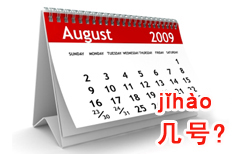
When I see a date given in mandarin, I always see the character 日 to indicate the day but never 号. Can anyone explain the diffrence? Or is it possible to use them both the same way?


JohnJuly 14, 2010
Changye is right.
I think 日 seems more proper because it's more consistent with the whole "unit of time" scheme. 年, 月, and 日 are all clear units of time, whereas 号 is actually "number" and is not directly tied to time.


pearltowerpeteAugust 27, 2009
Hi stevemisch,
That's great to hear. It does our hearts good. You're never too old to start (re)learning Chinese!

stevemischAugust 26, 2009
I work in China as a doctor and today I had a 65 year old lady patient who was born here, but then spent the last 55 years or more in the USA, so she knows some Chinese, but it's atrophied over the years. While I was chasing down her lab results and medicines I had her listen to Chinese pod in my office.
SHE JUST LOVED IT! To see her face light up as she heard her old native tongue spoken, then explained, as she watched on the computer screen was a joy to behold. She doesn't consider herself a "computer person" but it came alive for her today.
She squirmed with joy--really! She didn't know the noodle part of Chinese birthdays and enjoyed that nuance too. Good job! You may have a new subscriber. :-)
pipercubAugust 24, 2009
您好,
I did come across other words for the days of the week and i wonder if they are normally used:
Admin Edited

hobofatAugust 22, 2009
I thought it interesting that you guys described the man in this lesson as so busy he did not even realize it was his birthday! The first time through the dialogue I laughed outloud because I thought that the man was just being clever, letting somebody know it was his birthday without being so crass as to just announce it immediately!
weibwoAugust 21, 2009
Jenny
I have taught ESL to Chinese students for some 30 years. The pronunciation problem between day and date is what I call the lazy final consonant. Since Chinese does not have any final consonants that I know of. The Chinese ESL speaker tends to drop the pronunciation of the final consonant. It takes a real effort for Native Chinese speakers to concentrate on pronouncing the final consonant. I spend a lot of time practicing final consonants with my Chinese ESL students and have several drills where the student prounounces words like:
day/date
pay/paid
may/mate
may/made
However Jenny your pronunciation is superb and you make very few mistakes except for a little detectable Australian accent but that could be the Ken influence. I'd lose that.

bodaweiAugust 21, 2009
Hi culturedragon
That is more or less right, but note that the year is added at birth and then instead of using the anniversary of your actual birth you can 'pre-date' your birthday to (Chinese) New Year. The 'worst case' (in the sense of a discrepancy between the Chinese and Western calculation) is when you were actually born on (Chinese) New Year's Eve - in this case, on the following day you can overstate your Western equivalent birthday by almost two years. On other birthdates you are 'exaggerating' your Western-calculated age by less than two years. If born the next day (Chinese New Year) you can only call yourself 'one year old' until the following Chinese New Year. The exaggeration existing at each Chinese New Year increases by one day for births occuring every day after Chinese New Year, maximising in the case of birhts just before Chinese New Year. Gee, I hope i got that right.
changyeAugust 21, 2009
Hi culturedragon and dancan
That's right. And more precisely speaking, Chinese 虚岁 (xu1sui4, nominal age) is calculated based on the Chinese lunar calendar, so you add a year when you start the Chinese New Year (春节, chun1jie2). A birth certificate (and ID card) in China shows your birth year based on the Western solar calendar. Anyway, this age reckoning system is a little complicated, which might be one of the causes of Beijing Olympics' age-old problem, hehe.
dancanAugust 21, 2009
I have heard the Chinese add a year when the person is born, so what year is put on the birth certificate?
culturedragonAugust 21, 2009
I read that in China you are already 1 year old when you are born and you turn 2 on New Year's day. So a baby that was born on 28-12-2008 was 2 on 01-01-2009.
Is this true?
So when a Chinese says he/she is 28 years old, he/she could be 26 years old according to the werstern point of view?

helenshen_counselorAugust 20, 2009
@carlos_in_irvine, thanks! A really useful word for our Poddies. And this one "在这个特殊的日子里...." zài zhège tèshū de rìzi lǐ, in this special day.
@egret, it's the lunar calender birthday I guess, your lunar calender birthday is more than one month early than your birthday. Some of my friends will celebrate twice, to get more presents and fun. But, the older generation prefer to celebrate their lunar calender birthday, just keep the tradition.
helenshen_counselorAugust 20, 2009
@richnirish, good question!
1)他睡了一个钟头觉,“睡觉” is an intransitive verb, “睡” is a verb and "觉" here is a noun. 【In Chinese, there is a group of verbal-object constructions that are formed by a verbal element and a nominal element]】They can be seperate 睡......觉.
2)他睡觉睡了一个钟头, "睡了一个钟头" is a complement of duration, and “睡觉” is the verb in this sentence. You can also say as culturedragon mentioned above, 他睡了一个钟头.
3)他睡觉一个钟头,it's not correct.【Intransitive verbs cannot take objects, an object cannot directly follow an intransitive verb】
egretAugust 20, 2009
I had a few Chinese friends in University in the UK who were called up by their parents to wish them happy Chinese birthday, and had no idea it was.
Are Chinese calendar birthdays celebrated much in China now?
Off topic: Just found this, here is a recent BBC radio show to download with Jenny talking about cheese (near the beginning) - http://www.bbc.co.uk/worldservice/documentaries/2009/08/090814_cheese_to_chinese.shtml
culturedragonAugust 20, 2009
@richnirish
I am not sure, but 他睡觉一个钟头 seems somehow incomplete and there is no connection between the two parts. It's more like: He sleeps. One hour. In English you need for to glue both pieces together. In Chinese you have to use the time aspect like an adjectival clause of the verb to glue both parts together, hence 他睡了一个钟头觉.
(English is a foreign language to me and I don't know if adjectival clause is correct.)

richnirishAugust 20, 2009
HELP!!!!
I have just read a simple sentence two ways. Neither of which makes sense. The sentence is:
He slept for an hour.
I have read it as:
他睡了一个钟头觉
也
他睡觉睡了一个钟头
I would have written it as:
他睡觉一个钟头
Can anyone explain ...
1. why shuijiao is split into two words in the first sentence.
2. Why shui is repeated in the second sentence.
3. Is the way I would have written it incorrect
kaixin_in_tampaAugust 20, 2009
Another way to ask what day is today, using 日子.
https://chinesepod.com/resources/glossary/entry/日子

mudphudAugust 20, 2009
The happy birthday song in Mandarin:
祝你生日快乐 zhù nǐ shēng rì kuài lè 祝你生日快乐 zhù nǐ shēng rì kuài lè 祝你生日快乐 zhù nǐ shēng rì kuài lè 祝你永远快乐 zhù nǐ yǒngyuǎn kuài lè
(The last line yǒngyuǎn is forever.) Here it is sung.

jennyzhuAugust 20, 2009
@milanromeo, 'What is the day today' is 今天是星期几?/jin1 tian1 shi4 xing1 qi1 ji3?/
星期/xing1 qi1/ means week. Monday to Sunday is 星期一 、星期二、星期三、星期四、星期五、星期六 and 星期天。

changyeAugust 20, 2009
Hi joelaessig
I'm not sure about that. Maybe you can say "祝你生日快乐" in that case. Actually, one of my Chinese friends held his birthday party IN ADVANCE a few years ago due to his business trip scheduled on his birthday. We shouted "提前祝你生日快乐" at the party. 提前 (ti2qian2) means "in advance".
P/S. Thankfully, shenyajin has given us the answer, “迟到(chi2dao4)的生日快乐”. (Happy delayed birthday)

helenshen_counselorAugust 20, 2009
And "生日歌" is the easiest song I've ever heard in my life! 生日歌,Shēngri gē,birthday song
Hi ncmuck, 迟到的生日快乐!:-)

joelaessigAugust 20, 2009
@changye: is there also an expression in Chinese to express that I wish someone "Happy Birthday" in the aftermath?
changyeAugust 20, 2009
Hi ncmuck
It seems to be a little too late, but let me say "祝你生日快乐" (zhu4ni2 sheng1ri4 kuai4le4, Happy Birthday to You). I also had "a happy birthday" when I was young, but not anymore now at this age. A Japanese saying goes like this, "New Year's Day is a milestone on the road to the next world." The same is very true for a birthday, hehe.
ncmuckAugust 20, 2009
Wish we had this lesson 9 days earlier, it was my birthday!
As a non-native English speaker, I too had difficulties with 'day' and 'date'. It is complicated as the word for 'day' and 'date' in my native language is the same. (Though we have seperate word for 'day', it is considered old fashion to use it)
Until high school, I used to call my 'birthday' has 'happy birthday'. For e.g. 'Today is my happy birthday', 'August 11th is my happy birthday'.
jennyzhuAugust 19, 2009
I notice that many non native speakers of English (myself included) tend to confuse the words 'day' and 'date' when asking what's the day/date today. It might partly be that the two words sound slightly similar, but we tend to say 'day' when we should say 'date' and vice versa.
What did you notice in this lesson?
You are posting as a guest. Your reply is reviewed before it appears. Log in to post without review.