
ontrackNovember 23, 2010
There's a mistake in the vocab and dialogue pop-up. The definitions of 西药房 and 中药房 are both wrong. They should be defined as "Western medicine room/pharmacy" and "Chinese medicine room/pharmacy"
ontrackNovember 23, 2010
and it's not necessary to call 中药 "traditional Chinese medicine". Unless you want to call 西药 "traditional Western medicine", it's inconsistent

JasonSchNovember 23, 2010
Thanks for noticing, we'll have the end of the definitions added. As for 'traditional Chinese medicine', that's not our invention, but rather, one of the most common ways 中医/中药 are translated. You can check out the wiki page by the same name, here.

bodaweiNovember 16, 2010
Recent news report in Kunming included the following:
近几个月来,全国多个城市血库告急,昆明更是遭遇严重的“血荒”,在各方共同努力下情况初步缓解,昆明市260多家医院已能保证手术用血。*
I post this because of the reference to more than 260 hospitals (not to alarm foreigners contemplating a visit about shortages of blood.) In a city of about 4 million people (2006) it seems that there are at least 260 hospitals!
Purely from observation I would say that there are a few (say 30 or 40) large hospitals around the city, and so there must be many many small hospitals. (What qualifies as a 'small hospital' is unclear - as I say above, many are clinics located in residential streets.) Some only deliver traditional medical services. Most hospitals deliver a combination of Western and traditional medical services.
*It seems that the classifier for a hospital is 家, same as for a business. The dialogue does not include any conversation using a classifier for a hospital. It has a phrase 去一趟医院 - here the measure word 趟 refers to a *trip* to the hospital, not the hospital itself. Interesting construction.

lujiaojieNovember 15, 2010
在北京和上海,大医院,有名的医院人非常多,大概是因为全国人民都来看病了。比如上海的“华山医院”“第六人民医院”之类的。去一次真的很发愁。一些小医院人就比较少。

feixingyuanNovember 15, 2010
I am having trouble downloading lessons to my iPhone. Qing Wen seemed to work, but I cannot see the M-F lessons on the iPhone. Anyone else having trouble with this?

peterning11November 16, 2010
Hi 飞行员;=D, can you tell me if you are downloading the lessons using the iPhone App? Or using the RSS feed via iTunes?
Are you referring to the News & Features lessons (M-F lessons)? Your iPhone App lessons list should correspond with your dashboard/manage lessons lessons list. Are you able to download the newly published lessons? Intermediate - Farewell Dinner
Upper Intermediate - Hospital Visits and Prescription Medication
hiewhongliangNovember 15, 2010
《团团转》这一句听起来真有趣。查查这AAB式的重叠词,其他举例更可爱-哈哈笑,哇哇叫,喔喔啼,拍拍手,排排坐,节节高。。。语音真令人欢心!
《团团转》原字《團團轉》也满有韵味。我心中的情景:三名专家,两国一车,驾来驾出,总返原团。
CPod 老师们,谢谢你 (哈哈,也又一个AAB式词!:-D)
hiewhongliangNovember 15, 2010
A very interesting lesson topic. Thanks CPod team!
Growing up as a child in Malaysia (a messy system) to now owning a nursing agency in Australia (a relatively good health system), one thing I've noticed is that healthcare systems works only when people understand the system and everyone follows the rules.
Australian health authorities spends a heck of a lot of money on information dissemination and public education on new health systems. The media hammers politicians for these PR expenditures, but I have to say without them reforms will not work.
This public education and preparation work I feel is missing in Malaysia. Is that the same in China. Eg. is there any way for 老百姓 to know how their local hospital triage is suppose to work? Does even the triage people understand the whole system?
bodaweiNovember 15, 2010
Thanks for that - interesting reading for Americans, and also the links to China. Although China has only 1.5 doctors per 1,000 persons, compared to Australia with 2.8 per 1,000 persons, a social atlas tells the real story, Doctors in Australia (and most rich countries) are crowded into the best suburbs in the big cities. In China, while income is unevenly distributed, the health resources appear to be more fairly distributed than in Australia.
Oh, and thanks for putting us back on top (at least from the point of view of the OECD) where we belong. :)
hiewhongliangNovember 15, 2010
Or we could read the same data and say Japan has the best system! :-) Oh well, 各花入各眼

bababardwanNovember 15, 2010
hiewhongliang,
"Eg. is there any way for 老百姓 to know how their local hospital triage is suppose to work?"
...excellent question. I was going to ask the same thing [or something along those lines] from something that arose in the podcast discussion, but I was going to go back and listen more carefully first when I got a chance to see whether Jenny had answered it or not. I guess not. Thanks for the link btw mate.
ps. thanks also for 各花入各眼 which I take to be the Chinese equivalent of beauty is in the eye of the beholder. [Is that right?] Though in this case it seems more referring to the oft observed phenomenon that people will usually interpret studies from their own point of view...to support their own views, which is very true. It has also been shown that you can usually design studies to give results to "prove" your own views, thus the need to have a good understanding of study design and interpretation and the potential for biases [eg such as observer bias...which is perhaps what your Chinese [?saying...?suyu] comes closer to in meaning, duibudui?].
hiewhongliangNovember 16, 2010
Yes, that's what I meant. 各花入各眼 originally (I think) was used to refer to people different aesthetic preferences, especially for 美女 (or 美男, to be non-gender-bias). I borrowed it to refer to pleasure in numbers to our liking. I, like bodawei, like the numbers on the page because Australia came first. But whether it actually is or not... well that's another story.
As they say "There are three kinds of lies: lies, damned lies, and statistics." :-)
dicipline88November 15, 2010
I have a question about 啥。 I've heard this word spoken by all kinds of Chinese speakers, but I'm curious to know why dictionaries define it as "(dialect) what" . So my question is what is the deal with the "dialect" part of the definition? What Chinese dialect does it come from?
lujiaojieNovember 16, 2010
中国有七大方言区。”啥“是北方方言。但是很常用,所以你觉得”I've heard this word spoken by all kinds of Chinese speakers“.

suxiaoyaNovember 15, 2010
Aaah, good stuff! I'll be returning to the hospital tomorrow for a CTC scan on my fractured elbow (a rather unhappy running story from a weekend in Hangzhou)... I'll try to use some of this vocab :-)

paulinurusNovember 15, 2010
Hmm..,, perhaps due to the hoards of tripping tourists at West Lake? Hope it's not too serious. Get well soon!
amandaucscNovember 17, 2010
Reminds me of the unfortunate bike accident ON THE BIKE RIVERPATH in Taibei. I never rode there again; not like I could with a fractured hand and all.
My experience in Taiwan was very similar, except I discovered that instead of paying $2 to wait 3 hours in a line for 5-10 minutes of a doctor's time I could pay $9 to see a doctor right away at a private hospital (< 10 minutes waiting time). The doctor who put the pins in my hand did the surgery the evening after he diagnosed me and told me the surgery would cost a fortune since I didn't have national health insurance -- a whole $450 USD! Haha.... would have cost me a few thousand WITH insurance in the U.S.! Ironic since said doctor completed his residency at UCSD..........

svikNovember 17, 2010
Oh, sorry to hear about your bad luck in Hangzhou. It always seems a little dangerous to run in China, but I wouldn't know, since my running days were over by the time I got to China.
suxiaoyaNovember 17, 2010
Thanks, guys :-)
It was a pretty technical downhill, and I managed to tumble down and hit a few rocks on arrival at the bottom! Still, I don't regret racing (it's not like to walk the roads of Shanghai is much safer). Problem is, I don't necessarily trust the opinion of any one doctor here, so I'm going to get a second opinion on all this... aaarh 太麻烦了!!
bodaweiNovember 14, 2010
'听说有的国家就不是这样。一个人去医院也没问题,付钱,拿药什么的都有护士带着,帮你完成。'
In recent surveys I have seen, Australia is supposed to have the best health system in the world, or near to the best. In my experience after seeing a doctor we don't have nurses taking you to get your prescribed drugs. If you are in a hospital out-patients, there may be a pharmacy in the building (that is, like the Chinese system). But generally we are only in a hospital out-patients for an emergency. Mostly, for regular doctors visits, you have to go to find a private pharmacy near the doctors surgery, or go to your usual pharmacy near home. I wonder which country is being talked about here?
paulinurusNovember 15, 2010
Would you mind sharing with us here which surveys you've read showing Australia as having the best health care system in the world? The last survey by the World Health Organization showed France as number 1 with Australia at number 32, behind Canada.
WHO Ranking of the World's Health Systems
Because of the complexity of such a task, WHO has since discontinued such a ranking table.
bodaweiNovember 15, 2010
No worries - internal polling by the Australian Labor Party. I'm joking!!! It is a reference that was made in commentary on the recent publication of the Human Development Index, an annual index that combines a number of factors including a proxy for health. Australia is of course at number one and Canada is .. um round about number 32 I think. :)
hiewhongliangNovember 15, 2010
And of course there's the "ranking" appearing on wikipedia's world health care systems page. Like most wikipedia pages, is interesting reading but take with the same pinch-of-salt when consuming ALP internal polling. :-)
https://en.wikipedia.org/wiki/Health_care_system

tgifNovember 20, 2010
That ranking should not be taken at face value. There are many variables which the well-off are not inconvenience by - by that I mean if you are reading this forum, it probably doesn't apply to you.
I encourage you to think it about it this way. Presume you have some serious undiagnosed symptoms and you have the means to travel anywhere in the world and see any set of specialists. Where would you go? Me? Mass General, Johns Hopkins, Mayo.
bodaweiNovember 20, 2010
tgif
Point taken, in a global economy national boundaries take on a different meaning.
I would go to Princeton to see Dr House. :)

zhong_bideOctober 27, 2011
You are not from Queensland then? With all its problems, our system still seems good when compared to other countries.
The Australian health system is state based. And the private hospitals have much faster out-patients than the government hospitals.
This would make it hard to compare to, say, the US which does not have a free health system at all.
Out-patients in Oz are not ony for emergency. Many people go there out of hours or to get free treatement which they otherwise would have to pay for if the visited a GP at a medical centre. Most of my refugee students seem to always go to a hospital rather than a medical centre. Here is where China is really different. People in China usually go to a hospital when sick. In Oz they usually go to a medical centre where a group of doctors practise, often with a pharmacy, X-ray or other medical services nearby.
bodaweiOctober 27, 2011
Hi zhong_bide
I'm not sure what I said to draw you to conclude that I am not from Queensland! :) I'm from Queensland when we play State of Origin football, and when I find the place I live in embarrassing. Anyway, I agree that the Australian health system is pretty good. And that it is difficult to compare with the US .
bodaweiNovember 14, 2010
I have been to hospitals for consultations in Hangzhou, Chengdu, Dalian, Kunming, E'mei Shan City (in all probably about 20 visits counting taking other people) and find the system generally efficient. I am puzzled why a Chinese person would find it difficult. Lack of experience with the Western system for comparison?! Maybe there is a culture of being nervous about hospitals?
I have been to see heart specialists (and a dentist which is another 'specialty') in a Hangzhou hospital, and this is where the Chinese system shines. Without an appointment I went (alone), registered, and waited about 20 minutes each time. The process of getting your prescription and picking up your drugs is way more efficient than in most cases in Australia - it is all there in the same place.
I did go with a native speaker the very first time, to learn the ropes (in Hangzhou). The system seems to be much the same all over (or at least in the four provinces I have experience of.) But since then I have gone many times on my own without difficulty.
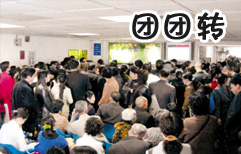
In all my visits for general consults I have never waited more than about five minutes, without an appointment. (Maybe the lesson photo is actually a betting shop? A stock exchange?)
But this is one of my all time favourite topics - thanks for the lesson, ChinesePod.
paulinurusNovember 15, 2010
"I am puzzled why a Chinese person would find it difficult. Lack of experience with the Western system for comparison?! Maybe there is a culture of being nervous about hospitals?"
Are you implying that this lesson is not a real scenario? There seems to be two China, one according to your observations and the other of others.. so I'm puzzled too.
bodaweiNovember 15, 2010
All ChinesePod dialogues are works of fiction, and very entertaining ones at that.* But the main goal is language learning and this lesson has lots of meat - it's a great lesson.
There is usually ample opportunity to discuss related cultural matters - I am just contributing to the discussion first-hand experience. Anyone representing the 'other China' you refer to (based on first-hand experience preferably) are welcome to pitch in. The more the merrier.
* Fiction is often considered hard work because it is required to be true. As any avid reader of history knows, non-fiction writers are not bound by the same strictions.

bodaweiNovember 15, 2010
You are right. And I try to stay true to this (I stray sometimes into generalizations but there are plenty of poddies out there to keep me on the straight and narrow.) I also try to give an honest impression - and this is one where I have done a fair bit of research. Part of this honesty involves testing what I find in as many places as possible. (Someone mentions 'I have to go to hospital' - I will no doubt put up my hand and ask can I tag along.)
Actually I also have been to local hospitals (an artefact now completely gone in Australia) .. the type you find in a little back street in a residential area. I went to one such for my hepatitis injections. :)
bababardwanNovember 15, 2010
"I am just contributing to the discussion first-hand experience. Anyone representing the 'other China' you refer to (based on first-hand experience preferably) are welcome to pitch in. The more the merrier. "
...this I have to agree with. Nothing like rounding out the picture and getting lots of different perspectives. The more input the better. Even better if we have someone who has a contrary view so as to spark a debate that we may all end up learning from. I rarely think things are likely to be black and white. My guess [and sorry mate, I have very limited experience visiting Chinese hospitals] is that the scenario in the dialogue is real enough in some settings, but the scene may be different elsewhere as bodawei suggests. It's possible this isn't even necessarily regional. It may be that the scene in the hospital on the other side of town [or possibly down the road] may be appreciably different. We need much bigger figures and input to get a fuller picture, but at least hearing of the experience of various poddies may give us some insights. So thanks mate for always being so generous in sharing your valuable experience. Join in everyone. hao ba.

zhenlijiangNovember 15, 2010
May just be repeating what you've said Baba, but:
I've said before I have great respect for experience. Like you and I'm sure many others, I'm also very interested in getting lots of different perspectives, the more input the better. More interested in that than hearing just one or two people's accounts, as impressive or solid their 'credentials' (I mean exposure such as years lived in and extent of travel in China, years of formal Chinese study, being employed or running businesses in China, relationships with the people) may apparently be. So 'novices' or first-time travelers there with impressions to share may not answer the great China mysteries or questions about China we have for instance, but I value their input here just as much.
I hope everybody who has something they'd like to share will feel entirely welcome to, because they are!
RJNovember 16, 2010
you don't have "local hospitals" in Oz? I'm guessing you mean clinics or urgent care centers. I always have to remember to get our terms lined up before we talk because it does cause a lot of confusion. I remember asking you about clinics and you were unaware of any. I guess I called them the wrong thing. I have seen small clinics like this in SH and other smaller cities. I remember walking into one in Foshan and there sat a room full of people all hooked up to IV's. (I have a thing for medicine). I left before they offered me one. I also entered one of these clinics in SH. It does remind one of the DMV. The doctors names and pictures are on the wall. There is a hierarchy. The guys with the most training at the top and the fees are also posted. The top guys getting top dollar of course. You stand in line - get a ticket to see a doctor by paying some money, (actually I think there were two lines- one to get ticket another to pay and get it stamped) head upstairs to little waiting rooms. It was a bit crowded, nobody seemed to notice me taking it all in. I guess everyone was so purpose driven that they didn't have time for nonsense. As I say it was a bit crowded but things were moving right along. The gals behind the windows were not tolerating any slow movement. So I didn't think it was so bad. Of course I didn't have to get in line either. I also took a field trip to a major hospital in SH once just to take a look. It was more difficult here to stealth about. I did notice one thing - the lobbies were not heated, standard for China, but this was a hospital, but then again how many patients lie around the lobby. I worked in a hospital lab long ago. Hospitals are the pressure cookers of society. It all breaks down there. If you want to learn about people, spend some time in a hospital. At least that has been my experience.

markNovember 14, 2010
In the US when you go to the hospital, you see a triage nurse fairly quickly. After the triage nurse figures out that you are in the "won't die without immediate attention" category, you get to wait a long time. In China is there any similar screening? Or, do you just wait your turn, and if your case turned out to be urgent, oh well?
bodaweiNovember 14, 2010
Hi Mark
In my experience there are triage nurses hanging around in the entrance - they ask 'What's wrong with you?' if you look lost. :) Or there is a desk you go to where you discuss your symptoms with maybe a group of three or four nurses (all very public). They send you to the appropriate clinic. If you know what you want you can go straight in to the department you want, & buy a ticket to see a doctor. The difference is that all the specialties are there, if you want to see a specialist. If not, you just take a ticket for the general clinic. In one hospital I used to go to the general clinic was called 'family medicine'. The other difference is that in China (in my experience) you don't wait long. This is because there are so many doctors - they are paid a pittance, so the system can afford to have many more doctors on tap than we have in the West.

lidiluNovember 16, 2010
Couple days ago i read about a piece of news, saying that a patient died in a waiting line for some heart check test in a big hospital. It may sounds a little dramatic but according to my own hopstial experience in Shanghai-this city is too crowded. I feel bad for the nusers working in big hospitals.
bodaweiNovember 20, 2010
I guess the possibility of dying in line is present if you are about to have a heart attack.
But there is a cultural explanation for this sense that hospitals are too crowded and un-responsive to our needs. In the West, people can stay on the waiting list for medical treatment for years. We keep our queues out of sight. :)

pretzellogicNovember 14, 2010
I will say that it was less of a hassle to see my doctor in the US, and then get the necessary referral to see the specialist. In China, I wouldn't really know to see the specialist in the first place. Certainly helpful that we tend to go to the western medicine hospitals, so there's no confusion around Chinese or western medicine being dispensed.
And thank God the line at the hospital I go to isn't like the line in the picture for this lesson. That looks like a DMV licensing fiasco.

geiwotangbaNovember 16, 2010
My mother-in-law was a teacher, who now resides with my family in America, I broke my hip a few years ago riding a bike and was fully treated for it in America but still had some persistent pain later, so my mother-in-law (po po) had connections with one of her students who was a doctor who agreed to look at my hip as a favor to her...so I went to the hospital and got special treatment...which meant cutting in line and stepping over many a real sick person wating for treatment. yeah, I felt a little guilty, but there were many people waiting that day with more pressing problems than my time to time aching hip...
So, looks like the hospital deal in China, at least from my experience is not one to look forward to. But i will tell you with all surprise and shock of my dental experience...between night and day, the difference between the American and Chinese Systems of dental care, China takes the gold medal and I imagine that America doesn't even finish in sixth place. The Chinese dentist was gentle caring and very careful in handling cavities, and considering my Chinese could barely be described as adequate, she found the root of my problem with the most simplistic of phrases, painlessly drilled and filled my cavity, all doing it with no drugs like novacain...I know some Chinese in America who will gladly spend the thousand or so dollars every year to get on a plane to get to China to get their teeth checked out in stead of subjecting themselves to the sadists that call themselves dentists in America. Up until now I never understood why they'd go to so much trouble, but now I understand how utterly top notch the Chinese system is regarding dental care...!
But, my experiences with American hospitals regarding basic treatment to say a problem like kidney stones is not good either. When one gets a kidney stone it is extremely painful, painful enough to make one double over in futility as the pain soars threw one's torso. The only real treatment is to dull the pain and get one to pass the stone through the kidney naturally and out the drain. So, really, it's as simple as taking a pain-killer and drinking lots of liquids. But, the American hospital makes you wait for an hour, takes an hour to get tests, like X-rays and then gives you the pill...two solid hours of pain to get treated, if you're lucky. next time I get kidney stones, I will just run to the liquor store, buy a bottle of whiskey, drink a large sum of it to get rid of the stone myself in stead of going to all that hospital trouble, to then again be charged an arm and a leg to get a simple pill....LOL
tgifNovember 20, 2010
LOL, if that's what you want to do next time you have urolithiasis (kidney stones) . . . . of course you could elect to undergo extracorporeal shockwave lithotripsy. Seriously though, dentristry is one thing, pretty mechanical, formulaic. Medicine is yet another. Ever wonder where the majority of Shanghai medical school graduates are residing after ten years? (in or out of China)
What did you notice in this lesson?
You are posting as a guest. Your reply is reviewed before it appears. Log in to post without review.