User Comments - fulankelin

fulankelin
Posted on: An Introduction to Chengyu
October 17, 2010 at 10:36 PMI have wondered what makes a chengyu a chengyu. Can any phrase be a chengyu? Usually four, or eight characters but sometimes 3 is not very defining.
For example, I have thought of 一人之下万人之上, one person below, 10,000 above as a chengyu (and one I can write) but I have no idea if I am right.
My all time favorite chengyu is 蜻蜓点水 / qīng tíng diǎn shuǐ / the dragonfly touches the water lightly / superficial contact
Posted on: Can't Get a Taxi
October 15, 2010 at 9:34 PMThinking about bodawei's question I thought because in Chicago there is the Yellow Cab Company. But then you have to to wonder if that is a what came first, chicken or egg answer so I googled the explanation below.
So, the Hertz Car Rental logo is yellow because the cabs are yellow.
" In 1907, car salesman John Hertz looked at his surplus of traded-in cars and decided to start a taxicab business. Since taxis need to stand out in a sea of cars, Hertz reportedly commissioned a study to determine which color was easiest to spot at a distance. The answer was yellow.
His Chicago Yellow Cab Company was the first taxicab service to use that now-familiar moniker. However, these days not all Yellow Cabs are yellow cabs.
In 1923, Hertz expanded his automobile empire by purchasing a car-rental business from Walter L. Jacobs. Although this particular company was acquired by General Motors a few years later, it was only the beginning for Hertz's rental cars and his affinity for yellow.
In fact, when the entrepreneur established the Hertz Corporation in 1953, he used yellow in the new logo. "
Posted on: A Stroll through the Hutongs
October 3, 2010 at 2:26 AM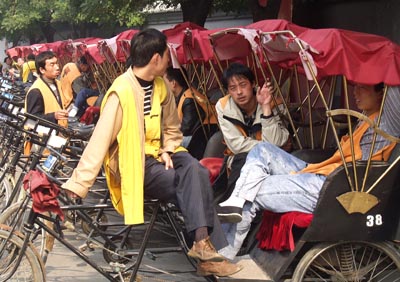
Here is a photo I took of the 三轮车人 sānlúnchē ren. I see it as looking across two cultures.
Posted on: A Stroll through the Hutongs
October 3, 2010 at 1:58 AMI believe hutong is originally a Mongolian dating back to the Yuan Dynasty and the origins of Beijing that means water well, or something like that in Mongolian.
"The term "hutong", originally meaning "water wells",[2] appeared first during the Yuan Dynasty, and it is believed to be a term of Mongol language origin" according to wikipedia, which is what I said.
Posted on: Progress Tracking and Grammar Guide
June 9, 2010 at 12:14 AMLast night The Daily Show had a segment on teaching Mandarin in American schools http://www.thedailyshow.com/watch/mon-june-7-2010/socialism-studies
and then there is the upcoming movie Red Dawn/China http://www.newyorker.com/online/blogs/evanosnos/2010/06/red-dawn-again.html
Sounds like a tough year for Mandarin speaking in the US and fenqinging in China.
Posted on: A Tour of Xi'an
June 8, 2010 at 12:23 AMCarl Hiaasen wrote a murder mystery A death in China where a corrupt government official dug up Qin Shi Huang Di and reburied him in Ohio and the reason they refuse to excavate the tomb is that they already know Qin Shi Huang Di is not there and don't want that found out. Sorry if I gave away the plot but there is more to the story.
Posted on: Dashboard Updates and a Visit from a User
April 26, 2010 at 11:42 PMMore on the Haibao as Gumby scandal, http://www.chinahush.com/2010/04/25/npr-reporter-accuses-shanghai-world-expo-mascot-being-plagiarized
"Then she picked up the tape recorder and microphone and rushed to the podium, asking Xu Wei for comments on the two plagiarism incidents. At the same time both Chinese and foreign media swarmed in and surrounded the podium."
Gumby looks like the Chinese character 人 to me, which was around thousands of years before Gumby - talk about plagiarism.
Posted on: Dashboard Updates and a Visit from a User
April 25, 2010 at 4:27 PMNPR has a segment on the soft opening of the Shanghai Expo this week, http://www.npr.org/templates/story/story.php?storyId=126223052
There appears to be some controversy about haibao
Seems to me gumby looks a lot like 人
Posted on: Special Green Hat
March 17, 2010 at 5:27 PMWho is going to lead the Shanghai St. Patrick's Day Parade this year?
Posted on: An Introduction to Chengyu
October 18, 2010 at 2:32 PMI checked the wikipedia entry for chengyu's which says "according to the most stringent definition, there are about 5,000 chengyu in the Chinese language, though some dictionaries list over 20,000." so I guess they are not very well defined.
It also said "Chengyu are mostly derived from ancient literature. The meaning of a chengyu usually surpasses the sum of the meanings carried by the four characters, as chengyu are often intimately linked with the myth, story or historical fact from which they were derived. As such, chengyu do not follow the usual grammatical structure and syntax of the modern Chinese spoken language, and are instead highly compact and synthetic.
Chengyu in isolation are often unintelligible to modern Chinese, and when students in China learn chengyu in school as part of the classical curriculum, they also need to study the context from which the chengyu was born. Often the four characters reflect the moral behind the story rather than the story itself."