User Comments - Gwilym-ChinesePod

Gwilym-ChinesePod
Posted on: Buying a Guard Dog
March 4, 2015 at 8:39 AMFYI, here are the different levels of adjective intensifiers that we taught in this class.
Level 1:
很好 = good
Level 2:
好得很 = great
Level 3:
好得不得了= awesome
Level 4:
好极了 = extremely good / amazing
You can replace 好 with any other adjective.
e.g: 热 = hot (adj)
很热 = hot
热得很 = really hot
热得不得了 = hot hot hot
热极了 = extremely hot
Posted on: Advantages:「优点」yōudiǎn VS 「好处」hǎochù [Video/Audio]
March 3, 2015 at 3:42 PMHi Dorothy. I've added a download button to the SD version for people on slow connections. Hope that helps :)
Posted on: School Drama Society
March 3, 2015 at 2:16 AMWe'll get try and get this fixes ASAP.
Posted on: Finding Some Money
February 25, 2015 at 2:12 AMThe grammar audiois now back. Go check it out to get a grasp of how the shì de structure can emphasisedifferent points in the same 3 sentences.
Posted on: Finding Some Money
February 25, 2015 at 1:49 AMIf you'd like to learn more about 是。。。的,here is a fun Qing Wen from our library :)
Posted on: Finding Some Money
February 24, 2015 at 12:15 PMFYI the grammar audio is missing. It will get fixed tomorrow. Sorry.
Posted on: Boba Tea
February 24, 2015 at 7:34 AMGood question.
甜 tián = Sweetness (Adj)
糖 táng = sugar (noun)
In the above example they say 不要太甜. In this example 太 tài = an intensifier (too/very) and so afterwards you would use an adjective.
The ones in brackets are the degrees of sweetness, so 3 parts sweetness, 5 parts sweetness etc.
What to say.
很甜 hěn tián | Very sugary/sweet
太甜 tài tián | Too sweet
What not to say
很糖 hěn táng | very sugar X
太糖 tài táng | too sugar X
Posted on: Boba Tea
February 23, 2015 at 11:46 AMHere is a clear representation of some of the different levels of sweetness. You have "Normal amount of sweetness" 正常甜度 at the top, "I don't want it too sweet" 不要太甜, "less sweet" 少糖 "half sweetness" 半糖, "micro-sweetness"微糖 and no sugar 无糖 (healthy 健康)
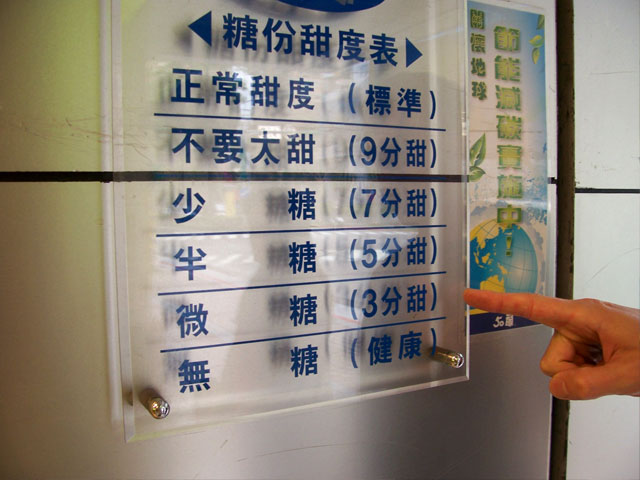
Picture taken from this blog
Posted on: Be Careful of Strangers
March 5, 2015 at 3:25 AMGreat question. So in the podcast we alluded that 刚刚 (gànggang) was a special kind of adverb, a special kind of time based adverb, so it shares similar characterisitics to regular time words like 今天, in that it can go before or after the subject.
There are very few adverbs like 刚刚.
常常 (chang2chang2) is a regular type of adverb so can't be moved and always goes after the subject/before veb).
Note that 刚刚 is not exactly like a time word in that you can't say 刚刚以前, 刚刚以后, or 一个刚刚。
Chess Analogy?:
刚刚 is like a Queen Adverb. It can move around quite freely
常常 is like a regular pawn - it can't move around so much.
Anyway, no one likes grammar explanations, so my advice would be just to practice using 刚刚 in different sentences, and maybe just pick one that sounds most natural for you.
You will soon automatically know when something sounds weird.