Relevant Content
We'll always make sure you know exactly what the lesson is about. You will easily understand whether it is relevant for you.

Going on a Picnic

Great Hosts
Here at ChinesePod, all our lessons are presented in an entertaining manner by our great hosts. You'll find language learners, teachers, and even professors sharing their insights, ideas, and teaching methods in our video and audio lessons.
Brief Lesson Summaries
A brief introduction of the lesson will always tell you what this lesson is about and what language level is the intended target. If you're interested in the subject, but might not be able to understand it in full, fear not; we have transcripts of lesson dialogues vocabulary so you can follow along.
IN THIS LESSON
ID: 1469 Elementary
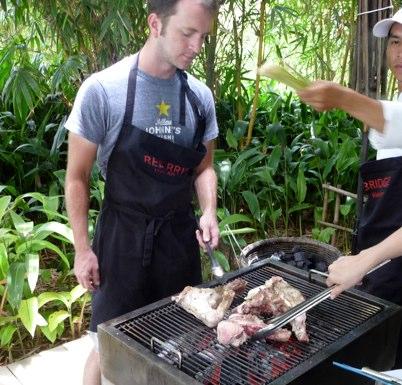
It's summertime - the perfect season for a nice picnic in the park. Check out today's lesson to learn how to describe planning a picnic in Chinese.
Awesome Materials
Our lessons contain natural communication in Chinese in video and audio format. We have have lessons focused on video or a podcast format and our lessons have transcripts of Lesson Dialogues, Important Vocabulary, Expanded Materials for a deep dive into the lesson topic and Exercises focused on testing your retention.
Detailed Vocabulary
Each lesson has it's unique vocabulary and will provide you with definitions and recordings so you can practice the pronunciation. You will also be able to grasp the core material of a lesson at a glance. Here we're showing you the Simplified Chinese version.
SIMPLIFIED PINYIN ENGLISH  
就 jiù just; simply
野餐 yěcān picnic, to have a picnic
来 lái to come
先 xiān first
我们就在这儿野餐吧。
wǒmen jiù zài zhèr yěcān ba。
Let’s have the picnic right here.
好啊!
hǎo a!
OK!
来,先休息一下。
lái,xiān xiūxi yīxià。
Come on, relax for a bit first.
今天我要做三明治。
jīntiān wǒ yào zuò sānmíngzhì。
I’m going to make some sandwiches today.
Natural Dialogues
Each lesson is centered around a natural dialogue with key vocabulary directly prepared and translated for your use. You can also listen to each sentence as an individual recording to improve your listening and comprehension skills.
Try It For Free
ChinesePod is 100% Free to Try. Create an account today and get started!

Comments (46)

Discuss in the forum
brendaninaus
You wouldn't need to picnic in China, there are that many delicious food stores everywhere. I can remember I had to give cooking classes to an Indian friend on how to make sandwiches. It seemed obvious to me, but I guess what you don't know can seem hard.

John
Heh... Trust me, the Chinese don't consider sandwich-making hard. How many times have I heard, "western food is so simple; it's all just a bunch of sandwiches"?

martijn819
Or as my wife lovingly calls all Dutch dishes: baby food. Just mash and boil it until it falls to pieces. I can see the point, but then again its nice variation from rice every day.

bodawei
On the other hand, eating sandwiches can be a challenge. Maybe because of the reluctance to eat anything with your hands at least without gloves on. I once found myself at one of those Chinese restaurants that advertises 'Western food' (long story). At the next table they ordered a 'sandwich' and when it arrived there was lengthy discussion about how to eat it. The sandwich was actually five or six sandwiches stuck together (more for show than practical eating.) They just looked at the sandwich for ages and then kind of tore it apart.

bababardwan
they mustn't have seen scooby doo handle a monster sandwich: he heeee hee hee hee hee https://www.youtube.com/watch?v=A_psRb5AtpI
L
light1945
yes you do. Diversification is the best tool for health
louisita72
Thanks for the food related lesson.  I've spend the past few weeks studying all the food vocab I can before my trip to China, so that even if I can't read what's on the menu at least I´ll have a few dishes in mind to tell the waiter.... I feel like whenever you travel to a new country sometimes the most frustrating thing is the food, because either you are just ordering "safe dishes" that you could really get anywhere in the world, or you order some unexpected strange dish and are highly disappointed - anyway i´m determined not to let this happen to me in China! thanks chinesepod....
blondedeb
here is a site that has alot of info regarding chinese food  (If I can add the link correctly) and you can find names for food dishes and fruits/ vegetables that you might or might not be familiar with, includes pictures of them so you can try to identify when you see them. If you dont have a chinese person with you when you order they will sometimes have english menu too, but that wont necessarily help because you wont know how its prepared and with what other ingredients, and that could get interesting.
bababardwan
for me, this word 野餐 yěcān [picnic] is definitely a good example of where knowing the breakdown of a word will make it easy to remember [open space/wild +meal]. What catches my interest though is the fact that I only recently learnt this character 野 in the UI series "outdoor survival". Now having recently introduced words or characters reappear in subsequent lessons for reinforcement is a well known and clever teaching strategy CPod employs, but given the gap in levels I'm left wondering how much of it was coincidence in this case. ....not that it matters. Just have these random thoughts. Anyhow, for ellies that may be interested, the most recent outdoor survivors had several 野 words, such as: 野外..outdoors 野兽...wild animals 野味..wild game 野猪..wild boar 野人...wild person
Tal
I'd be willing to bet it's not coincidence mate! Anyway another good one is: 田野 tiányě = open country, farmland and fields. e.g. 春天来了,田野里充满了生机。 Chūntiān lái le,tiányě lǐ chōngmǎn le shēngjī。 Spring has come and the fields are full of life.
bababardwan
I'd be willing to bet it's not coincidence mate! ...yeah I guess you're right. It's perfect for someone like me who likes to listen to UI but still has holes at Ellie level needing filling...so it's nice to see these connections. And there is nothing any more difficult about those ye words at UI it's just too low frequency to have something like bigfoot and wild man at Ellie. I guess this strategy more importantly may encourage some Ellies to venture forth into the higher levels when they start seeing some familiarity and some connections.
RJ
you forgot 野女友 or 野蛮女友 (as in the movie)
bababardwan
this one?: https://zh.wikipedia.org/zh/%E6%88%91%E7%9A%84%E9%87%8E%E8%9B%AE%E5%A5%B3%E5%8F%8B
Tal
Actually I too really appreciate Ellie lessons these days and usually always study them, seems like there's always something new to learn. (I didn't know the Chinese for 'picnic' or 'ham' before going through this!) I think it's also really nice to have a study period where you actually know almost everything and that gives you the feeling you're really making progress - lol. 野女友,呵呵。
bababardwan
hehe, I'm mesmerised by that clip. Good one tal. 你回不回帖子。。you returned/not returned post ....he didn't return her [or an] invitation...or an online post?
Tal
Have to confess, I've never actually seen that movie . It seems that it was/is very popular in China. First I heard of it was when a couple of lovebirds in one of my classes, (a boy and a girl who had 'paired off' and thereafter spent all their time in the back row holding hands - lol) gave a classroom presentation together about 'Love in the Movies', and they included a lot of pics and clips from it, (without ever actually explaining the plot!) Could be it's a classic as it seems to have been remade for an English-speaking audience.
bill
I notice in the dialog that the popup for 生菜 says "to give birth" rather than "lettuce" or "romaine lettuce." It's in this sentence: 你们看,我带了火腿,生菜和番 茄
John
Fixed. Sorry about that.
treeloveschina
My friends and I are Americans teaching English in Jilin China. We had a picnic at the park a few weeks ago and people were coming to our blanket and looking at what kind of food the "foreigners" were eating. One guy even asked us if he could have some. He was pretty funny, his girlfriend was a liitle embaressed though. The food we had was American food we bought from specialty shops. We love Chinese food, but every once in a while we try to put together American meals.
bill
In this lesson 什么三明治啦,生菜和番茄啦,水果色拉啦,等等 .. It' seems like a very American 野餐. In this lesson shénme sānmíng la, shēngcàila hé fánqié la, shuǐguǒsèlā la, děngdeng ... In this lesson there's sandwiches, lettuce and tomatoes, fruit salad, etc ... One way of making a list is to say, 什么 x 啦,什么 y 啦, ... 但是为什么没有葡萄酒吗?dànshì wèishénme méiyǒu pútaojiǔ ma? But why isn't there wine?
B
brianhz
chinese don't drink much wine. wine (wine that is not chinese and you can acually drink) is expensive an most people only drink beer or 白酒 baijiu with food. In Hangzhou there are some nice parks where you can sit on the grass and people have picnics but most people will still sit inside a restaurant and eat....with beer not wine
bodawei
In Australia Christmas lunch (the main meal) can be a picnic.  My family has done the picnic at the beach on Christmas Day a few times.  Solves the problem of finding enough room at the table for a large crowd.  The only time this came to grief was one year at Cottesloe Beach, Perth.  The Fremantle Doctor (a 'false friend' if ever there was one) came in and we were howled off the beach, stung by the sand whipped up by a 40km or 50km wind.   My city in China has places by the lake which are becoming popular with the locals for picnics. 
RJ
Fremantle who? I must say I had to look that one up. Interesting term for a breeze. btw- does it ever snow in Oz? Im guessing not. Xmas to me is hot chocolate or some good wine, a fireplace, and "Jack Frost". Or er uh, "fremantle frostbite" maybe?
bodawei
Hi RJ. I am well placed to continue your education - I am currently getting a refresher myself. It does snow in parts of Australia but not much at Christmas time. :) We have our snow resorts in NSW, Vic and New Zealand (that was a bit cheeky); they rely heavily these days on snow making machines. I don't know which city is the coldest - I wonder if it is Canberra after allowing for the wind chill factor. Maybe cities in Tasmania are still colder. We sometimes need a jumper at night in Darwin in the middle of Winter. Also we get low temperatures in the deserts but snow would be very rare. Just west of Sydney (around the Blue Mtns) would get snow most Winters I think. The Fremantle Doctor is a false friend because it is more a gale than a breeze. (Australia also has its myths.)
bababardwan
"fremantle frostbite" ..lol...good one RJ...I like your thinking.
kimiik
"色拉" site:chinesepod.com has 21 hits on Google "沙拉" site:chinesepod.com has 20 hits on Google "色拉" has 4.560.000 hits on Google "沙拉" has 6.600.000 hits on Google
kimiik
"沙律" (≈salut) has 519.000 hits on Google "沙拉" seems to be prevalent in cantonese areas.
bodawei
沙律是粤语对吧? My dictionary says 色拉 but I have never heard anything but 沙拉. I will stay with 沙拉.
kimiik
Yes me too, I will keep using 沙拉 and ... 沙拉米. I never heard the word 沙律 whatsoever. Also, for me "水果色拉" would be "杂果" (short and efficient). "杂果" has 198.000 hits on Google "水果色拉" has 75.000 hits on Google
kimiik
Argh ... here we go again ! "沙拉米" has 76.500 hits on Google "萨拉米" has 47.200 hits on Google
ewong
I have read 沙拉 in menus in Taiwan instead of 色拉
gaojian
One of the many small differences between Taiwan and Chinese vocabulary. Both are generally understood.
danchao
My mom once said "I want some sala" in English. The waiter was very confused. Then she got confused.
B
BlueThru
Loved the sanmingzhi comment. Doesnt really sound that much like sandwich haha.
matthewrudy
This and many other traditional english words I reckon have come from Cantonese rather than Mandarin. As such the cantonese pronunciation of 三明治 ("sammingjee"-ish) sounds a bit less different than the mandarin.
xiao_liang
I'm sure I've asked this before... sorry, I'm a slow learner. Expansion sentence: "你就是王老师吗?" Nǐ jiùshì wáng lǎoshī ma? What does the 就 add to this sentence?
bababardwan
quick answer from a fellow learner...I think it basically just adds emphasis.
John
bababardwan is correct... We normally do this kind of emphasis with tone of voice in English. It's similar to the difference between the following two questions: You're Mr. Wang? YOU're Mr. Wang? (with 就)
xiao_liang
Right oh! Thanks John and babababababababardwan!
U
u-huh...
呃,朋友们你们觉得学中文难不难..我就觉得学外语挺难的.. PS.我是地道的中国人..
nderrett
Can you explain more on the use of 最喜爱? My colleagues in Taiwan first taught me to use this to tell someone:   "[something] 是我最喜爱的"  (e.g., "this is my favorite dessert") Is that much different from saying: "我最喜爱[something]了“? I understood it that using 的 in this way indicates that it is your most favorite of all.  Like milkshakes are my favorite of all desserts and none come before it. Is that right? Is using 了 less of a commitment? (...or is it even relevant to compare the 了 and 的 ?)
lujiaojie
"[something] 是我最喜爱的" and "我最喜爱[something]了“ are interchangeable. "是....的" is a sentence pattern, and "最....了" is also a sentence pattern.
P
pretzelllogic36
Speaking of intrachangeable, may the 3rd expansion sentence be also said correctly in Mandarin as "Nǐmen jiù děng wǒ zài lùkǒu ba"?
lujiaojie
"Nǐmen jiù děng wǒ zài lùkǒu ba" sounds weird.
P
pretzelllogic36
Thank you. I figured separating the 'jiù' from 'zài' here might be a bad idea.
bennyboyk
The girl in this dialouge is excited about sandwiches 真的!, maybe she thought she was getting the scooby doo one instead of a ham, lettuce and tomato one...